
€23k vs €327kPlanned repair vs estimated worst case in the featured case
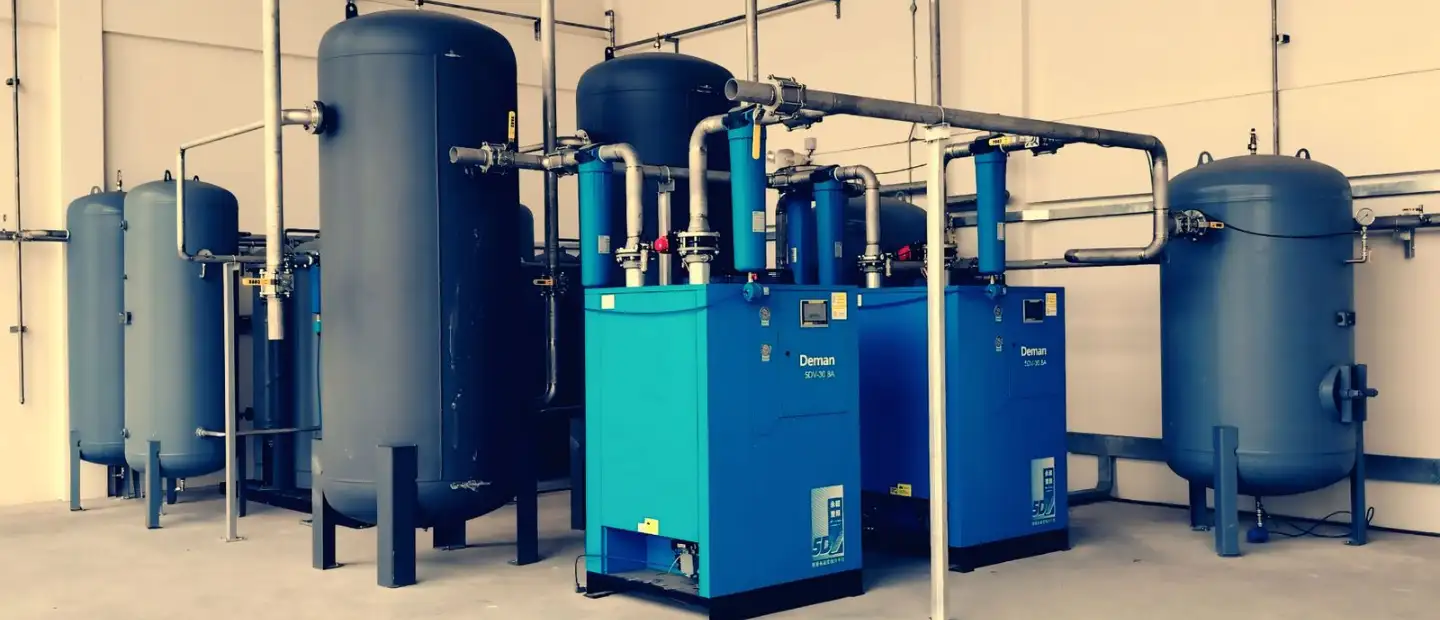
Asset monitoring / Compressors
Catch it as a repair.
Not as an overhaul.
Screw, reciprocating and turbo compressors carry high repair bills and long lead times. Artesis follows motor and compressor condition from the MCC, so bearing, valve and winding problems surface while they are still a planned job.
3 compressor typesScrew, reciprocating and turbo
0 sensors on the compressorCurrent and voltage measured in the MCC
01 / The challenge
High stakes.
Complex machines.
Process gas, refrigeration and air compressors sit at the heart of refineries, petrochemical and glass plants. An unplanned stop means lost throughput, flaring or scrapped product — and a rewind or overhaul can take weeks.
Load and unload cycles, pulsation and many moving parts make condition hard to read with occasional checks. ESA sees the motor and the compressor together through the current, under real operating load, around the clock.
Connect at the motor control cabinet
e-MCM uses the existing current and voltage signals, including on medium-voltage drives. Nothing is fitted inside the compressor package.
Learn each operating state
Baselines reflect the machine’s real load and unload behaviour, so genuine deviations stand out.
Plan the intervention
Findings are classified by domain and severity, giving time to order parts and schedule the stop.
02 / Featured case · Oil refinery
A bearing fault found early:
€23,000 instead of €327,000.
DOCUMENTED FIELD CASESCREW PROPANE COMPRESSOR / BEARING TREND
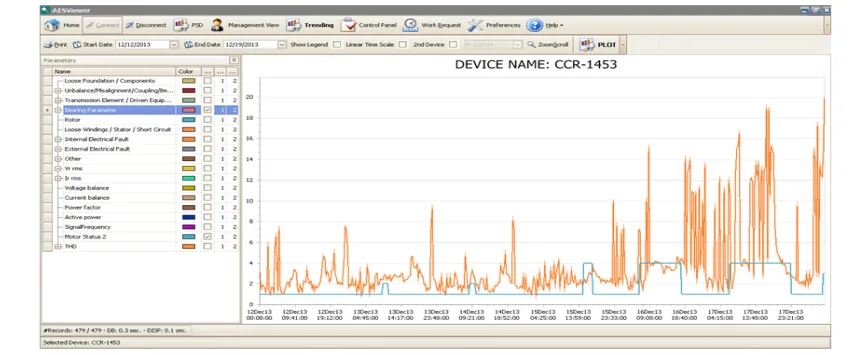
Bearing parameter rising above its alarm level. Select to open full size.
14×
Estimated worst case vs actual repair
Planned repair cost €23,000. Running to failure was estimated at up to €327,000.
Estimated cost if the fault had run to failure
From alarm to a three-day planned repair.
440 kWMotor rating
ScrewCompressor type
3 daysPlanned repair
The findingThe CCR unit’s screw propane compressor raised an Artesis alarm. The site’s vibration monitoring agreed.
The decisionThe rotating equipment team shut the machine down for repair. Teardown found a bearing fault and burned grease damaging the motor windings.
The repairAll bearings, gaskets and O-rings were replaced and the windings checked and cleaned. The compressor restarted after three days.
- 1Artesis bearing alarm
- 2Planned shutdown and teardown
- 3Back in service after 3 days
Source: Artesis O&G cases and ROI example. Worst-case figures are the refinery’s own estimates (20 days rewind at ~€9,000/day lost throughput). Customer name withheld.
03 / More field cases
Valves, windings
and a whole plant.
2 INDUSTRIESValve looseness, before and after overhaul
The spectrum pointed to mechanical looseness; Artesis engineers traced it to the valve assembly. After overhaul the valve-related pattern was gone, and a new pattern pointed to a piston baffle.
- Type
- Reciprocating compressor
- Outcome
- Valve fix confirmed, next issue located
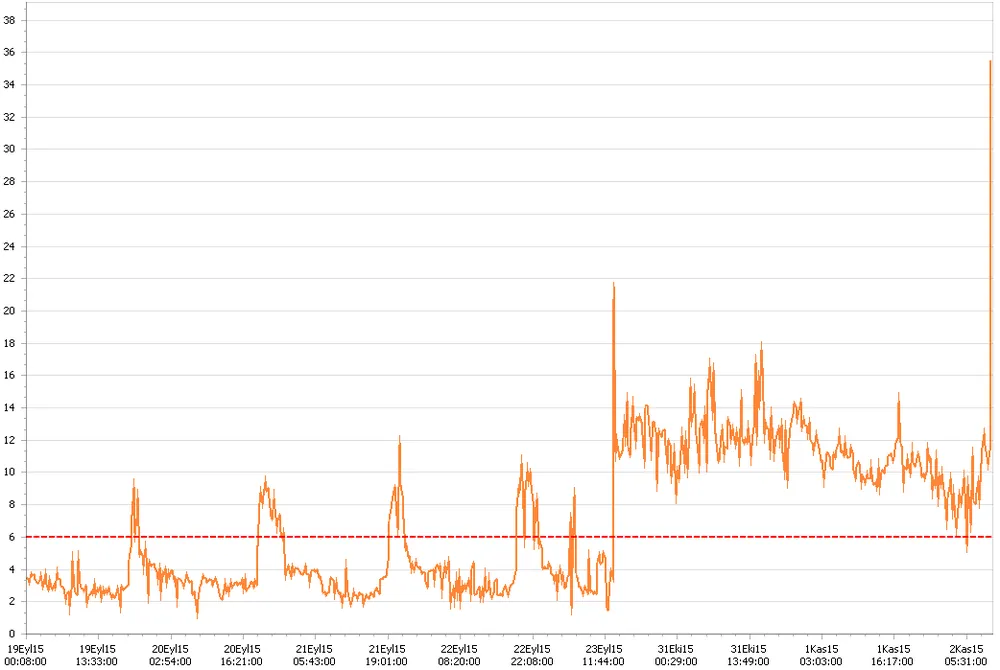
Loose stator windings rubbing the rotor
After five weeks out of service, the compressor restarted and the internal electrical fault trend jumped. Three days after the alarm it was stopped: the stator windings had loosened and were rubbing against the rotor.
- Type
- Turbo compressor
- Outcome
- Stopped before a major failure
One year of online monitoring
After go-live the plant’s failure rate fell by 79% and the system paid for itself within a year. A 2% energy loss was avoided across the monitored assets — 623,419 kWh.
Cases are individual outcomes from Artesis field deployments between 2010 and 2016. All visuals are from Artesis software. Customer names are withheld.
04 / What we detect
Fault modes, signals
and evidence strength.
Evidence strength reflects how reliably a condition produces an observable electrical pattern in typical compressor installations — not a guarantee of detection.
| Condition | What changes in the signal | Evidence | Field case |
|---|---|---|---|
| Motor · electrical | |||
| Stator windings and insulation | Internal electrical fault trend; current vs voltage imbalance | Strong | Turbo compressor |
| Rotor bars | Rotor-related pattern in the current spectrum | Strong | — |
| Supply and connections | Voltage imbalance, harmonics, per-phase RMS | Strong | — |
| Drive train · mechanical | |||
| Bearing wear | Bearing indicator trend | Good | Screw compressor → |
| Valve and assembly looseness | Valve and looseness-related pattern | Good | Reciprocating compressor |
| Coupling misalignment, unbalance | Alignment and unbalance-related pattern | Good | — |
| Load · process | |||
| Load and unload behaviour | Load pattern and stability versus learned states | Good | — |
| Lubricant condition | Only visible once it affects bearings or load | Limited | — |
05 / Outside the envelope
Where electrical signatures are weaker.
We state the limits up front, so monitoring is set up where it adds most and paired with the right complementary checks.
Rapid load cycling
Machines that switch state every few seconds need per-state baselines; short states are harder to judge.
Oil and lubricant quality
Oil degradation is not seen directly; use oil analysis alongside.
Internal clearance wear
Gradual screw or piston wear without a load change may not be visible early.
Very low speed
Below about 20 Hz on a VFD, signatures can fall under reliable thresholds.
Observed patterns are interpreted by qualified personnel; they guide investigation rather than replace it. AMTPro spot tests need near-constant speed (±1% frequency) during capture.
06 / How you deploy it
Continuous where it matters.
Portable everywhere else.
Online · permanently installed
e-MCM
- Process-critical and MV compressors
- 24/7 learning, trending and alarms
- Supports VFD applications
- Results in OmniSight across sites
Portable · route-based
AMTPro
- Plant air and refrigeration compressors
- Spot tests from the MCC in minutes
- Automatic condition report per test
- Energy impact estimate in every report
Artesis Insight explains the finding.
Artesis Insight turns spectra and trends into plain-language explanations and next steps. Your team does not need to be an ESA specialist to act on a result.
Illustrative maintenance guidance
Inspect the compressor bearings.
A rising bearing parameter with matching spectral components suggests bearing wear. Plan an inspection and check lubrication and grease condition, including around the motor windings.
After action
Compare the trend under the same load state and confirm it returns to its learned level.
Example wording only; not a live alarm or a reproduced AI report.
07 / Applications
Across your compressor fleet.
Screw air compressorsProcess gas compressorsRefrigeration and chiller compressorsReciprocating H₂ and air compressorsTurbo compressorsPropane and hydrocarbon compressors
Do I need sensors on the compressor?
No. Current and voltage are measured in the motor control cabinet, which is useful for packaged and hazardous-area machines.
Can reciprocating compressors be monitored?
Yes. Their pulsating load is learned as part of the baseline; valve and assembly looseness show up as changes in the spectrum, as the reciprocating case shows.
Can medium-voltage compressor motors be monitored?
Yes, through the existing CT and PT secondaries. The configuration is reviewed for each application.
Does this replace vibration or oil analysis?
It complements them. ESA gives a continuous view of motor and compressor health; oil analysis and vibration remain useful to confirm specific findings.
What information is needed to start?
Motor nameplate data, compressor type, load/unload pattern, starter or drive arrangement and the measurement points in the cabinet.
Related assets
Other equipment we monitor.
Bring your compressors into view.
Tell us about your compressors. We’ll help you find where monitoring prevents the most expensive failures.










 White Papers
 Case Study
 Documents
 Webinars
 Events
 ROI Calculator
 FAQ
FAQ