
5.5 kVHighest fan motor voltage in the cases below
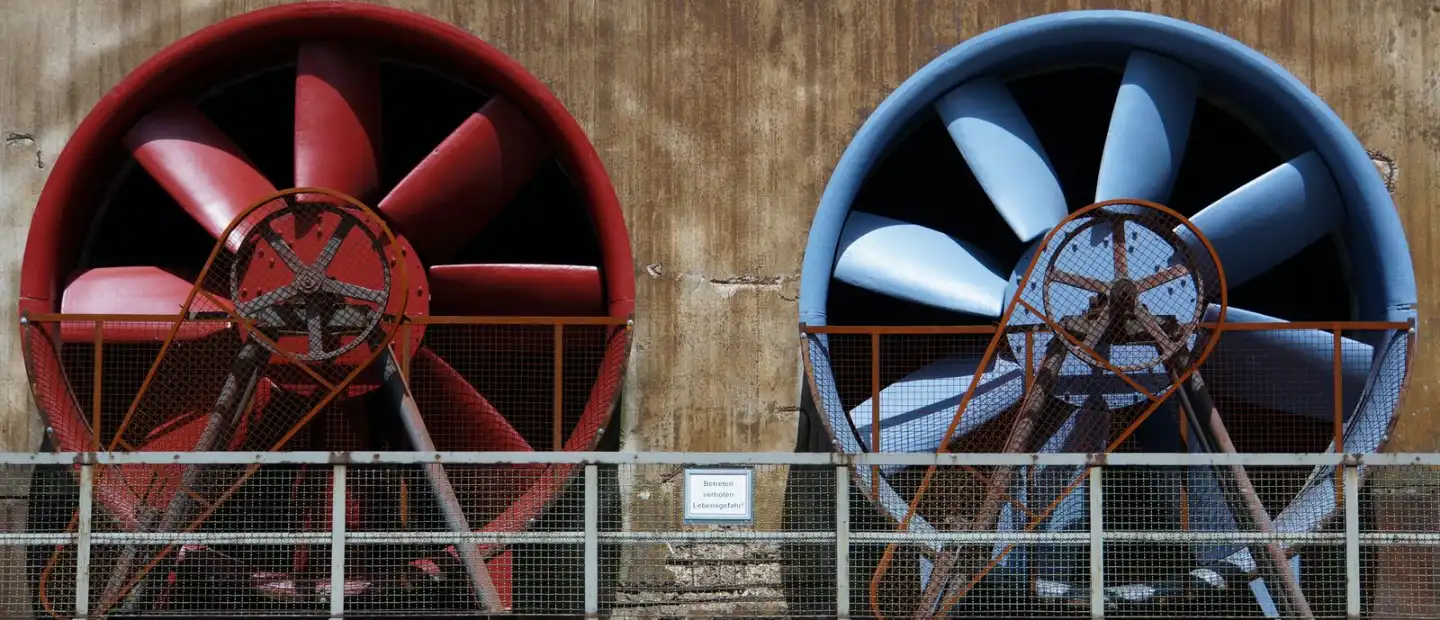
Asset monitoring / Industrial fans
Keep air moving.
Keep production running.
Unbalance, misalignment, bearing wear and loose foundations all change the current a fan motor draws. Artesis follows those changes from the electrical panel — no sensors on the fan, the duct or the platform.
7 field casesCement, food, glass and automotive plants
0 sensors on the fanCurrent and voltage measured in the MCC
01 / The challenge
Critical airflow.
Challenging access.
Process, ID and exhaust fans keep gases and air moving through kilns, dryers, ovens and extraction systems. When one trips, the process behind it stops too.
Dust, heat, height and enclosed housings make route-based inspection slow and infrequent. Because the fan is mechanically coupled to its motor, developing faults show up as small, characteristic changes in motor current — continuously visible from the MCC.
Connect at the electrical panel
e-MCM uses the existing three-phase current and voltage signals. No vibration sensors on the fan, no cabling on platforms.
Learn operating behaviour
Electrical Signature Analysis and machine learning build a baseline for each motor–fan set under its real load.
Turn findings into action
Deviations are grouped as electrical, mechanical or load-related and explained with maintenance guidance.
02 / Featured case · Cement
Fan misalignment detected.
Improvement verified in the field.
DOCUMENTED FIELD CASEFAN BC3 / CONDITION COMPARISON
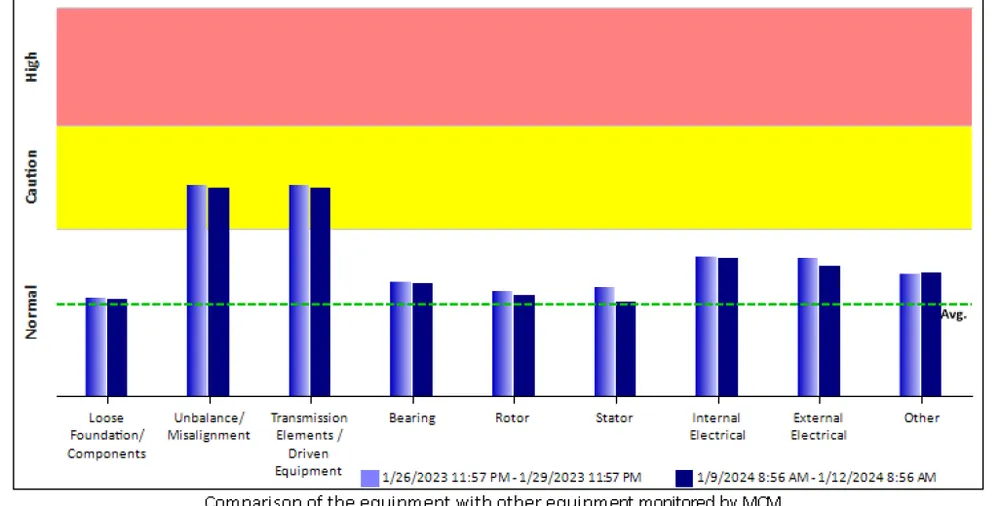
Unbalance/misalignment and transmission indicators in the caution band.
FAN BC3 / POWER SPECTRAL DENSITY
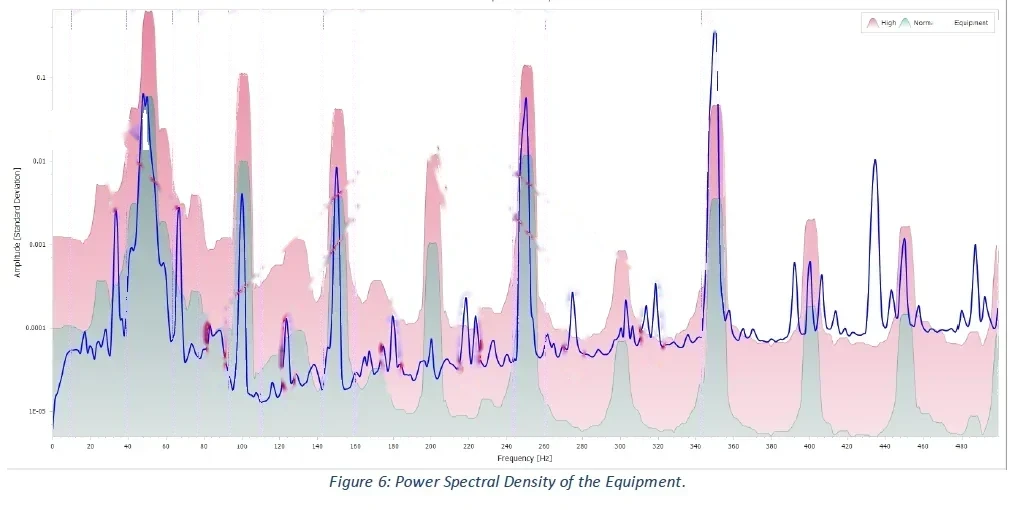
Unbalance and bearing-related peaks above the learned envelope. Select to open full size.
50%
Lower reported vibration
6 mm/s → 3 mm/s after the motor-to-fan coupling alignment was corrected.
A targeted alignment correction.
5,500 VNominal voltage
184 ANominal current
The findingArtesis flagged elevated unbalance/misalignment and transmission indicators on a medium-voltage cement plant fan.
The interventionThe customer found poor alignment between the motor and the fan coupling and corrected it.
The verificationReported vibration fell from 6 mm/s to 3 mm/s after the correction — an independent check of the maintenance result.
- 1Misalignment indicators in caution band
- 2Coupling alignment corrected
- 3Vibration halved: 6 → 3 mm/s
Source: Artesis Case Study 2024, slides 18–20. The 50% reduction is calculated from the reported values. Customer name withheld.
03 / More field cases
Bearings, belts, looseness
and wasted energy.
4 INDUSTRIES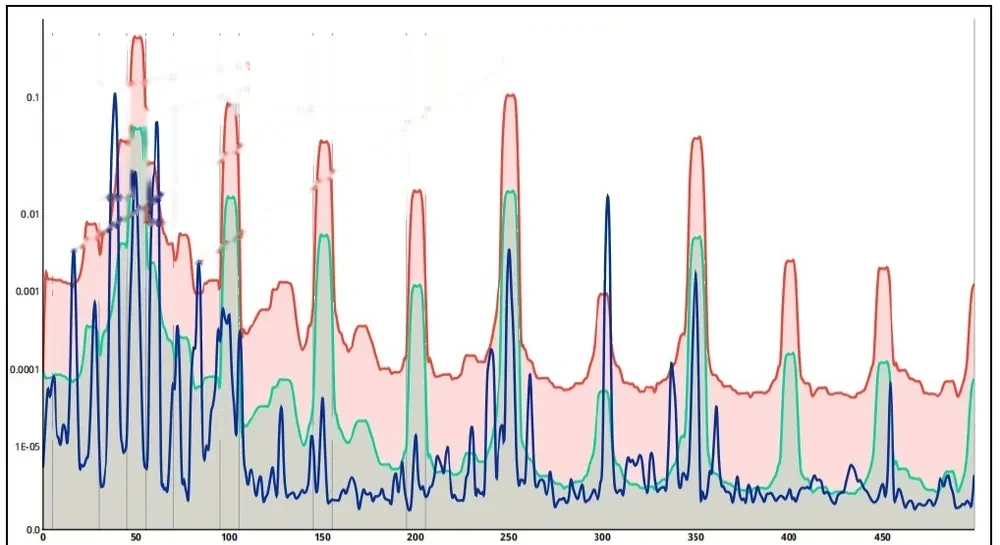
A small ID fan with two problems — and an oversized motor
The spectrum showed transmission and bearing components above the learned envelope. The electrical report added that the motor ran below 60% load, so a smaller motor would save energy.
- Rating
- 415 V · 10.6 A
- Outcome
- Faults flagged + right-sizing advice
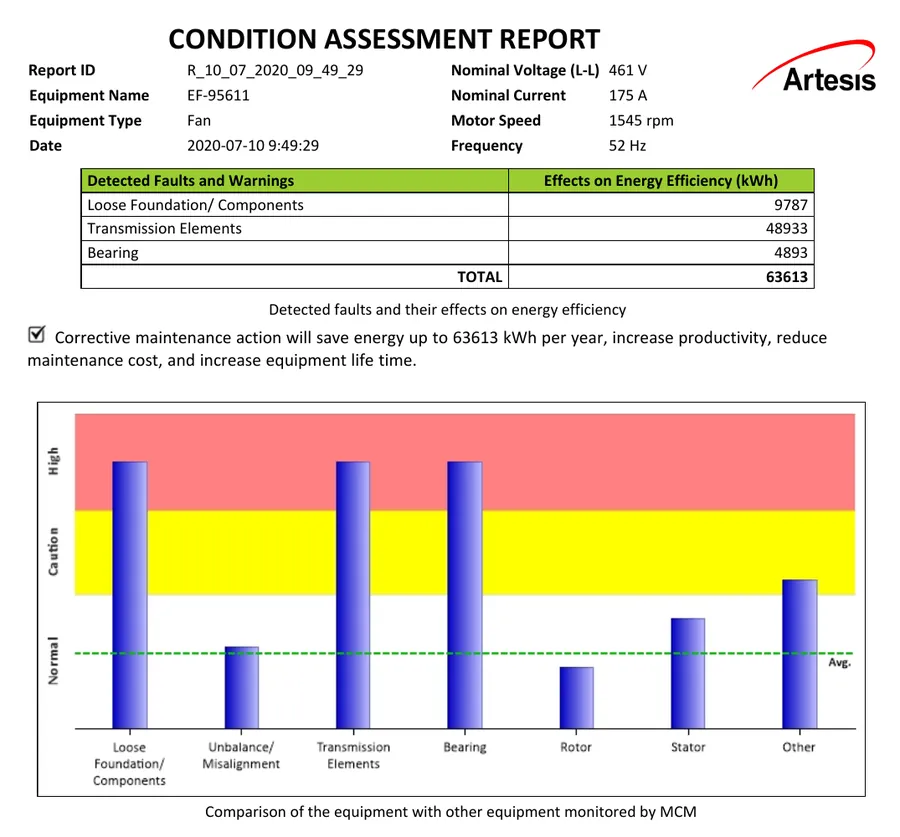
What the faults cost in energy
One AMTPro test flagged looseness, transmission-element and bearing faults, and estimated their combined energy effect. Correcting them was worth up to 63,613 kWh per year.
- Rating
- 461 V · 175 A · 52 Hz
- Energy effect
- 63,613 kWh / year
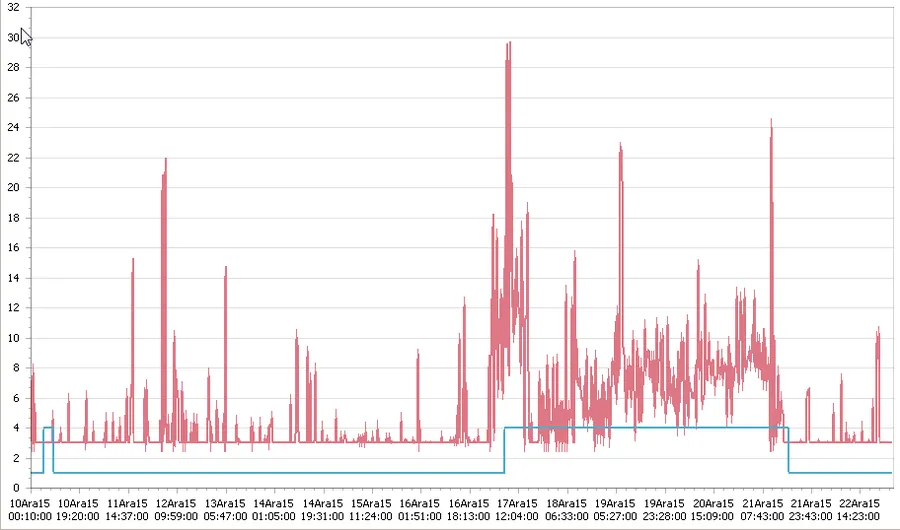
Swapped to the spare before it failed
On a mould cooling fan the bearing parameter crossed its alarm level. A motor bearing fault was found; the spare motor took over, and after repair the parameter returned to its learned level.
- Duty
- Mould cooling, 24/7
- Outcome
- Unplanned downtime avoided
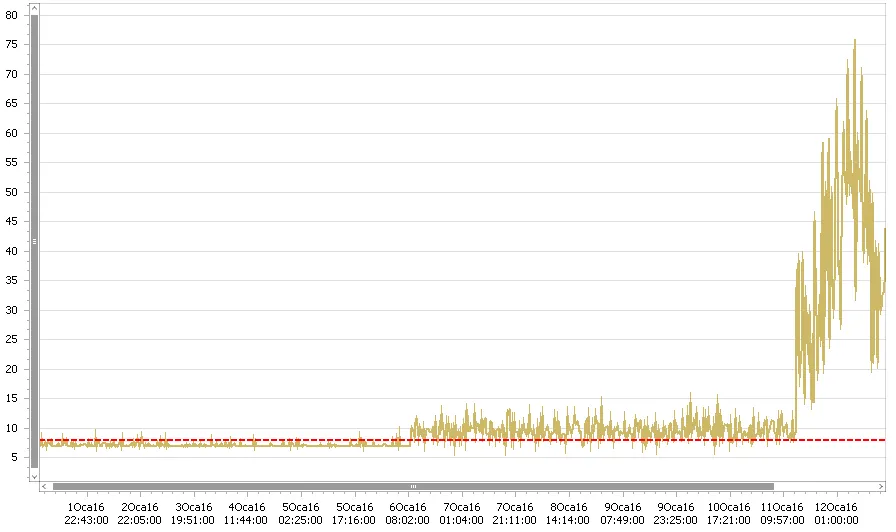
Loose bearing housing screws
The loose component parameter crept over its alarm level, then jumped five days later. Maintenance found loose bearing housing screws and tightened them.
- Duty
- Mould cooling, 24/7
- Outcome
- Screws re-tightened
A loose belt, read from the trend
A transmission fault alarm led engineers to the trend data, which pointed to a loose belt. Maintenance confirmed it — belt slip also wastes energy.
An e-mail, then lubrication
A sudden rise in the bearing parameter triggered an alarm e-mail. The front motor bearing was running hot; after lubrication the parameter fell back.
Cases are individual outcomes from Artesis field deployments between 2005 and 2024. All visuals are from Artesis software. Customer names are withheld.
04 / What we detect
Fault modes, signals
and evidence strength.
Evidence strength reflects how reliably a condition produces an observable electrical pattern in typical industrial fan installations — not a guarantee of detection.
| Condition | What changes in the signal | Evidence | Field case |
|---|---|---|---|
| Drive train · mechanical | |||
| Unbalance | Unbalance-related pattern | Good | Cement fan → |
| Misalignment and coupling | Alignment-related pattern | Good | Cement fan → |
| Bearing wear | Bearing-related pattern in the current spectrum | Good | ID fan, mould cooling fan |
| Belt and transmission | Belt and pulley-related pattern | Good | ID fan, spray booth fan |
| Looseness and foundation | Looseness-related pattern | Good | Mould cooling fan, exhaust fan |
| Motor · electrical | |||
| Rotor bars | Rotor-related pattern in the current spectrum | Strong | — |
| Stator and insulation | Current imbalance well above voltage imbalance | Strong | — |
| Supply and connections | Voltage imbalance, harmonics, per-phase RMS | Strong | — |
| Load · process and energy | |||
| Airflow restriction, damper changes | Load level and stability versus learned baseline | Good | See AHU page |
| Oversized motor, wasted energy | Load below ~60% of rating; kWh effect per fault | Strong | ID fan, exhaust fan |
05 / Outside the envelope
Where electrical signatures are weaker.
We state the limits up front, so monitoring is set up where it adds most and paired with the right complementary checks.
Very low speed
Below about 20 Hz on a VFD, signatures can fall under reliable thresholds.
Blade cracks and erosion
Early blade damage may not change load or balance enough to be seen.
Duct and housing resonance
Structural vibration not transmitted to the motor load is outside ESA’s view.
Detailed bearing grading
For fine bearing assessment, a portable vibration check adds sensitivity — without permanent sensors.
Observed patterns are interpreted by qualified personnel; they guide investigation rather than replace it. AMTPro spot tests need near-constant speed (±1% frequency) during capture.
06 / How you deploy it
Continuous where it matters.
Portable everywhere else.
Online · permanently installed
e-MCM
- Critical process, ID and FD fans
- 24/7 learning, trending and alarms
- Supports VFD applications
- Results in OmniSight across sites
Portable · route-based
AMTPro
- Auxiliary and HVAC fans
- Spot tests from the MCC in minutes
- Automatic condition report per test
- Energy impact estimate in every report
Artesis Insight explains the finding.
Artesis Insight turns spectra and trends into plain-language explanations and next steps. Your team does not need to be an ESA specialist to act on a result.
Illustrative maintenance guidance
Investigate fan alignment.
Elevated misalignment indicators warrant checking alignment between motor and fan, together with coupling condition and mounting integrity.
After action
Compare condition trends under similar speed and load, and verify with an appropriate field measurement.
Example wording only; not a live alarm or a reproduced AI report.
07 / Applications
One approach. Across your critical fans.
Induced-draft (ID) fansForced-draft (FD) fansProcess and exhaust fansDust extraction fansKiln and cooler fansMould cooling fansSpray booth exhaust fansCooling tower and HVAC fans
Does monitoring require access to the fan?
No. Current and voltage are measured at the electrical panel, so nothing is fitted to the fan. Installation is planned electrical work inside the cabinet by qualified personnel.
Can medium-voltage fans be monitored?
Yes. The cement case on this page runs at 5.5 kV. The e-MCM configuration and the available CT/PT secondary signals are reviewed for each application.
Does it work on belt-driven fans?
Yes. Belt wear, slip and pulley misalignment produce a characteristic pattern in the spectrum, as the ID fan and spray booth cases show.
Can fans on VFDs be monitored?
Yes. e-MCM supports VFD applications. The baseline is best established at a fixed speed first; diagnostic confidence is reduced below roughly 20 Hz.
What information is needed to start?
Motor nameplate data, fan type, typical operating current, drive arrangement (direct, coupling or belt) and the measurement points available in the cabinet.
Related assets
Other equipment we monitor.
Bring your critical fans into view.
Tell us about your fan application. We’ll help you identify a suitable monitoring setup.









 White Papers
 Case Study
 Documents
 Webinars
 Events
 ROI Calculator
 FAQ
FAQ