
$1.4MEstimated loss avoided on a petrochemical reactor mixer
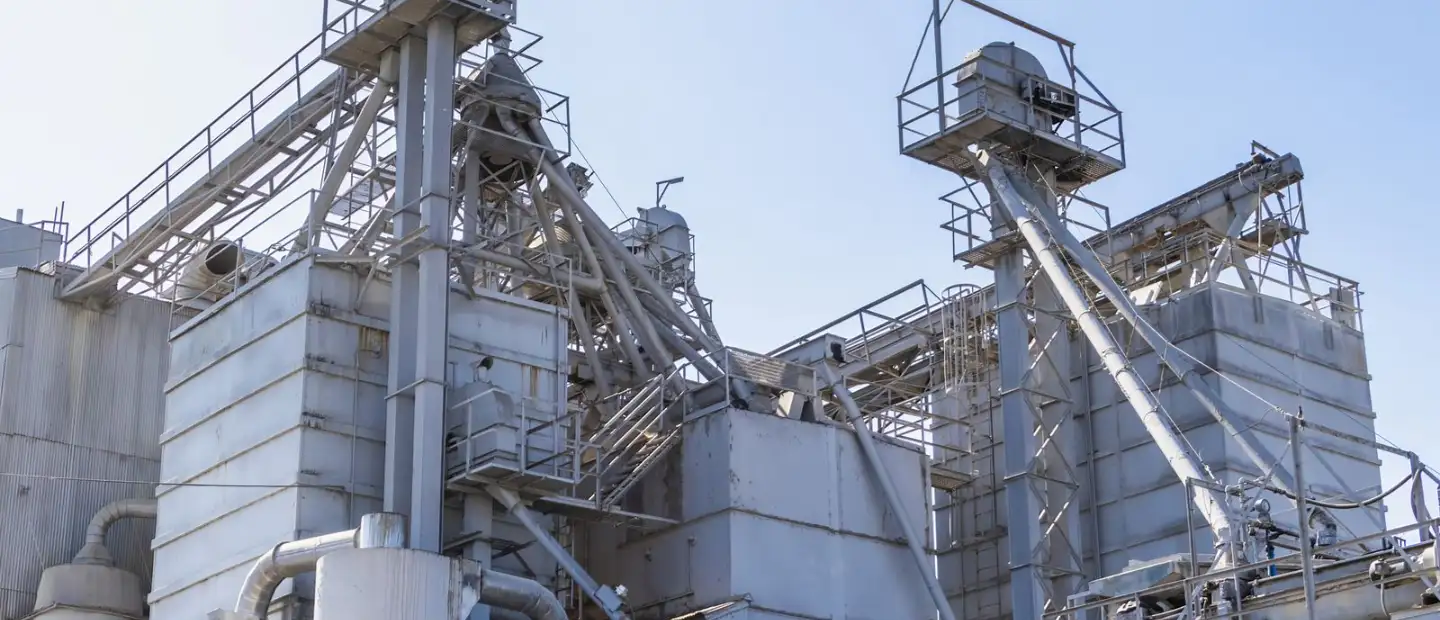
Asset monitoring / Mixers, agitators & mills
Heavy duty, variable load.
Still readable from the MCC.
Mixers, agitators and mills work under changing loads, inside vessels or behind guards, often at low speed. Artesis follows their motors, belts, gearboxes and bearings from the electrical panel — without entering the vessel or stopping the mill.
173 rpmLowest motor speed in the cases below, at 6.3 kV
0 sensors in the vesselCurrent and voltage measured in the MCC
01 / The challenge
Sealed vessels.
Shifting loads.
Agitators sit on top of sealed or hazardous vessels; mills run behind guards in dust and noise. Inspecting them means isolation, confined-space entry or a production stop.
Their load changes with every batch or ore type, so fixed vibration limits are hard to set. Artesis learns each machine’s normal behaviour under its real load range and flags what does not fit — belt, pulley, bearing, rotor or process.
Connect at the motor control cabinet
e-MCM or AMTPro uses the existing current and voltage signals, including on medium-voltage mill motors.
Learn the load range
Baselines cover the machine’s normal batch or feed variation, so real faults stand out from process swings.
Plan the stop
Findings are classified by domain and severity, with the energy effect of each fault.
02 / Featured case · Mining
One mixer, two faults.
Both confirmed by maintenance.
DOCUMENTED FIELD CASEMIXER / POWER SPECTRAL DENSITY
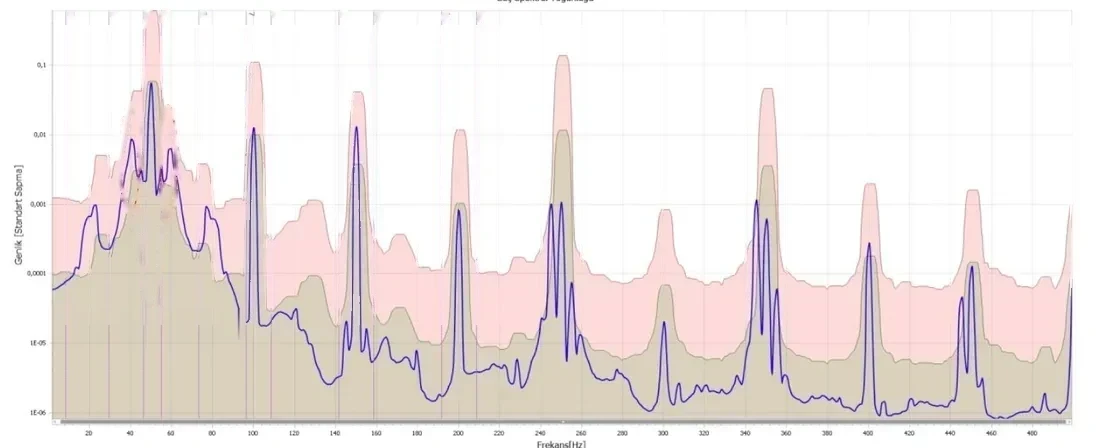
Transmission-element components during the learning phase: a belt and pulley problem.
MIXER / BEARING TREND
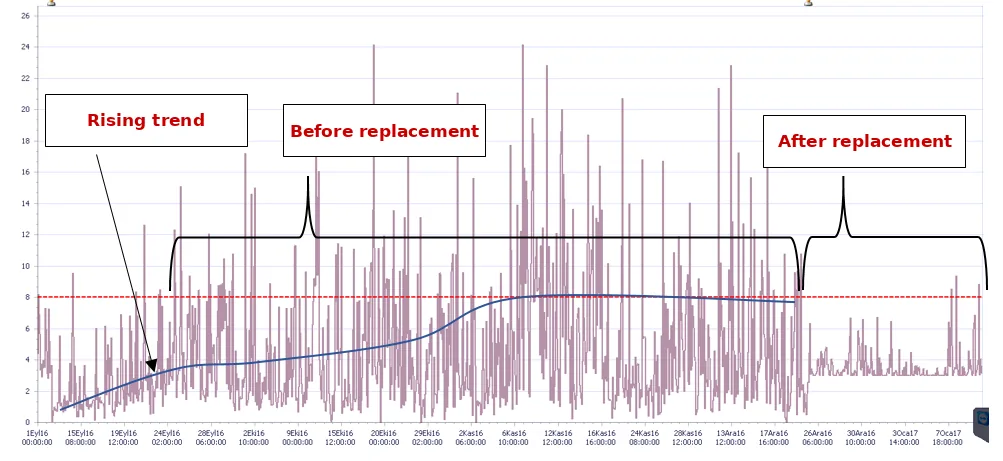
The bearing trend rises to its alarm level, then drops after replacement. Select to open full size.
2 / 2
Faults confirmed on site
The belt and pulley were replaced and aligned; the bearing showed wear and scratch marks on the outer ring and balls.
From belt drive to bearing.
MiningIndustry
MixerBelt-driven
e-MCMOnline monitoring
The first findingAlready during the learning phase, Artesis saw a transmission pattern in the spectrum. Maintenance changed the belt and aligned the pulley.
The second findingOver the following months the bearing parameter rose steadily until it reached its alarm level.
The confirmationWhen the bearing was replaced, maintenance found wear and scratch marks on the outer ring and balls. The bearing trend dropped straight after the change.
- 1Transmission fault in learning phase
- 2Belt changed, pulley aligned
- 3Bearing trend alarm → worn bearing replaced
Source: Artesis mining industry case study. Customer name withheld.
03 / More field cases
Mills, agitators
and a reactor mixer.
5 INDUSTRIES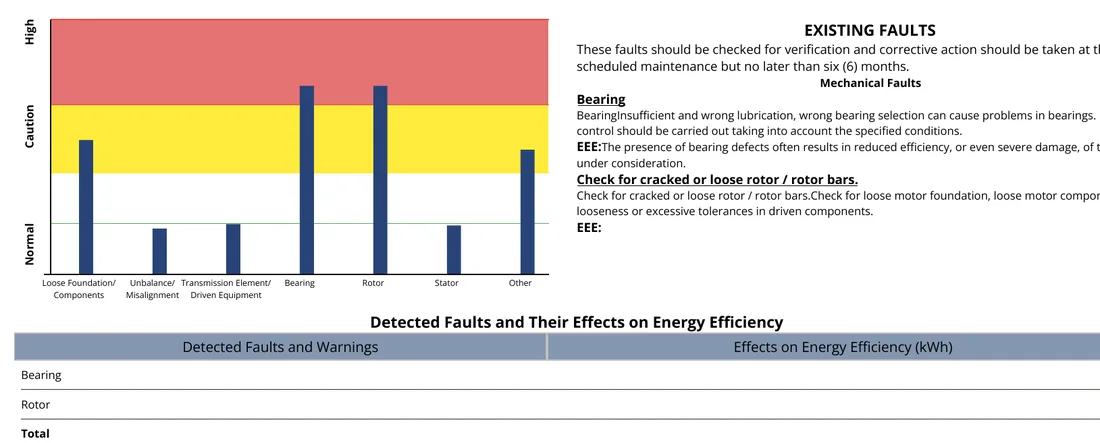
Bearing and rotor on a 1 MW mill drive
An AMTPro test on a 690 V vertical mill drive running near 90% load flagged bearing and rotor indicators in the caution band. The report put their energy effect at 260,263 kWh per year.
- Rating
- 690 V · 1,243 A
- Energy effect
- 260,263 kWh / year
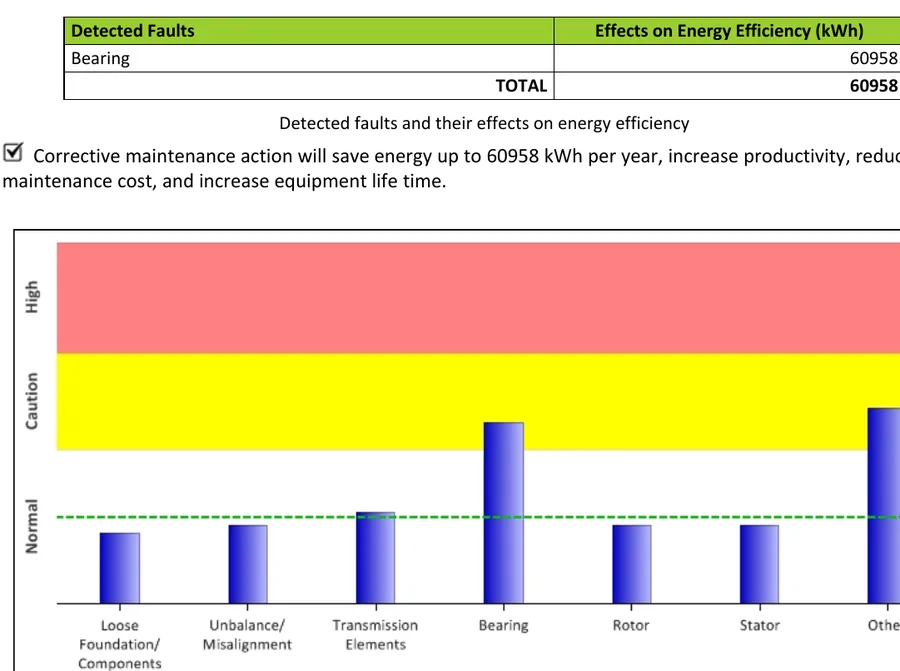
A bearing fault at 173 rpm
On a 6.3 kV mill motor running at just 173 rpm, the condition report flagged a bearing fault. Its sister motor on the same mill showed only a spectral anomaly to watch.
- Rating
- 6,287 V · 142 A · 173 rpm
- Energy effect
- 60,958 kWh / year
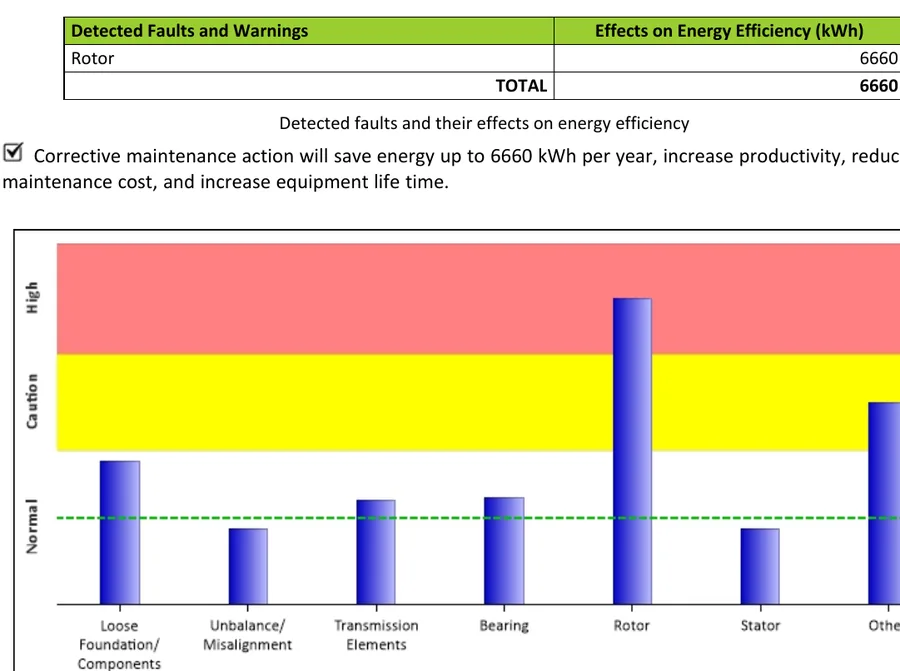
Rotor bars on an agitator
A crystallizer agitator showed its rotor indicator in the high band and a 5.8% current imbalance. The report advised checking for cracked or loose rotor bars within three months.
- Rating
- 416 V · 66 A
- Energy effect
- 6,660 kWh / year
Unbalance from a bent shaft
A sharp change in the unbalance parameter raised an Examine 1 alarm on a reactor mixer motor. Maintenance confirmed the unbalance and traced it to shaft curvature. The plant estimated that three days of unplanned downtime would have cost about $1.35 million in lost production — around $1.4 million including repairs.
- Alarm
- Examine 1 · unbalance
- Loss avoided
- ≈ $1.4 million (plant estimate)
Five drives, one AMTPro visit
A single AMTPro visit covered a mill motor, two kiln main drives and two kiln fans. All five needed maintenance within 3–6 months; fixing the faults was estimated to save $29,200 a year in energy.
Transmission and bearing, plus imbalance
An AMTPro test flagged transmission-element and bearing faults and a 4.6% current imbalance to be watched on a starch mixer drawing about 55 kW.
Cases are individual outcomes from Artesis field deployments between 2012 and 2022. All visuals are from Artesis software. Customer names are withheld.
04 / What we detect
Fault modes, signals
and evidence strength.
Evidence strength reflects how reliably a condition produces an observable electrical pattern in typical mixer and mill installations — not a guarantee of detection.
| Condition | What changes in the signal | Evidence | Field case |
|---|---|---|---|
| Drive train · mechanical | |||
| Belt, pulley and transmission | Transmission-element and belt-related indicators | Good | Mining mixer → |
| Bearing wear | Bearing indicator trend | Good | Mining mixer, MV mill motor, mill drive |
| Unbalance, bent shaft | Unbalance-related pattern | Good | Reactor mixer |
| Gearbox and looseness | Transmission and looseness-related patterns | Good | Kiln drives |
| Motor · electrical | |||
| Rotor bars | Rotor-related pattern in the current spectrum | Strong | Agitator, mill drive, rubber mill |
| Stator and insulation | Current imbalance well above voltage imbalance | Strong | Kiln mill motor |
| Supply and connections | Voltage imbalance, harmonics, per-phase RMS | Strong | — |
| Process · load | |||
| Batch or feed change | Load pattern versus learned range | Good | — |
| Energy lost to faults | kWh effect per fault | Strong | Mill drive, MV mill motor |
05 / Outside the envelope
Where electrical signatures are weaker.
We state the limits up front, so monitoring is set up where it adds most and paired with the right complementary checks.
Extreme load swings
Mills with very erratic feed need longer learning before small changes can be judged.
Impeller and blade wear
Gradual wear in the vessel may not change load enough to be seen early.
Seals and stuffing boxes
Seal leakage without a load change leaves little electrical trace.
Very low VFD speed
Below about 20 Hz, diagnostic confidence is reduced.
Observed patterns are interpreted by qualified personnel; they guide investigation rather than replace it. AMTPro spot tests need near-constant speed (±1% frequency) during capture.
06 / How you deploy it
Continuous where it matters.
Portable everywhere else.
Online · permanently installed
e-MCM
- Critical mills and reactor agitators
- 24/7 learning, trending and alarms
- Supports VFD applications
- Results in OmniSight across sites
Portable · route-based
AMTPro
- Routes across mixers and auxiliary drives
- Spot tests from the MCC in minutes
- Automatic condition report per test
- Energy impact estimate in every report
Artesis Insight explains the finding.
Artesis Insight turns spectra and trends into plain-language explanations and next steps. Your team does not need to be an ESA specialist to act on a result.
Illustrative maintenance guidance
Check the belt drive and pulley.
Transmission-element components suggest belt wear, slip or pulley misalignment. Check belt tension and condition and pulley alignment.
After action
Confirm the transmission indicator falls back after the work and watch the bearing trend.
Example wording only; not a live alarm or a reproduced AI report.
07 / Applications
Wherever product is mixed or ground.
Process agitators and reactor mixersCrystallizer agitatorsBall, SAG and vertical millsHammer mills and crushersRubber mixing millsFood and starch mixers
Do I need to enter the vessel or stop the mill?
No. Everything is measured in the motor control cabinet.
Our load changes with every batch. Will that cause false alarms?
Artesis learns the normal load range first. Findings are judged against that learned behaviour, not a fixed limit.
Can low-speed mills be monitored?
Yes. The MV mill motor case runs at 173 rpm. Very slow driven-side bearings behind large gear reductions are harder to see than motor-side faults.
Can medium-voltage mill motors be monitored?
Yes, through the existing CT and PT secondaries, as the 6.3 kV mill motor case shows.
What information is needed to start?
Motor nameplate data, drive arrangement (belt, gearbox or direct), typical load range, starter or drive type and the measurement points in the cabinet.
Related assets
Other equipment we monitor.
Bring your mixers and mills into view.
Tell us about your process drives. We’ll help you pick where continuous monitoring pays off.










 White Papers
 Case Study
 Documents
 Webinars
 Events
 ROI Calculator
 FAQ
FAQ