
62,572 kWhYearly energy effect of faults on two fans in the featured case
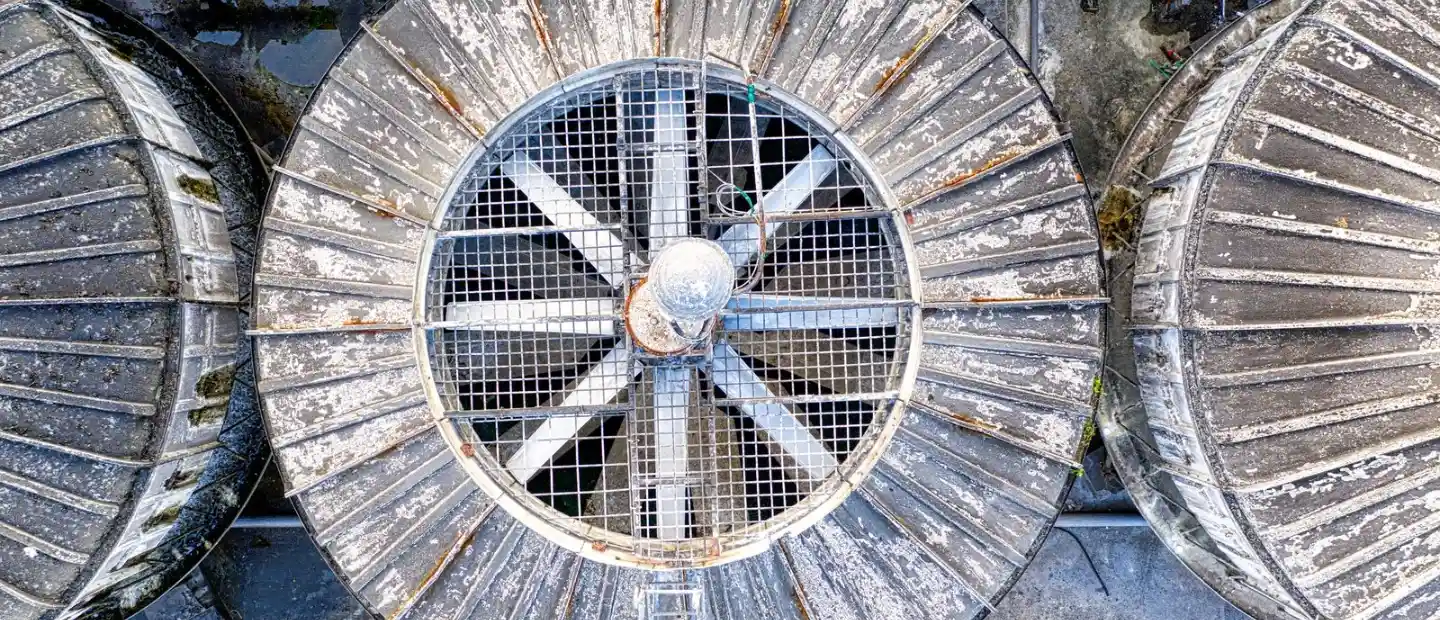
Asset monitoring / Cooling tower fans
Stay off the fan deck.
See the gearbox from the MCC.
Cooling tower fans sit on wet, windy decks with long drive shafts and right-angle gearboxes. Artesis follows motor, shaft, gearbox and fan condition from the electrical panel — nothing to mount in the plume.
3 sitesSemiconductor, automotive and refinery
0 sensors in the towerCurrent and voltage measured in the MCC
01 / The challenge
Wet, windy
and hard to reach.
A cooling tower fan is driven through a long shaft and a right-angle gearbox, often 10 m or more above ground, in humid air and spray. Vibration sensors there corrode, and route rounds mean climbing onto the deck.
When a tower cell trips, condenser water warms and chillers or process units lose capacity. Because motor, shaft, gearbox and fan are one mechanical chain, their condition shows up in the motor current — readable from the MCC in the dry.
Connect at the motor control cabinet
e-MCM or a portable AMTPro test uses the existing current and voltage signals. Nobody needs to go onto the fan deck.
Learn each cell’s normal behaviour
Baselines reflect the fan’s real load, including VFD speed changes with the seasons.
Plan work before the hot season
Findings are classified as looseness, unbalance, gearbox or bearing, with the energy each fault costs.
02 / Featured case · Semiconductor
Two tower fans. Gearbox,
looseness and 62,572 kWh a year.
DOCUMENTED FIELD CASECOOLING TOWER FAN 01 · 37 kW / CONDITION REPORT
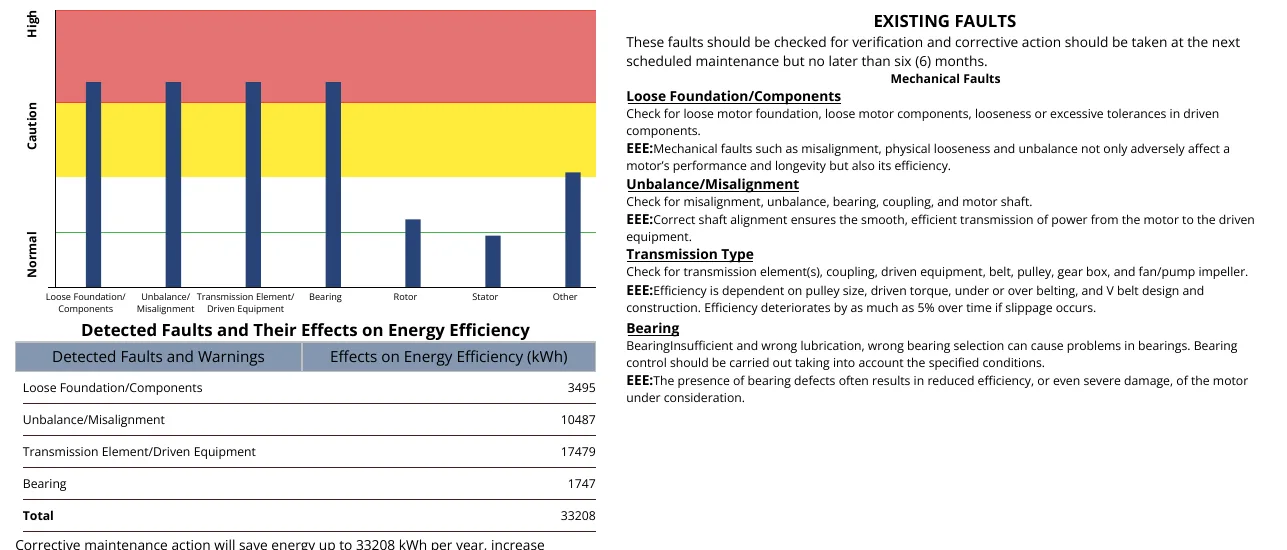
Four fault indicators in the caution band, each with its yearly energy effect.
COOLING TOWER FAN 01 / POWER SPECTRAL DENSITY
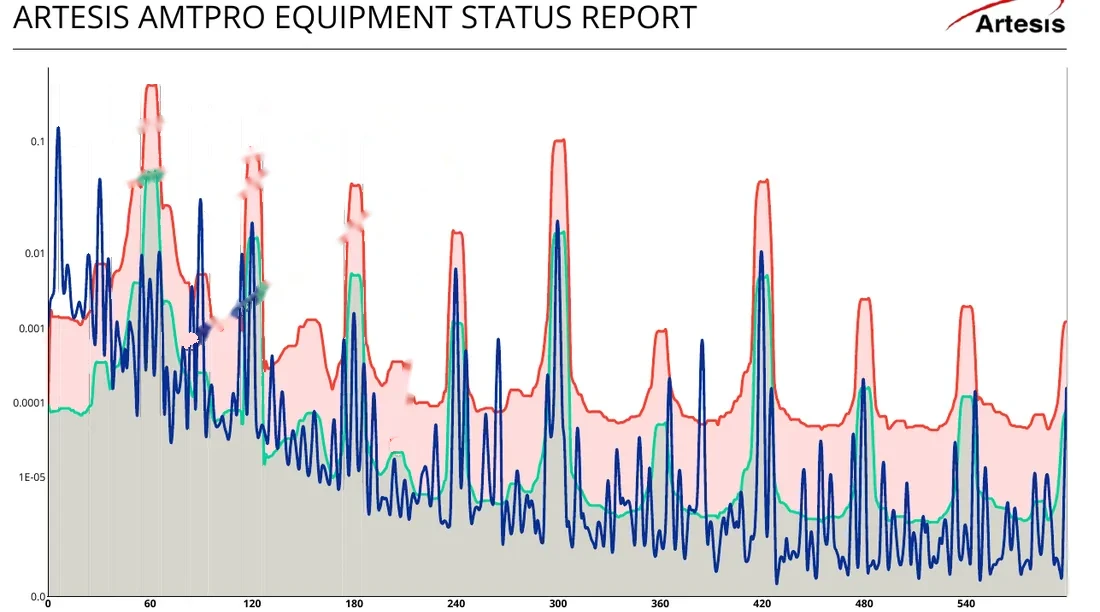
Looseness, misalignment and gear components above the learned envelope. Select to open full size.
2 fans
Faults found on both tested cells
Both 480 V, VFD-driven fans with gearboxes showed looseness and gearbox/transmission faults.
33,208kWh / year · fan 01 (37 kW)
29,364kWh / year · fan 08 (55 kW)
62,572kWh / year · both fans
Noisy fans, clear answers.
480 VNominal voltage
84 ANominal current
VFDGearbox drive
The situationCooling tower fans at a semiconductor plant were running with unusual noise and malfunction. AMTPro tests were run from the MCC on two cells.
The findingFan 01 showed loose foundation, unbalance/misalignment, transmission-element (gearbox) and bearing faults. Fan 08 showed loose foundation and transmission/gear faults.
The valueThe reports put the energy effect of the faults at 33,208 and 29,364 kWh per year — a clear case for correcting them before summer load.
- 1AMTPro tests from the MCC
- 2Gearbox and looseness faults on both fans
- 3Energy effect quantified per fault
Source: Artesis Case Study 2024, slides 6–8, and AMTPro reports for both fans (2023). Customer name withheld.
03 / More field cases
Gear mesh, loose bolts
and oversized motors.
3 INDUSTRIES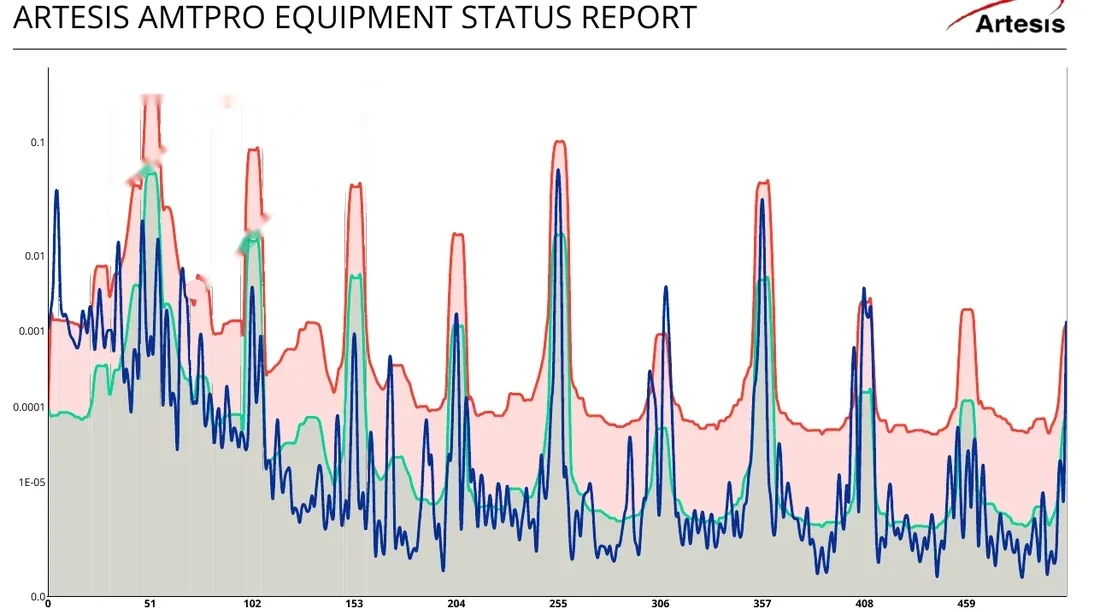
The second cell: looseness and gear
On the 55 kW cell the spectrum showed a raised looseness floor and transmission/gear components. The report estimated the faults’ energy effect at 29,364 kWh per year.
- Rating
- 480 V · VFD · gearbox
- Energy effect
- 29,364 kWh / year
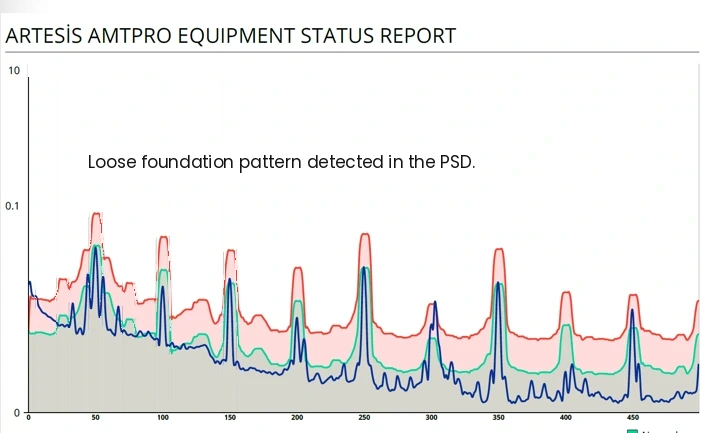
Today’s AMTPro view: a loose foundation pattern detected in the PSD. Example from another asset.
A loose bolt, followed for four months
e-MCM first warned of looseness in October. A renewed alert in November started an inspection, and in February a loose attachment bolt was found and fixed.
- Duty
- Central cooling tower
- Outcome
- Loose bolt found and fixed
Healthy — but oversized
AMTPro found no mechanical faults, but both motors ran at about 41% load. The reports advised a smaller, more efficient motor at the next replacement.
Cases are individual outcomes from Artesis field deployments between 2005 and 2023. All visuals are from Artesis software. Customer names are withheld.
04 / What we detect
Fault modes, signals
and evidence strength.
Evidence strength reflects how reliably a condition produces an observable electrical pattern in typical cooling tower fan installations — not a guarantee of detection.
| Condition | What changes in the signal | Evidence | Field case |
|---|---|---|---|
| Drive train · mechanical | |||
| Gearbox and transmission | Transmission-element indicator | Good | Fan 01 and 08 → |
| Looseness and foundation | Looseness-related pattern | Good | Fan 01, fan 08, automotive |
| Unbalance and misalignment | Alignment-related pattern | Good | Fan 01, automotive |
| Bearing wear | Bearing-related pattern in the current spectrum | Good | Fan 01 |
| Motor · electrical | |||
| Rotor bars | Rotor-related pattern in the current spectrum | Strong | — |
| Stator and insulation | Current imbalance well above voltage imbalance | Strong | — |
| Supply and connections | Voltage imbalance, harmonics, per-phase RMS | Strong | — |
| Load · energy | |||
| Energy lost to faults | kWh effect per detected fault | Strong | Fan 01, fan 08 |
| Oversized motor | Motor load below ~60% of rating | Strong | Refinery fans |
| Blade pitch or airflow change | Load level versus learned baseline | Good | — |
05 / Outside the envelope
Where electrical signatures are weaker.
We state the limits up front, so monitoring is set up where it adds most and paired with the right complementary checks.
Slow fan speeds
Fan-side components after a large gear reduction are small; gearbox and motor faults are clearer than blade faults.
Blade cracks and erosion
Early blade damage may not change load or balance enough to be seen.
Very low VFD speed
Below about 20 Hz in winter operation, confidence is reduced.
Gear oil condition
Oil quality is not seen directly; keep oil checks in the routine.
Observed patterns are interpreted by qualified personnel; they guide investigation rather than replace it. AMTPro spot tests need near-constant speed (±1% frequency) during capture.
06 / How you deploy it
Continuous where it matters.
Portable everywhere else.
Online · permanently installed
e-MCM
- Critical tower cells and large fans
- 24/7 learning, trending and alarms
- Supports VFD applications
- Results in OmniSight across sites
Portable · route-based
AMTPro
- Seasonal checks across all cells
- Spot tests from the MCC in minutes
- Automatic condition report per test
- Energy impact estimate in every report
Artesis Insight explains the finding.
Artesis Insight turns spectra and trends into plain-language explanations and next steps. Your team does not need to be an ESA specialist to act on a result.
Illustrative maintenance guidance
Check the gearbox and fan mounting.
Transmission and looseness indicators together suggest checking gearbox mounting, drive shaft couplings and fan hub bolts.
After action
Re-test at a similar fan speed and confirm the energy effect has fallen.
Example wording only; not a live alarm or a reproduced AI report.
07 / Applications
Across your cooling towers.
Induced-draft cooling tower fansForced-draft cooling tower fansGearbox-driven fansBelt-driven tower fansAir-cooled condenser fansChiller plant tower cells
Does anyone need to go onto the fan deck?
No. All measurements are taken in the motor control cabinet, in the dry.
Can you see the gearbox?
Gearbox and transmission faults show up as transmission-element components in the motor current, as both featured fans show. Very small fan-side effects behind a large reduction are harder to see.
Our fans run on VFDs. Is that a problem?
No. e-MCM supports VFD applications and AMTPro tests at the running speed. Confidence is reduced below roughly 20 Hz.
Can this help with energy?
Yes. Every AMTPro report estimates the energy effect of detected faults and flags oversized motors running below about 60% load.
What information is needed to start?
Motor nameplate data, gearbox or belt arrangement, fan speed range, drive type and the measurement points in the cabinet.
Related assets
Other equipment we monitor.
Bring your cooling towers into view.
Tell us about your tower cells and drives. We’ll show which fans to test first.








 White Papers
 Case Study
 Documents
 Webinars
 Events
 ROI Calculator
 FAQ
FAQ