
~20%Extra energy drawn by a faulty blower in the featured case

Asset monitoring / Blowers
Blowers run the process.
Watch them from the panel.
Aeration, conveying and scrubber blowers work hard in hot, noisy plant rooms. Artesis follows motor, belt, bearing and electrical condition from the MCC — and shows what each fault costs in energy.
7 field casesWastewater, food, oil & gas, labs and leisure
0 sensors on the blowerCurrent and voltage measured in the MCC
01 / The challenge
Hard-working.
Rarely watched.
Blowers often run 24/7 with little redundancy. In wastewater aeration, a stopped blower means an oxygen-starved process within hours; in food and chemical plants, a failed scrubber or conveying blower stops the line.
Belts, pulleys, bearings and electrical connections degrade quietly — and many faults first show up as higher energy use. ESA sees both the fault and its energy effect from the same current signal.
Connect at the motor control cabinet
e-MCM uses the existing current and voltage signals. Nothing is mounted on the blower, its enclosure or silencers.
Learn each blower’s normal behaviour
A baseline is built for the specific motor, drive and blower under real duty — including the pulsating load of PD machines.
See the fault and its cost
Findings are classified by domain and each report estimates the energy effect of what it found.
02 / Featured case · Wastewater aeration
Loose connections,
stressed bearings, 20% more energy.
DOCUMENTED FIELD CASEPD BLOWER / ELECTRICAL AND BEARING TRENDS
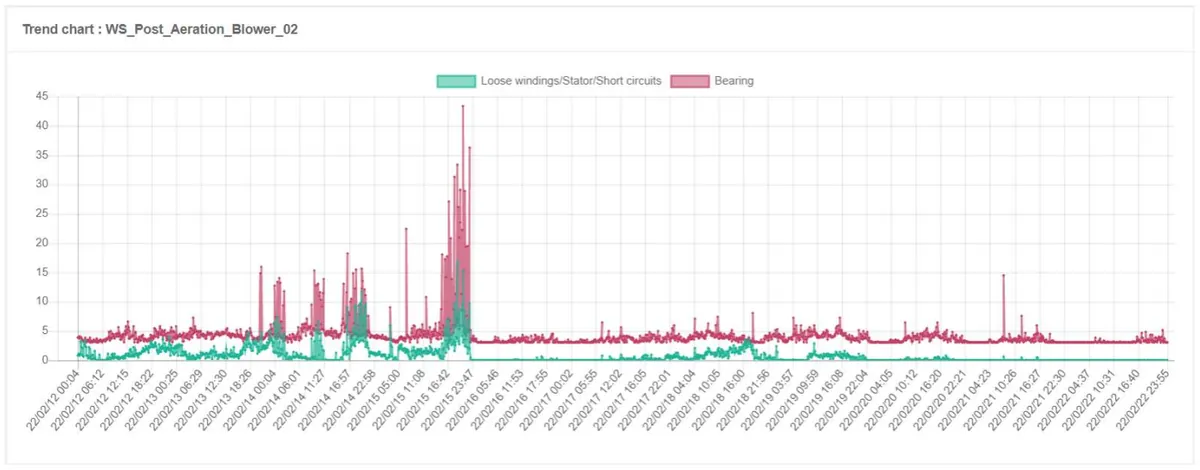
Electrical (green) and bearing (red) parameters rise together, then drop after repair on 15 Feb.
PD BLOWER / ACTIVE POWER
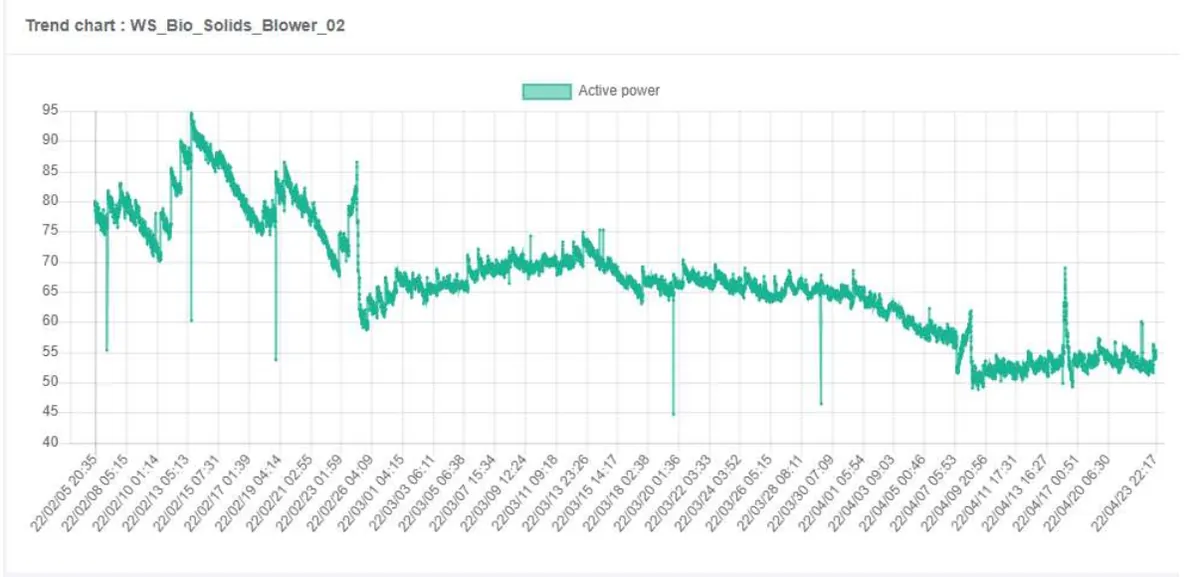
Active power steps down after the repair. Select to open full size.
−20%
Energy use back to normal
The electromechanical faults had raised the blower’s energy consumption by about 20%. After repair it returned to normal.
“We would have never found the fault without the Artesis MCSA system.”Project Director, plant operations contractor
An electrical fault with a mechanical cost.
PDPositive displacement
e-MCMOnline monitoring
2022Case year
The findingEarly in February, e-MCM showed developing electrical faults; within days the signals crossed their thresholds.
The investigationThe electrician found hot spots at the weather head and corroded connections at the motor and the MCC, and re-terminated all connections.
The knock-on effectPhase fluctuations had sharply increased stress on the bearings. The bearing trend rose with the electrical fault and fell straight after the repair.
- 1Electrical trend crosses threshold
- 2Hot, corroded connections re-terminated
- 3Bearing trend and power fall back
| Week | kWh | Annualised cost |
|---|---|---|
| 7 Feb 2022 | 77 | $40,471 |
| 14 Feb 2022 | 81 | $42,574 |
| 21 Feb 2022 | 80 | $42,048 |
| 28 Feb 2022 | 68 | $35,741 |
| 7 Mar 2022 | 67 | $35,215 |
| 28 Mar 2022 | 66 | $34,690 |
Source: Artesis PD blower case study, 2022. Customer and contractor names withheld.
03 / More field cases
Belts, bearing currents
and misalignment.
5 INDUSTRIES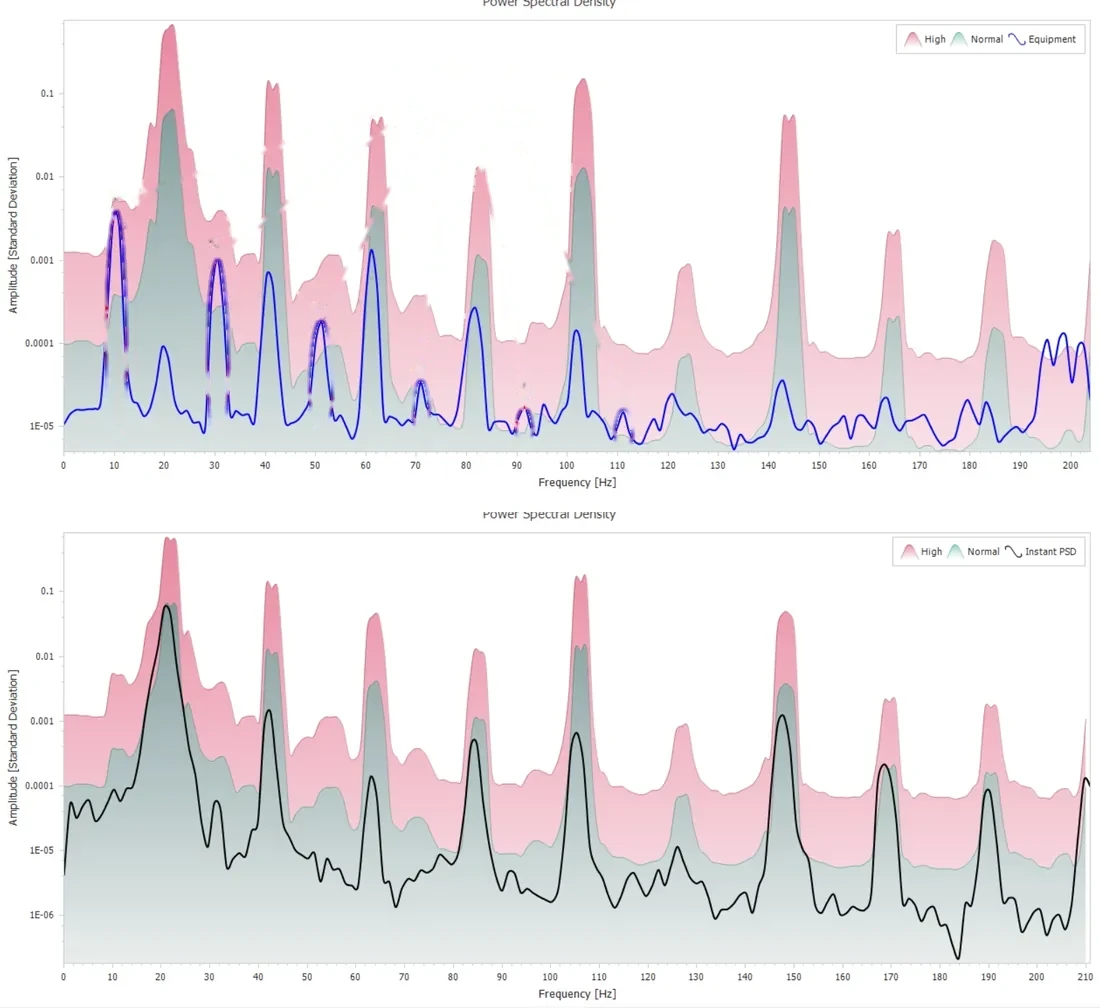
Parallel misalignment — and proof of the fix
The spectrum showed the pattern typical of parallel misalignment. After alignment work, those amplitudes fell away on the following spectra (bottom).
- Rating
- 38.5 A
- Outcome
- Repair verified in the spectrum
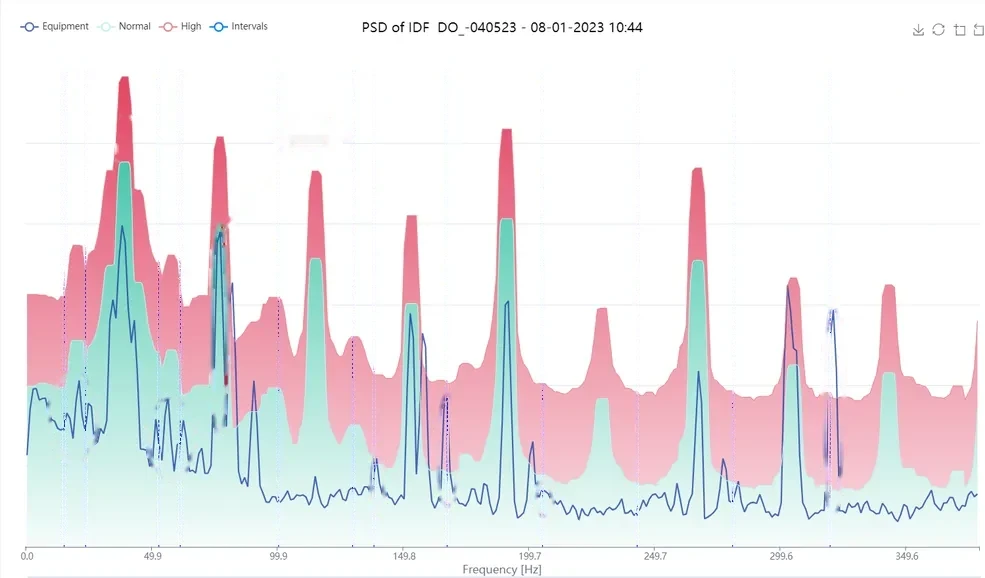
Bearing fluting caused by the drive
The spectrum showed a bearing defect and an early stator fault. VFD-induced circulating currents were damaging the bearing; current imbalance ran over ten times the voltage imbalance.
- Rating
- 440 V · 176 A · VFD
- Outcome
- Confirmed by customer feedback
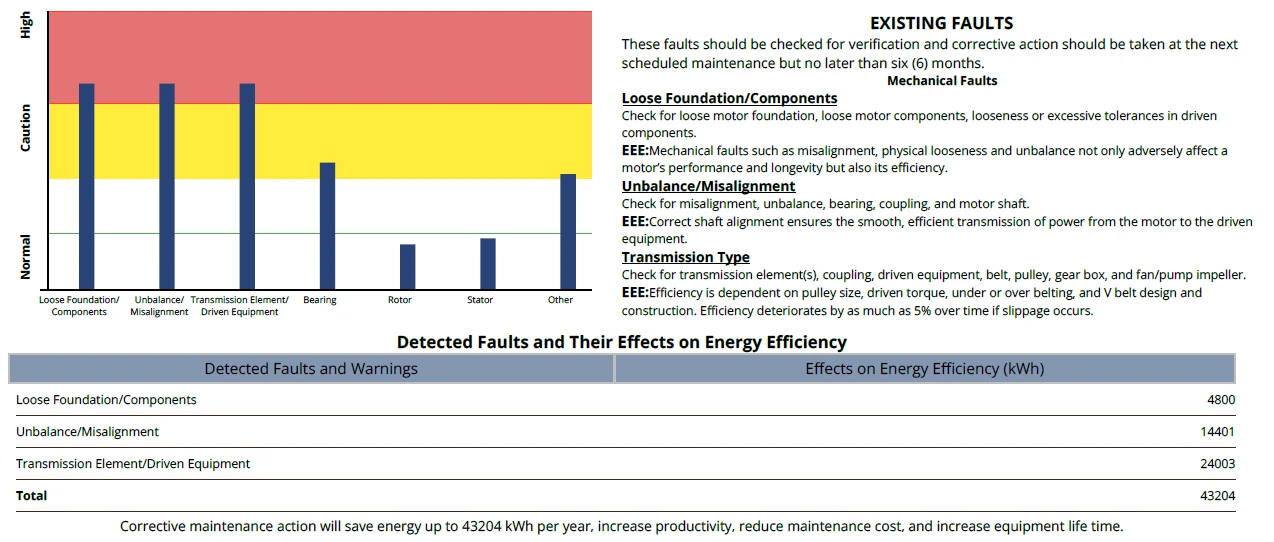
Three faults in one test
A single AMTPro test found bearing and belt problems — belt wear and belt misalignment — plus loose foundation.
- Rating
- 415 V · 95.3 A
- Outcome
- Bearing, belt and foundation flagged
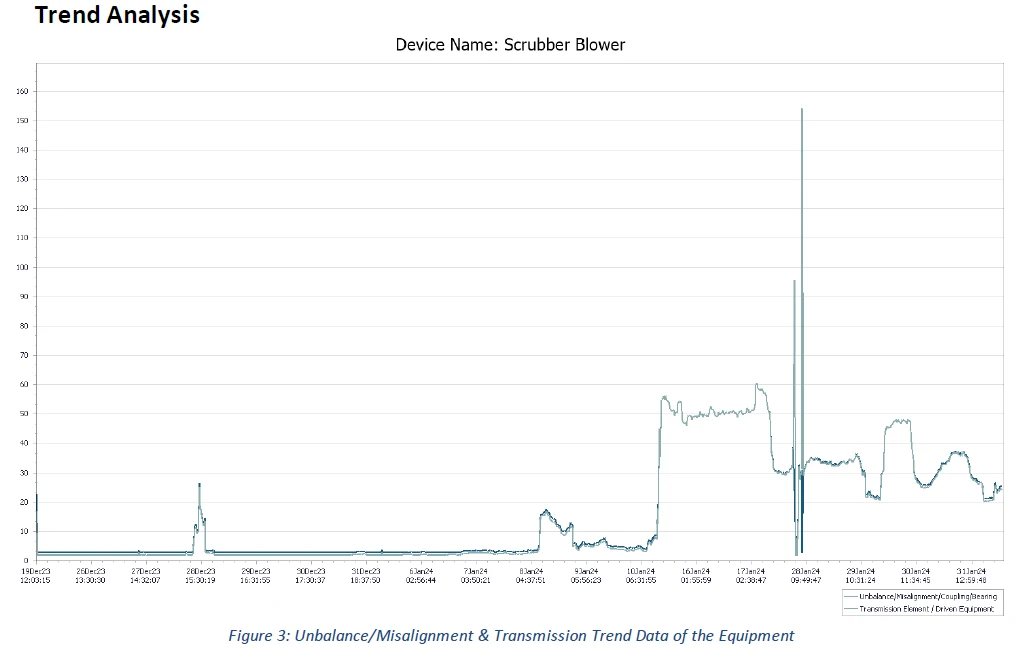
Bearing damage traced to misalignment
The trends showed misalignment appearing first, with bearing and electrical trends following — pointing to misalignment as the root cause.
- Rating
- 266 V · 31.2 A
- Outcome
- Root cause identified
A hot phase cable
Per-phase RMS values in the AMTPro test differed by more than 10%. A heat check found a hot spot on one of the three phase cables.
Faults plus an oversized motor
The test flagged transmission and bearing faults and a motor running below 60% load — a candidate for a smaller, more efficient motor.
Cases are individual outcomes from Artesis field deployments between 2022 and 2024. All visuals are from Artesis software. Customer names are withheld.
04 / What we detect
Fault modes, signals
and evidence strength.
Evidence strength reflects how reliably a condition produces an observable electrical pattern in typical blower installations — not a guarantee of detection.
| Condition | What changes in the signal | Evidence | Field case |
|---|---|---|---|
| Motor · electrical | |||
| Loose or corroded connections | Per-phase RMS deviation, internal/external electrical trends | Strong | Aeration blower → |
| Stator and insulation | Current imbalance well above voltage imbalance | Strong | Food blower |
| VFD bearing currents | Bearing components with distorted, high crest-factor waveforms | Good | Food blower |
| Drive train · mechanical | |||
| Bearing wear | Bearing-related pattern in the current spectrum | Good | Aeration, scrubber, belt blowers |
| Belt wear, slip, pulley misalignment | Belt and pulley-related pattern | Good | Belt-driven blower |
| Coupling misalignment | Alignment-related pattern | Good | Oil & gas blower |
| Looseness and foundation | Looseness-related pattern | Good | Belt-driven blower |
| Load · process and energy | |||
| Pressure or flow change | Load level and pulsation versus learned baseline | Good | — |
| Energy waste from faults | Active power trend; kWh effect per fault | Strong | Aeration blower |
05 / Outside the envelope
Where electrical signatures are weaker.
We state the limits up front, so monitoring is set up where it adds most and paired with the right complementary checks.
Strong load pulsation
PD blowers pulse by design. A proper baseline is needed before small changes can be judged.
Very low speed
Below about 20 Hz on a VFD, signatures can fall under reliable thresholds.
Impeller fouling
Build-up that does not change load or balance may not be visible early.
Detailed bearing grading
For fine bearing assessment, a portable vibration check adds sensitivity — without permanent sensors.
Observed patterns are interpreted by qualified personnel; they guide investigation rather than replace it. AMTPro spot tests need near-constant speed (±1% frequency) during capture.
06 / How you deploy it
Continuous where it matters.
Portable everywhere else.
Online · permanently installed
e-MCM
- Aeration and process-critical blowers
- 24/7 learning, trending and alarms
- Supports VFD applications
- Results in OmniSight across sites
Portable · route-based
AMTPro
- Auxiliary and standby blowers
- Spot tests from the MCC in minutes
- Automatic condition report per test
- Energy impact estimate in every report
Artesis Insight explains the finding.
Artesis Insight turns spectra and trends into plain-language explanations and next steps. Your team does not need to be an ESA specialist to act on a result.
Illustrative maintenance guidance
Check the belt drive.
A belt and pulley-related pattern suggests belt wear or slip. Check belt tension and condition, pulley alignment and sheave wear.
After action
Compare the trend under similar load and confirm the energy effect has dropped in the next report.
Example wording only; not a live alarm or a reproduced AI report.
07 / Applications
Across your blower fleet.
Aeration blowersPositive displacement (rotary lobe) blowersCentrifugal blowersScrubber and fume blowersPneumatic conveying blowersCombustion air blowers
Do I need sensors on the blower?
No. Current and voltage are measured in the motor control cabinet. Nothing is mounted on the blower, its enclosure or pipework.
Does the pulsating load of PD blowers cause false alarms?
e-MCM learns each blower’s normal behaviour, including its pulsation, before alarms are set. Findings are judged against that baseline.
Can you detect belt problems?
Yes. Belt wear, slip and pulley misalignment produce a characteristic pattern in the spectrum, as the belt-driven blower case shows.
Can blowers on VFDs be monitored?
Yes. e-MCM supports VFD applications and can also reveal drive-related bearing currents. Confidence is reduced below roughly 20 Hz.
What information is needed to start?
Motor nameplate data, blower type, drive arrangement (direct, coupling or belt), typical operating current and the measurement points in the cabinet.
Related assets
Other equipment we monitor.
Bring your blowers into view.
Tell us about your blowers and drives. We’ll show where monitoring pays back in reliability and energy.








 White Papers
 Case Study
 Documents
 Webinars
 Events
 ROI Calculator
 FAQ
FAQ