
11 kVHighest motor voltage in the cases below
Asset monitoring / Centrifugal pumps
Hear the pump
from the panel.
Rotor defects, cavitation, bearing wear and coupling problems change the current your pump motor draws. Artesis reads those changes at the motor control cabinet, so nothing has to be fitted to the pump.
6 field casesPower, steel, oil & gas, utilities and marine
0 sensors on the pumpCurrent and voltage measured in the MCC
01 / The challenge
Pumps rarely fail
where you can see them.
Cooling water, condensate, process and fire water pumps run around the clock, often in pits, basements, hazardous areas or behind guards. Route-based vibration rounds catch a snapshot every few weeks; a developing fault can grow in between.
Because the pump and motor are mechanically coupled, what happens in the impeller, bearings and coupling shows up as small, characteristic changes in motor current. That is the signal Artesis follows continuously.
Connect at the motor control cabinet
e-MCM clips onto the existing current and voltage signals. No work on the pump and no cabling out in the field; installation is planned electrical work inside the cabinet.
Learn how this pump normally behaves
Electrical Signature Analysis and machine learning build a baseline for the specific motor–pump set under its real operating conditions.
Act on clear findings
Deviations are classified by fault domain — electrical, mechanical, hydraulic — and explained in plain language with maintenance guidance.
02 / Featured case · Power generation
Two identical pumps.
One had a rotor problem.
DOCUMENTED FIELD CASECONDENSATE PUMP 13 vs PUMP 12 / POWER SPECTRAL DENSITY
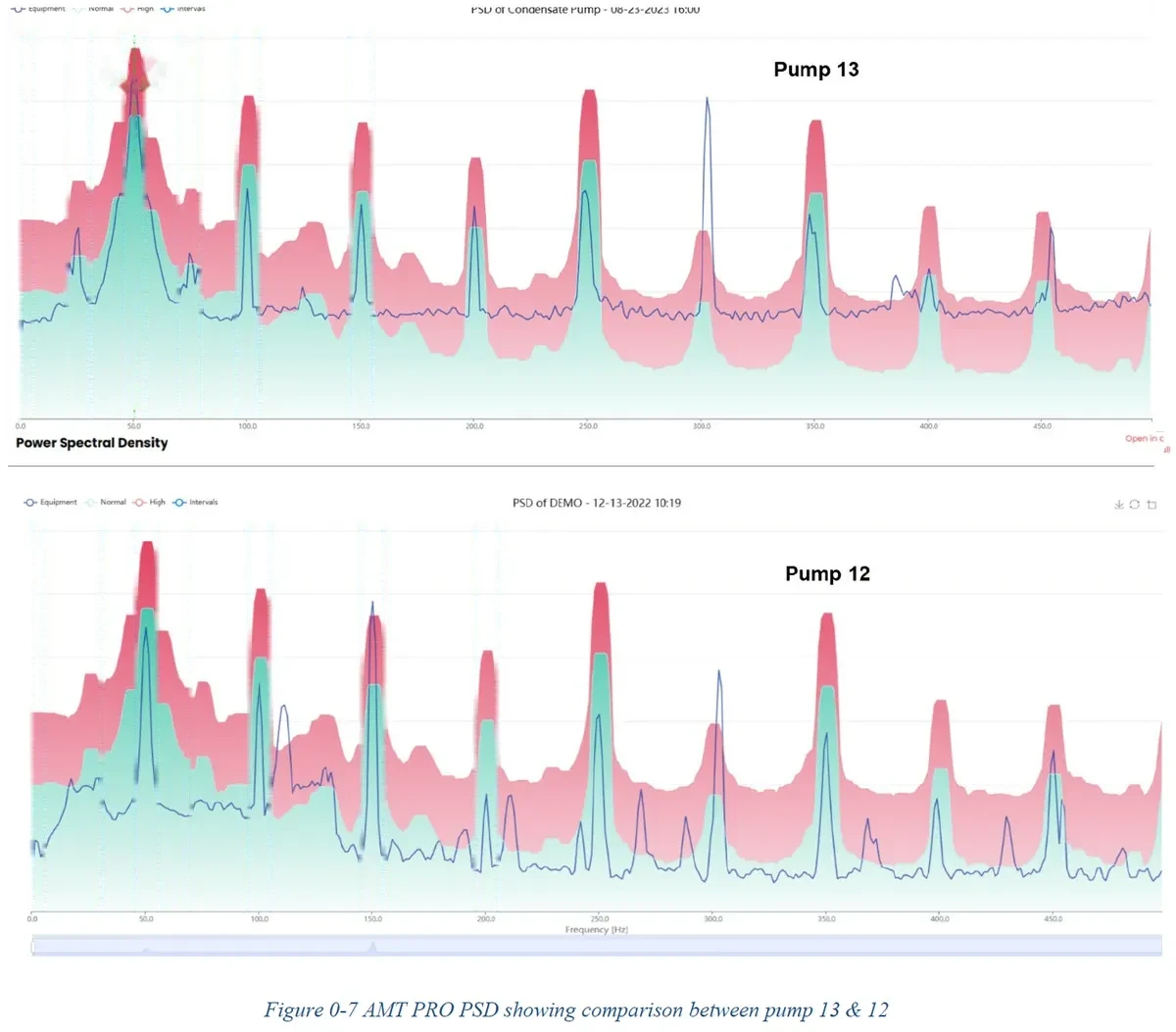
Top: Pump 13, with a rotor-related pattern. Bottom: identical Pump 12, without it. Select to open full size.
3×
Repeated test, consistent result
A dedicated rotor evaluation test was run three times on Pump 13; the rotor-bar indicator stayed at alarm level each time.
A rotor fault, isolated by comparison.
11 kVNominal voltage
32 ANominal current
510 kWMotor rating
The findingOnline monitoring flagged a spectral pattern on Pump 13 associated with rotor bar defects.
The cross-checkPump 12 is identical in every respect and runs the same duty. Its spectrum showed no such pattern, ruling out supply or process effects.
The confirmationAn offline rotor evaluation test indicated cracked or defective rotor bars. The test was repeated three times with consistent results.
- 1Online alert on Pump 13
- 2Twin comparison with Pump 12
- 3Offline rotor test, repeated 3×
Source: Artesis Case Study 2024, slides 81–87. Customer name withheld.
03 / More field cases
From cavitation
to bearing faults.
5 INDUSTRIES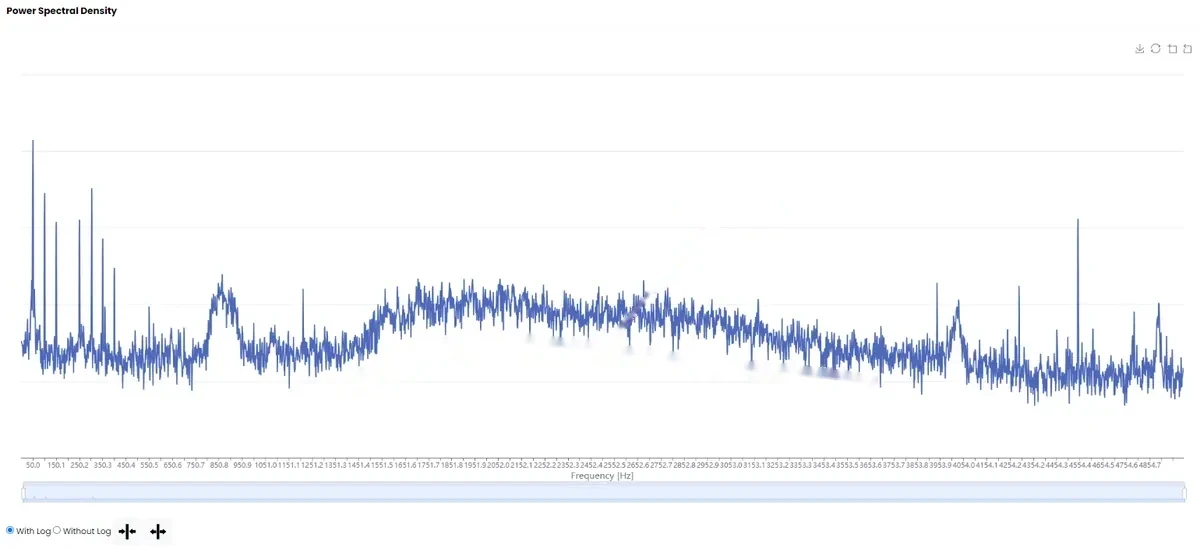
Cavitation on a 6.6 kV pump
The high-frequency spectrum showed the typical signature of cavitation. The customer’s vibration check on the pump side agreed.
- Rating
- 6,600 V · 81.5 A
- Outcome
- Cavitation confirmed on site
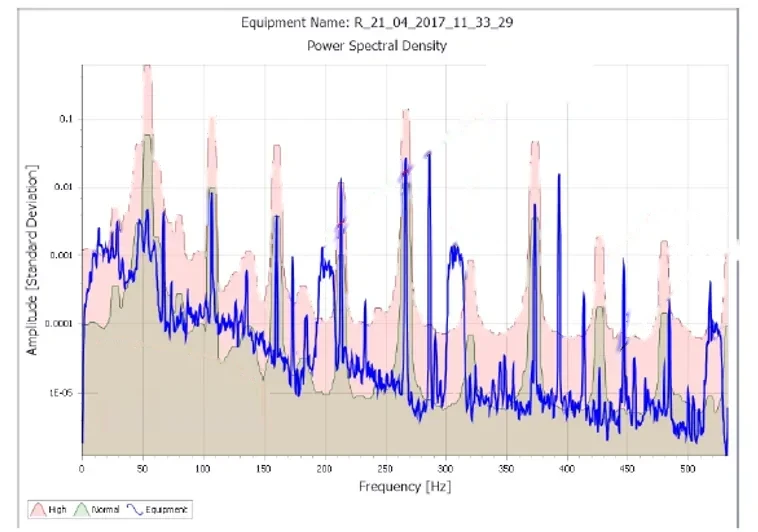
Three faults on one cooling pump
Bearing-related components rose above the learned envelope and the spectrum also pointed to flow turbulence. Teardown found a worn bearing, broken coupling rubber and cavitation dents on the vane.
- Rating
- 480 V · 130.7 A · VFD
- Outcome
- All three found at teardown
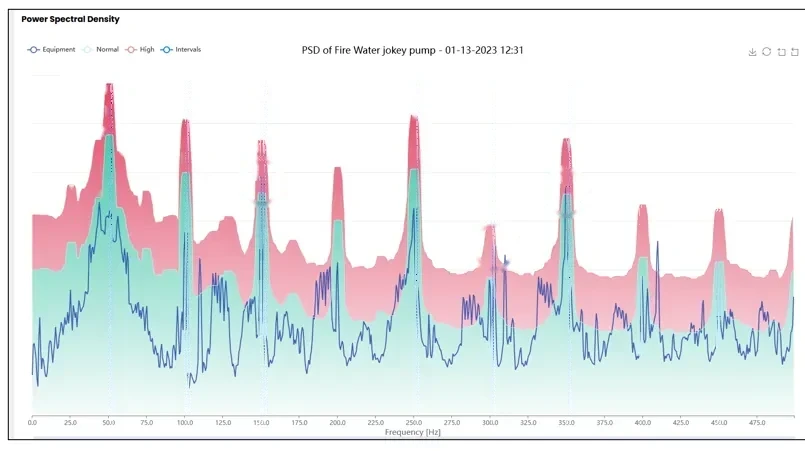
Bearing fault on a fire water jockey pump
The automatic bearing analysis, based on the bearing model, matched the observed spectrum and pointed to an outer-race fault.
- Rating
- 415 V · 75 A
- Method
- Automatic bearing analysis
Checking the repair, not just the fault
On a diesel fuel pump, spectrum trends were followed through several shaft adjustments until the alignment was confirmed as correct.
Monitoring beyond the CM programme
On two seawater pumps aboard an LNG carrier, monitoring pointed to rub, misalignment and impeller issues. Repair returned the pumps to normal efficiency.
Cases are individual outcomes from Artesis field deployments between 2005 and 2024. All visuals are from Artesis software. Customer names are withheld.
04 / What we detect
Fault modes, signals
and evidence strength.
Evidence strength reflects how reliably a condition produces an observable electrical pattern in typical pump installations — not a guarantee of detection.
| Condition | What changes in the signal | Evidence | Field case |
|---|---|---|---|
| Motor · electrical | |||
| Broken or cracked rotor bars | Rotor-related pattern in the current spectrum | Strong | 11 kV condensate pump → |
| Stator winding and insulation | Internal electrical fault indicator and phase balance | Strong | — |
| Supply and connection issues | Voltage imbalance, harmonics, RMS deviation per phase | Strong | — |
| Drive train · mechanical | |||
| Bearing wear | Bearing-related pattern in the current spectrum | Good | Jockey pump, cooling pump |
| Misalignment and coupling | Coupling and alignment-related pattern | Good | Cooling pump, fuel pump |
| Unbalance and looseness | Unbalance and looseness-related patterns | Good | — |
| Pump · hydraulic and process | |||
| Cavitation | Characteristic hydraulic pattern in the spectrum | Good | 6.6 kV pump |
| Flow turbulence, impeller damage | Flow-related pattern in the spectrum | Good | Cooling pump |
| Dry running, blockage, operating point drift | Load level and stability versus learned baseline | Good | — |
| Early seal wear | Only visible once leakage changes the load | Limited | — |
05 / Outside the envelope
Where electrical signatures are weaker.
We state the limits up front, so monitoring is set up where it adds most and paired with the right complementary checks.
Very low speed
Below about 20 Hz on a VFD, or on slow-running pump bearings, signatures can fall under reliable thresholds.
Early seal wear
Seal degradation without a measurable load change leaves little electrical trace. Use process instrumentation or visual checks.
Slow erosion and corrosion
Gradual material loss without hydraulic impact may not be observable until it affects performance.
Detailed bearing grading
For fine bearing assessment, a portable vibration check adds sensitivity — without permanent sensors.
Observed patterns are interpreted by qualified personnel; they guide investigation rather than replace it. AMTPro spot tests need near-constant speed (±1% frequency) during capture.
06 / How you deploy it
Continuous where it matters.
Portable everywhere else.
Online · permanently installed
e-MCM
- Critical and hard-to-reach pumps
- 24/7 learning, trending and alarms
- Supports VFD applications
- Results in OmniSight across sites
Portable · route-based
AMTPro
- Balance-of-plant and spare pumps
- Spot tests from the MCC in minutes
- Automatic condition report per test
- Energy impact estimate in every report
Artesis Insight explains the finding.
Artesis Insight turns spectra and trends into plain-language explanations and next steps. Your team does not need to be an ESA specialist to act on a result.
Illustrative maintenance guidance
Inspect for cavitation.
A cavitation signature in the spectrum suggests cavitation. Check suction pressure, NPSH margin and strainer condition, and compare with the pump’s operating point.
After action
Compare the trend under similar flow and load, and confirm with a vibration measurement if needed.
Example wording only; not a live alarm or a reproduced AI report.
07 / Applications
Across your pump fleet.
Cooling water pumpsCondensate extraction pumpsBoiler feed water pumpsProcess and transfer pumpsChilled water pumpsFire water and jockey pumpsSeawater lift pumpsTreated water pumps
Do I need sensors on the pump?
No. Artesis measures three-phase current and voltage in the motor control cabinet. Nothing is mounted on the pump, motor or pipework.
Can pumps on variable frequency drives be monitored?
Yes. e-MCM supports VFD applications. The initial baseline is best established at a fixed speed for about five hours before multi-speed learning is added. Diagnostic confidence is reduced below roughly 20 Hz.
Can medium-voltage pumps be monitored?
Yes. The cases on this page include pumps at 6.6 kV and 11 kV, measured through the existing CT and PT secondaries.
Does this replace vibration analysis?
It complements it. ESA gives a continuous, global view of motor and pump health from the panel. Portable vibration testing remains useful to confirm specific bearing or hydraulic findings.
What information is needed to start?
Motor nameplate data, pump type, typical operating current, the starter or drive arrangement and the available measurement points in the cabinet.
Related assets
Other equipment we monitor.
Bring your critical pumps into view.
Tell us about your pumps and drives. We’ll suggest where online monitoring pays off and where portable testing is enough.









 White Papers
 Case Study
 Documents
 Webinars
 Events
 ROI Calculator
 FAQ
FAQ