
10×Cost of a bearing failure vs a timely repair, lift station case
Asset monitoring / Submersible & borehole pumps
Know what’s failing underwater.
Without going underwater.
Submersible and borehole pumps can’t carry vibration sensors or be inspected while running. Artesis reads their condition from the motor control cabinet on the surface — the only practical continuous view of these assets.
14,000×Rise in the rotor parameter after a seeded fault
0 sensors down the wellCurrent and voltage measured at the surface
01 / The challenge
Out of sight.
Out of reach.
Borehole, wet well and lift station pumps work tens or hundreds of metres down. Pulling one for inspection means a crane, a crew and downtime — so most run until they fail.
The motor sits right next to the pump, and its supply cable runs to the surface. Every change in impeller, bearing or coupling condition travels up that cable as a change in current. Artesis reads it at the MCC.
Connect at the surface
e-MCM uses the current and voltage in the motor control cabinet. Nothing is installed down the well.
Learn normal operation
Baselines reflect the pump’s real head and flow, so hydraulic and mechanical changes stand out.
Pull the pump only when needed
Findings indicate whether the problem is electrical, mechanical or hydraulic — and when to act.
02 / Featured case · Water utility · Lift stations
Two lift station pumps.
Bearings watched from the panel.
DOCUMENTED FIELD CASELIFT STATION 12 / 130 HP PUMP · e-MCM BEARING TREND
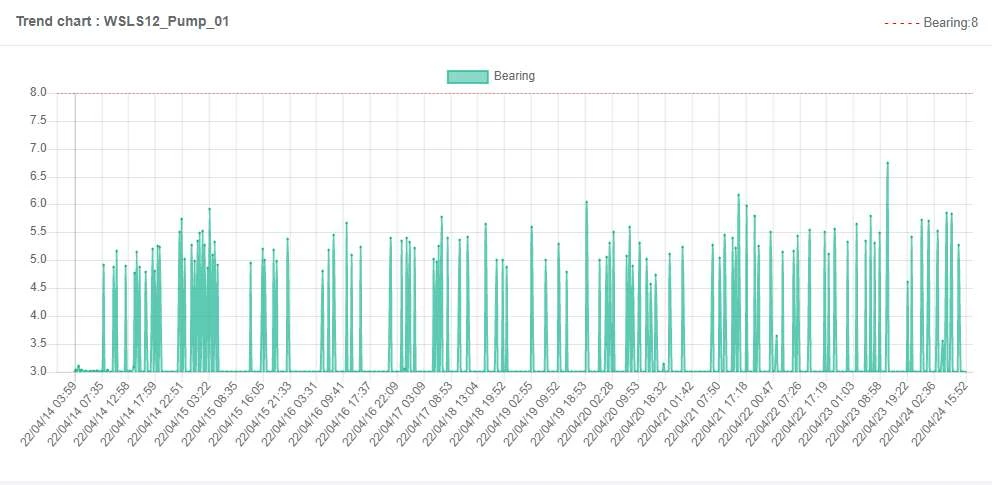
Bearing indicator over ten days in April 2022, below the warning line (red dashed).
LIFT STATION 52 / 45 HP PUMP · e-MCM BEARING TREND
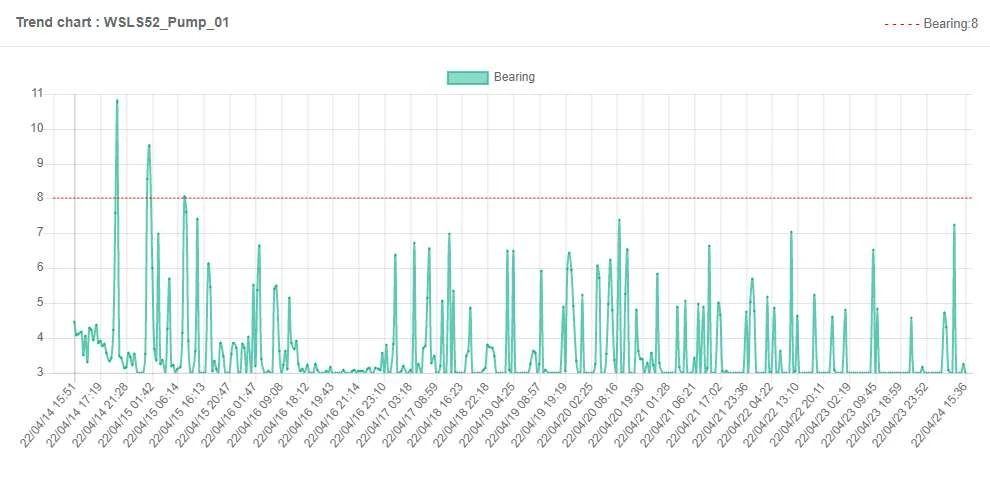
Mostly below the warning line after a few short peaks early in the period. Select to open full size.
10×
The cost of waiting
On the 130 HP pump, a bearing failure means a repair of about $60,000 — half the price of a new pump. Replacing bearings and seals in time costs about $6,000.
Continuous bearing trends on pumps no one can see.
130 HPLift station 12
45 HPLift station 52
≈ $6kTimely bearing + seal job
The situationAt a US water utility, submersible lift station pumps had doubled in price in three years: a similar 130 HP pump was now quoted at about $120,000.
The setupe-MCM units in the motor control panels trend each pump’s bearing condition continuously against a warning line. Nothing is installed in the wet well.
The valueThe operator follows the trend over time and can replace bearings and seals before a failure — about $6,000 instead of a $60,000 repair on the larger pump, and $5,000 instead of $50,000 on the smaller one.
- 1Continuous bearing trend
- 2Warning line per pump
- 3Planned bearing + seal job
Source: Artesis e-MCM user presentation by the utility’s operations contractor, 2022 (trend data April 2022). Customer names withheld.
03 / More field cases
A borehole prediction
and seeded faults.
FIELD + TEST LOOP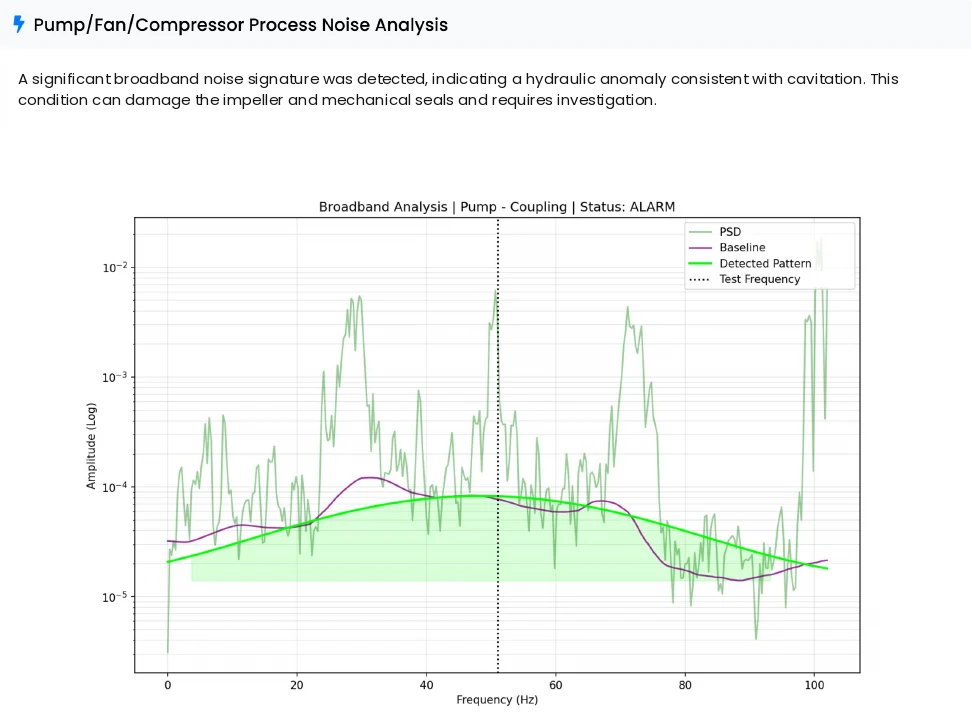
Today’s AI report view: a hydraulic anomaly flagged from broadband noise. Example from another pump.
A borehole failure, predicted to within days
In an 18-month pilot on six pumps, Artesis flagged both borehole pumps and later advised replacing one for an impeller-related problem. Left to run as a test, it failed within a couple of days of the predicted date.
- Pilot
- 6 pumps · 18 months
- Outcome
- Failed within days of prediction
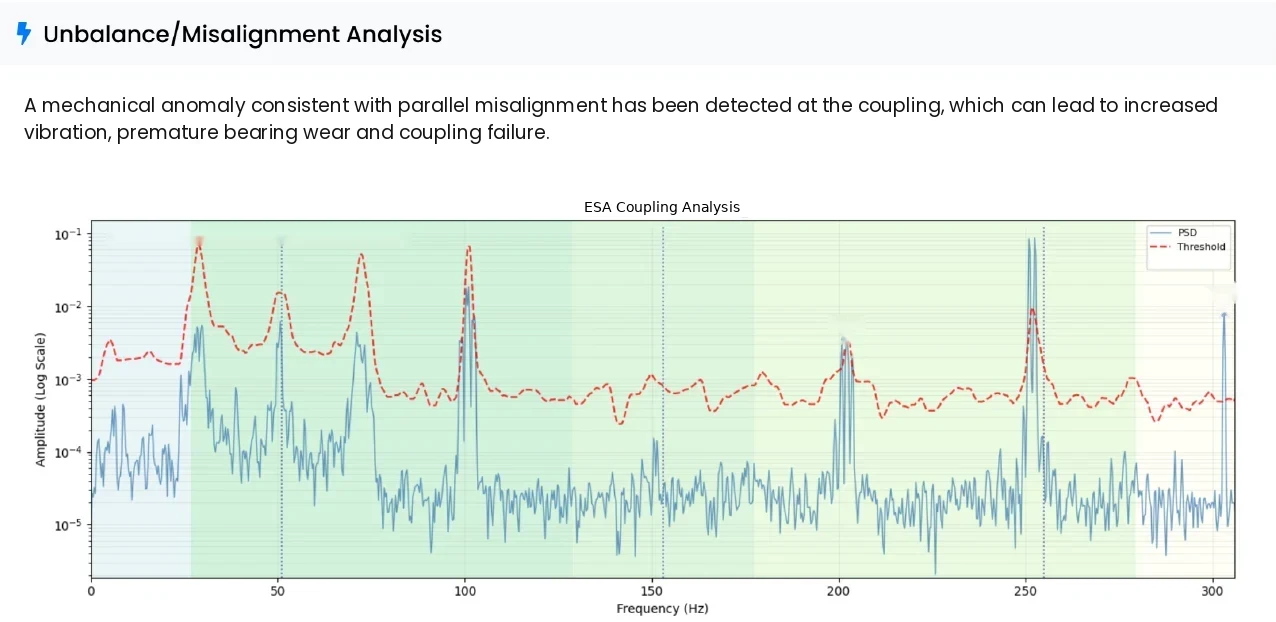
Today’s AI report view: coupling misalignment found automatically. Example from another pump.
A known bad coupling
The pump was trained at two duty points, then restarted with a known bad coupling. The transmission parameter rose about 5,000-fold and an Examine 1 alert followed within an hour — while a vibrometer on the pipe flange read only 4 mm/s.
- Duty
- 80–88 m head, 175–193 m³/h
- Outcome
- Examine 1 alert
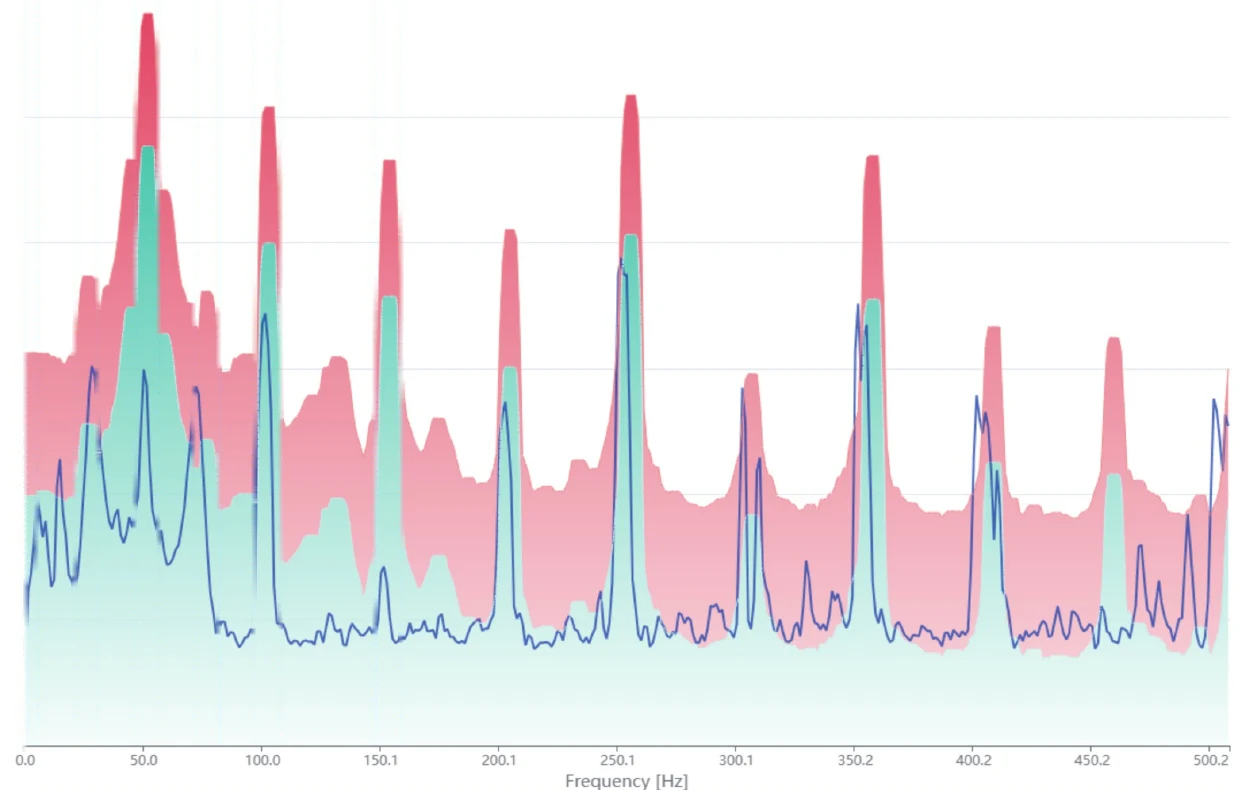
Today’s AMTPro PSD: the spectrum is judged against learned normal and high envelopes. Example from another pump.
Missing wear ring and bearing
With a good coupling but the wear ring and bearing removed from one stage, head at the same flow dropped from 88 m to 83 m. The transmission parameter rose about 5,500-fold, the rotor parameter about 14,000-fold and the rub parameter about 150-fold against the known good condition.
- Rotor parameter
- ≈14,000× baseline
- Rub parameter
- ≈150× baseline
Faults you can’t inspect, made visible
Seeded faults on an instrumented loop show which internal pump faults produce a clear electrical signature — before relying on it in a well.
Lift station case from 2022; borehole case from 2008–2009; test loop results from July 2010. Card visuals are current Artesis report views from other pumps. Customer names are withheld.
04 / What we detect
Fault modes, signals
and evidence strength.
Evidence strength reflects how reliably a condition produces an observable electrical pattern in typical submersible pump installations — not a guarantee of detection.
| Condition | What changes in the signal | Evidence | Field case |
|---|---|---|---|
| Pump · hydraulic | |||
| Impeller wear or damage | Driven-equipment (vane) indicator | Good | Borehole pump |
| Wear ring loss, internal rub | Rub and rotor parameters; head drop at same flow | Good | Test loop |
| Blockage, dry running | Load level versus learned baseline | Good | — |
| Drive train · mechanical | |||
| Coupling faults | Transmission-element parameter | Good | Test loop |
| Bearing wear | Bearing indicator trend | Good | Lift stations → |
| Motor · electrical | |||
| Rotor bars | Rotor-related pattern in the current spectrum | Strong | — |
| Stator and insulation | Current imbalance well above voltage imbalance | Strong | — |
| Cable and supply issues | Per-phase RMS, voltage imbalance, harmonics | Strong | — |
05 / Outside the envelope
Where electrical signatures are weaker.
We state the limits up front, so monitoring is set up where it adds most and paired with the right complementary checks.
Very long cables
Long drop cables damp high-frequency components; baselines are set per installation.
Early seal wear
Seal degradation without a load change leaves little electrical trace.
Slow erosion and corrosion
Gradual material loss may not be visible until it affects performance.
Very low VFD speed
Below about 20 Hz, confidence is reduced.
Observed patterns are interpreted by qualified personnel; they guide investigation rather than replace it. AMTPro spot tests need near-constant speed (±1% frequency) during capture.
06 / How you deploy it
Continuous where it matters.
Portable everywhere else.
Online · permanently installed
e-MCM
- Borehole and lift station duty pumps
- 24/7 learning, trending and alarms
- Supports VFD applications
- Results in OmniSight across sites
Portable · route-based
AMTPro
- Standby pumps and screening before pulling
- Spot tests from the MCC in minutes
- Automatic condition report per test
- Energy impact estimate in every report
Artesis Insight explains the finding.
Artesis Insight turns spectra and trends into plain-language explanations and next steps. Your team does not need to be an ESA specialist to act on a result.
Illustrative maintenance guidance
Investigate the impeller.
A rising vane / driven-equipment indicator with a change in load suggests impeller wear or damage. Plan a pull at the next suitable window.
After action
After refurbishment, confirm the trend returns to its learned level at the same duty point.
Example wording only; not a live alarm or a reproduced AI report.
07 / Applications
Wherever the pump is out of reach.
Borehole and deep well pumpsWet well and lift station pumpsSewage and stormwater pumpsDewatering pumpsSeawater lift pumpsIrrigation pumps
Do I need to pull the pump to install monitoring?
No. Everything is installed in the motor control cabinet at the surface.
Does a long cable affect the measurement?
Long cables damp some high-frequency content. Each installation gets its own baseline, so changes are judged against that pump’s own normal.
Can pumps on VFDs be monitored?
Yes. e-MCM supports VFD applications. The baseline is best established at a fixed speed first; confidence is reduced below roughly 20 Hz.
Can you tell hydraulic from mechanical problems?
Findings are classified by domain — e.g. vane / driven equipment, transmission, bearing, rotor — as the test loop shows.
What information is needed to start?
Motor nameplate data, pump type and setting depth, cable length, typical current, starter or drive type and the MCC measurement points.
Related assets
Other equipment we monitor.
Bring your submersible pumps into view.
Tell us about your wells and lift stations. We’ll help you decide which pumps to monitor online.









 White Papers
 Case Study
 Documents
 Webinars
 Events
 ROI Calculator
 FAQ
FAQ