
2× over limitBearing wear confirmed at teardown in the featured chiller case
Asset monitoring / AHU & HVAC
Comfort, clean rooms, cooling.
All visible from the MCC.
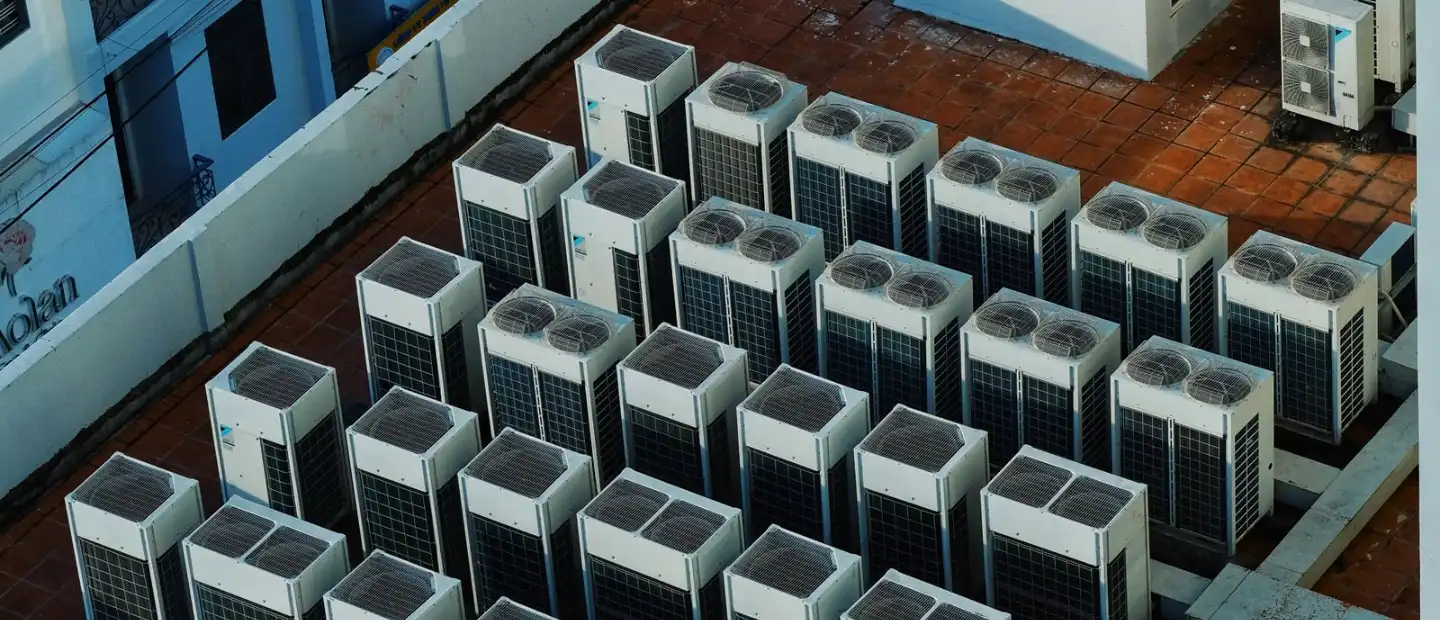
AHUs, chillers and exhaust fans sit in plant rooms, ceilings and rooftops. Artesis follows their motors, belts, bearings and even filter condition from the electrical panel — without climbing into the ductwork.
6 field casesCoatings, glass, water and campus sites
0 sensors in the ductsCurrent and voltage measured in the MCC
01 / The challenge
Many machines.
Little attention.
Buildings, labs, clean rooms and process plants run dozens of AHUs, supply and exhaust fans and chillers. They are rarely critical one by one — until a chiller fails in summer or a clean room loses pressure.
Vibration routes rarely cover them, and belts, filters and bearings wear out of sight. ESA sees mechanical faults and process changes such as filter clogging in the same motor current.
Connect at the motor control cabinet
e-MCM or AMTPro uses the existing current and voltage signals. No access to ceilings, ducts or rooftops is needed.
Learn each unit’s normal load
Baselines reflect each unit’s real airflow, so load drops from clogged filters stand out.
Maintain by condition
Change belts, filters and bearings when the data says so, not by the calendar.
02 / Featured case · Coatings manufacturing
A vague vibration alarm.
A precise chiller diagnosis.
DOCUMENTED FIELD CASECHILLER 1 / HIGH-RESOLUTION POWER SPECTRAL DENSITY
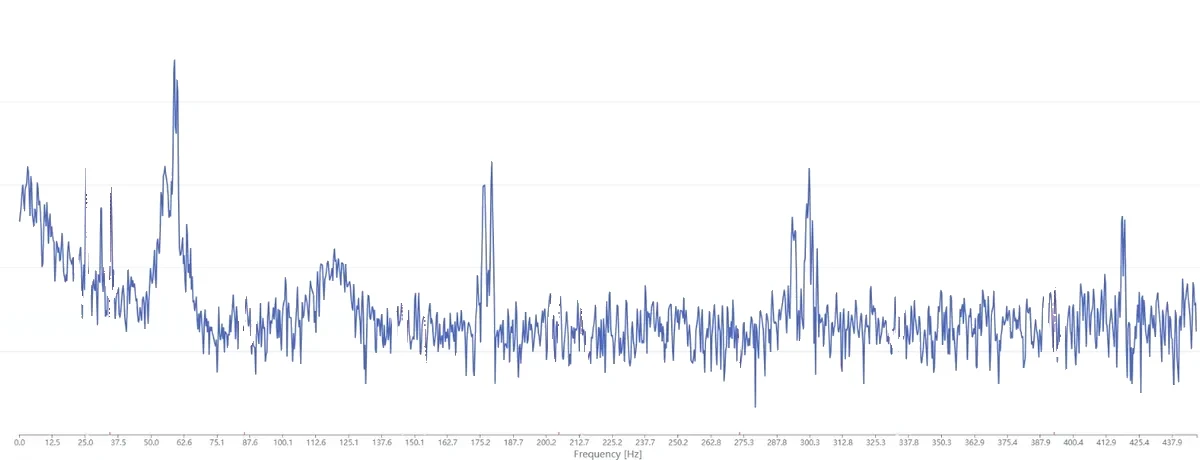
Sleeve bearing indicators in the high-resolution spectrum. Select to open full size.
2×+
Wear beyond the maximum allowed
The input-gearbox sleeve bearing measured 0.058 in against a 0.013–0.026 in specification.
0.058 inMeasured bearing wear
0.026 inMaximum allowed
278,061kWh / year energy effect
From “take it out of service” to a targeted repair.
2025Case year
13,427 rpmGearbox output speed
AMTProPortable test
The challengeA critical chiller failed a routine vibration check, with a recommendation to take it out of service immediately — but no fault location, an incorrect nameplate and the cooling season ahead.
The analysisAn AMTPro test found sleeve bearing indicators in the gearbox, plus looseness, gearbox misalignment and a 5.3% current imbalance.
The confirmationThe chiller was opened with a clear target. The input-gearbox sleeve bearing was worn to more than twice the maximum allowed and was replaced before the season.
- 1Vague vibration alarm
- 2AMTPro pinpoints gearbox sleeve bearing
- 3Teardown confirms, bearing replaced
Source: Artesis AMTPro sleeve bearing case study, May 2025. Customer names withheld.
03 / More field cases
Filters, belts, alignment
and power quality.
4 INDUSTRIES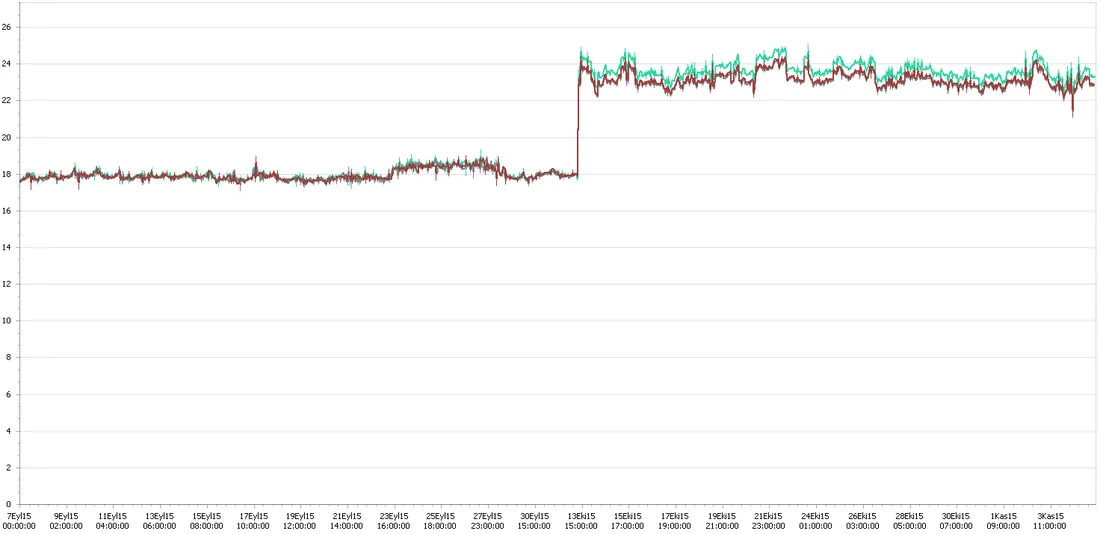
Clogged filters, seen in the current
As an aspirator’s filters clogged, its current fell below the learned level; after the filters were renewed it stepped back up (shown). On another AHU, dirty filters cut current to about 45% below nominal until they were changed.
- Signal
- Load current vs baseline
- Outcome
- Filters changed by condition
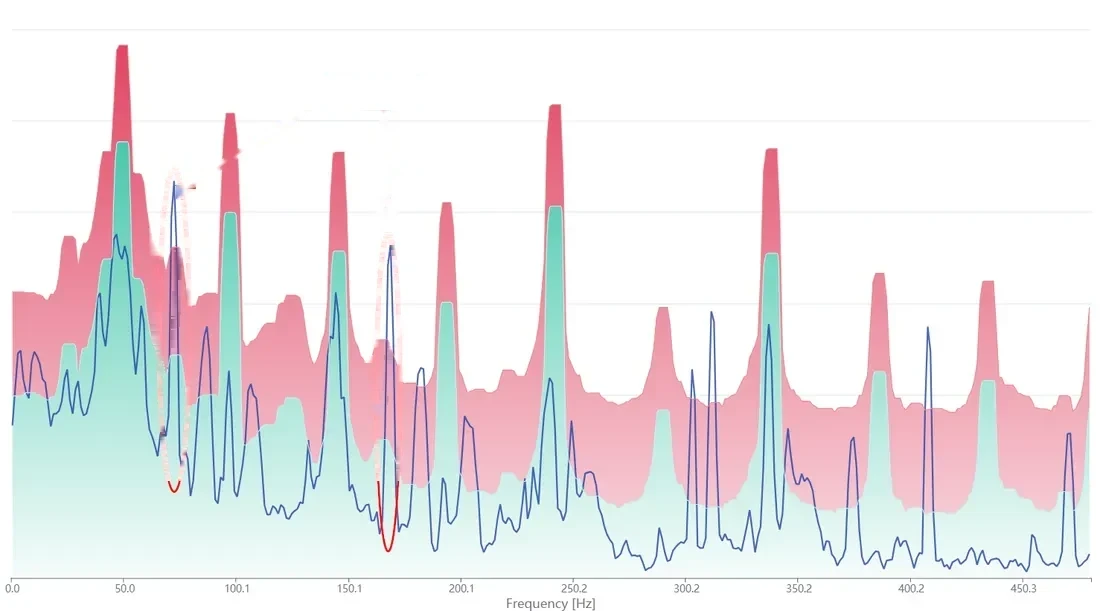
Angular misalignment on an AHU fan
The spectrum pattern pointed to angular misalignment between motor and fan.
- Rating
- 460 V · 46 A
- Outcome
- Misalignment flagged
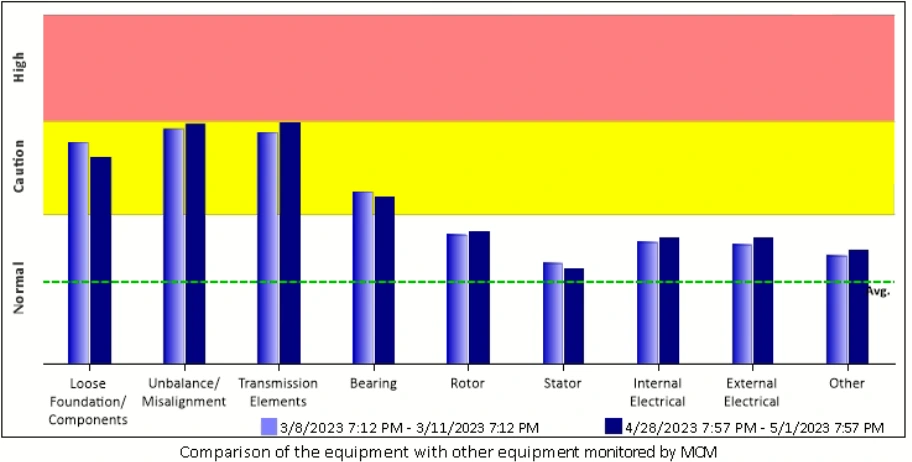
Belt wear and pulley misalignment
Loose foundation, unbalance/misalignment and transmission indicators rose into caution, pointing to belt wear and looseness, fan pulley misalignment and a loose base.
- Rating
- 415 V · 10.6 A
- Outcome
- Belt, pulley and base flagged
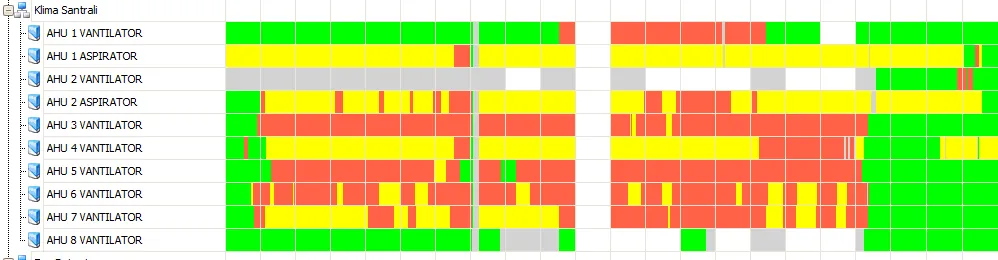
Every AHU alarmed at once
All AHUs raised electrical alarms in the same weeks. The cause was upstream: UPS units for a furnace had been connected to the transformer feeding the AHUs, adding harmonics.
- Signal
- Electrical parameters, all units
- Outcome
- Supply problem traced
Bearing noise, confirmed and planned
On three clean room fans, rising bearing parameters triggered alarms. Maintenance confirmed bearing noise each time and swapped in spares at planned stops.
Belt tension, by condition
A transmission alarm led to loose belts. After re-tensioning, the parameter dropped back below its alarm level.
Cases are individual outcomes from Artesis field deployments between 2015 and 2025. All visuals are from Artesis software. Customer names are withheld.
04 / What we detect
Fault modes, signals
and evidence strength.
Evidence strength reflects how reliably a condition produces an observable electrical pattern in typical HVAC installations — not a guarantee of detection.
| Condition | What changes in the signal | Evidence | Field case |
|---|---|---|---|
| Drive train · mechanical | |||
| Bearing wear, incl. sleeve bearings | Bearing-related pattern in the current spectrum | Good | Chiller gearbox → |
| Belt wear and slip | Belt-related pattern | Good | Campus fan, aspirator |
| Misalignment and pulley alignment | Alignment-related pattern | Good | AHU fan, campus fan |
| Looseness and base | Looseness-related pattern | Good | Chiller, campus fan |
| Motor · electrical | |||
| Rotor bars | Rotor-related pattern in the current spectrum | Strong | — |
| Stator and insulation | Current imbalance well above voltage imbalance | Strong | — |
| Harmonics and supply quality | THD, harmonic levels, voltage imbalance | Strong | AHU group |
| Process · airflow | |||
| Filter clogging | Load current drop versus learned baseline | Good | AHU aspirators |
| Damper or airflow change | Load level and stability | Good | — |
05 / Outside the envelope
Where electrical signatures are weaker.
We state the limits up front, so monitoring is set up where it adds most and paired with the right complementary checks.
Small motors
Very small fan motors give weaker signals; group them for AMTPro routes instead.
Coil and duct problems
Fouled coils or duct leaks are only visible if they change fan load.
Very low VFD speed
Below about 20 Hz, confidence is reduced.
Refrigerant circuit
Refrigerant charge and leaks are outside ESA’s view; use the chiller controls.
Observed patterns are interpreted by qualified personnel; they guide investigation rather than replace it. AMTPro spot tests need near-constant speed (±1% frequency) during capture.
06 / How you deploy it
Continuous where it matters.
Portable everywhere else.
Online · permanently installed
e-MCM
- Chillers and critical clean room AHUs
- 24/7 learning, trending and alarms
- Supports VFD applications
- Results in OmniSight across sites
Portable · route-based
AMTPro
- Routes across building AHUs and fans
- Spot tests from the MCC in minutes
- Automatic condition report per test
- Energy impact estimate in every report
Artesis Insight explains the finding.
Artesis Insight turns spectra and trends into plain-language explanations and next steps. Your team does not need to be an ESA specialist to act on a result.
Illustrative maintenance guidance
Check AHU filters.
Load current well below the learned level suggests restricted airflow. Check filter condition and damper positions.
After action
Confirm the current returns to its learned level after the change.
Example wording only; not a live alarm or a reproduced AI report.
07 / Applications
Across your HVAC plant.
Air handling unitsChillers (centrifugal and screw)Clean room supply and exhaust fansKitchen and lab exhaust fansRooftop unitsAspirators and ventilators
Can you really see filter clogging?
Yes. A clogged filter reduces airflow and therefore motor load. Artesis sees the current fall against the learned baseline, as the glass plant AHUs show.
Is it worth monitoring small HVAC motors?
For critical units yes; for large fleets of small units, portable AMTPro routes are usually the better fit.
Can chillers be monitored?
Yes. The featured case diagnosed a gearbox sleeve bearing in a chiller that a vibration check had flagged only vaguely.
Does it work on VFD-driven fans?
Yes. e-MCM supports VFD applications and AMTPro tests at the running speed. Confidence is reduced below roughly 20 Hz.
What information is needed to start?
A list of units with motor nameplates, drive type (belt or direct), VFD or DOL starting and the MCC locations.
Related assets
Other equipment we monitor.
Bring your HVAC assets into view.
Tell us about your AHUs and chillers. We’ll suggest which to monitor online and which to route.










 White Papers
 Case Study
 Documents
 Webinars
 Events
 ROI Calculator
 FAQ
FAQ