
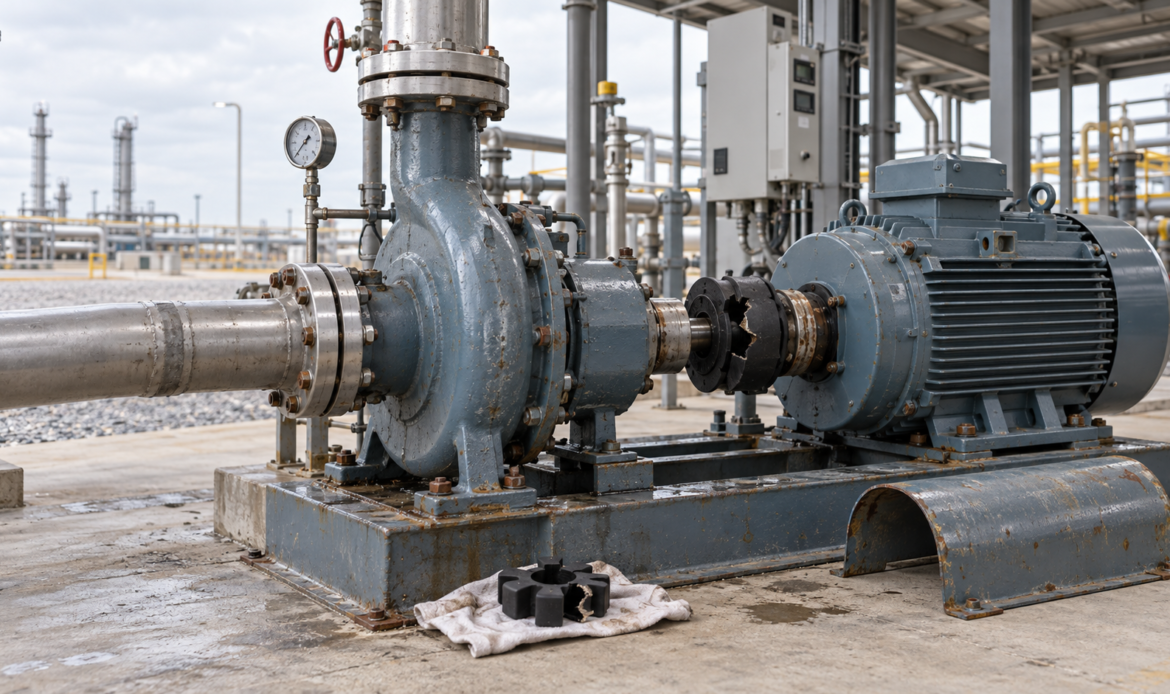
The process cooling pump at the oil & gas facility had a reputation: it “always sounded a bit rough”. It was driven by a 480 V motor through a VFD and connected directly to the pump. Because nothing had failed, the roughness had been accepted as normal.
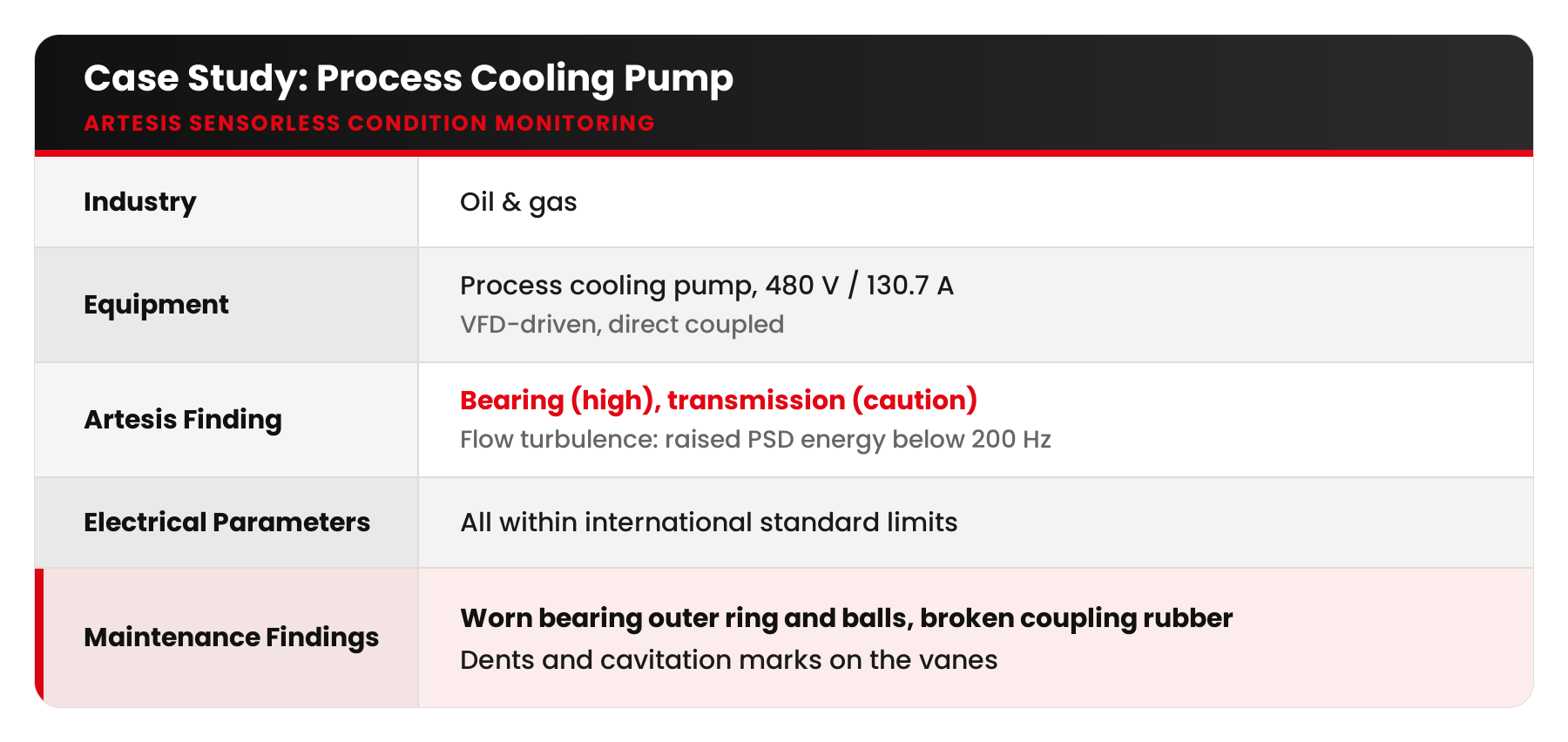
The Artesis AMT Pro report did not accept it. It rated bearing faults as high severity, meaning corrective action within three months, and transmission elements at caution level, action within six months. It also showed something easy to miss: raised PSD energy below 200 Hz, the typical sign of flow turbulence inside the pump.
What the maintenance team found
When the pump was opened, the report was confirmed point by point:
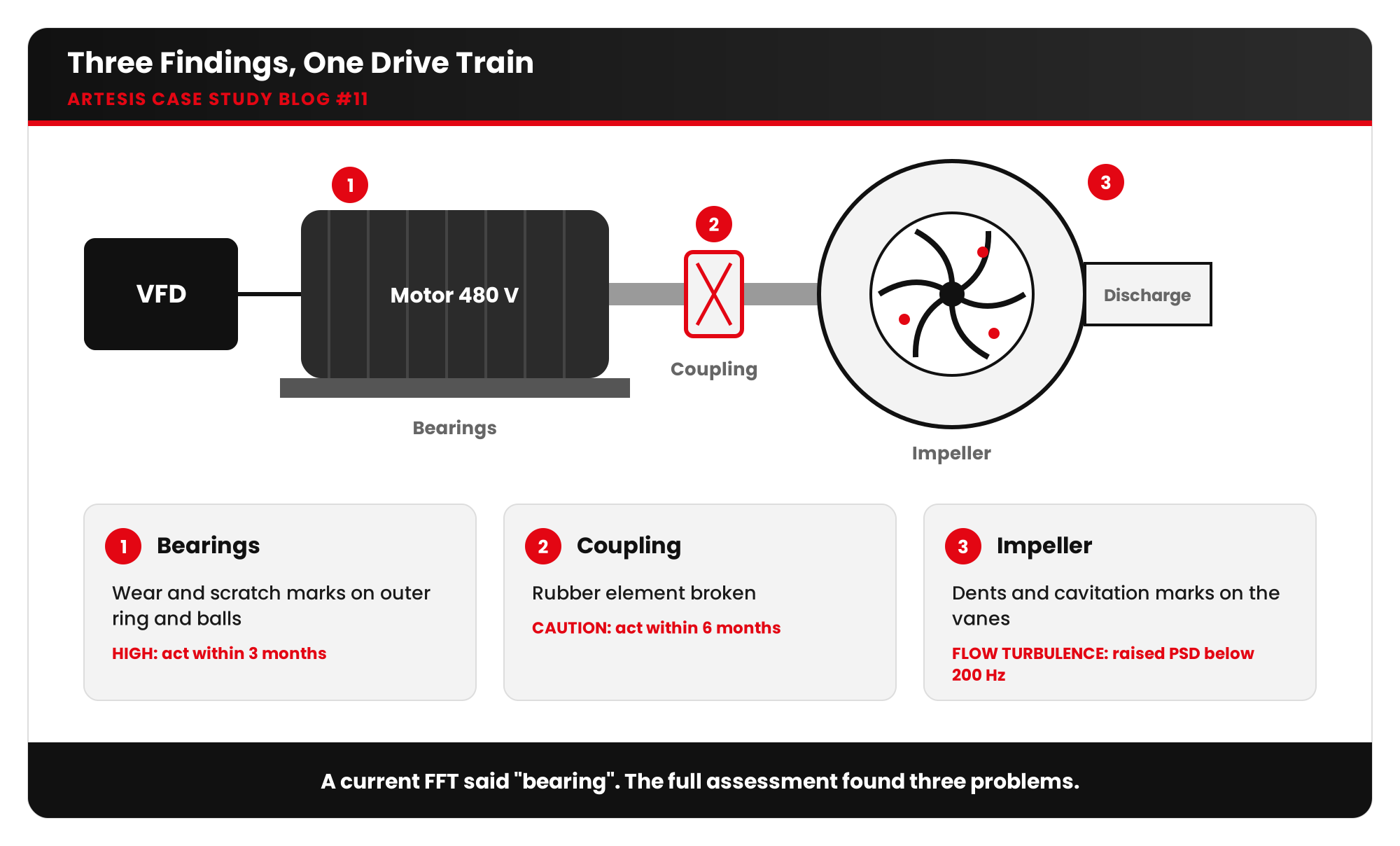
- Bearings: wear and scratch marks on the outer ring and the balls.
- Coupling: the rubber element was broken, explaining the transmission finding.
- Impeller: dents and cavitation marks on the vanes. This was the physical evidence of the flow turbulence the spectrum had shown.
The electrical parameters were all within limits, so the motor itself was not the problem. The problems were in the pump and the coupling.
The team also learned something useful. A third-party current FFT analysis had seen the bearing signature and declared “bearing problem”, nothing more. Replacing only the bearing would have left the broken coupling and the damaged vanes in place, and the new bearing would have been on borrowed time.
What flow turbulence is
In a well-designed, correctly operated pump or fan, flow moves smoothly through the impeller. Turbulence occurs when that flow becomes disorganised: it separates from the vanes, recirculates or swirls. The motor experiences this as a random, fluctuating load, which shows up as raised broadband energy in the lower part of the spectrum.
Causes of flow turbulence
In pumps
- Operation far from the best efficiency point (too little or too much flow)
- Suction recirculation and cavitation
- Damaged, eroded or deformed vanes
- Poor suction piping (elbows too close to the inlet, air entrainment)
In fans and blowers
- Two fans feeding the same duct and interacting
- Damper positions causing stall or surge
- Blocked filters or dirty coils changing the operating point
- Damaged or fouled blades
What turbulence leads to
- Fluctuating loads on bearings, couplings and seals
- Vane damage and erosion, especially when combined with cavitation
- Noise and vibration
- Lower efficiency: more energy for the same flow
- Unstable process conditions (pressure and flow swings)
Correlations to check
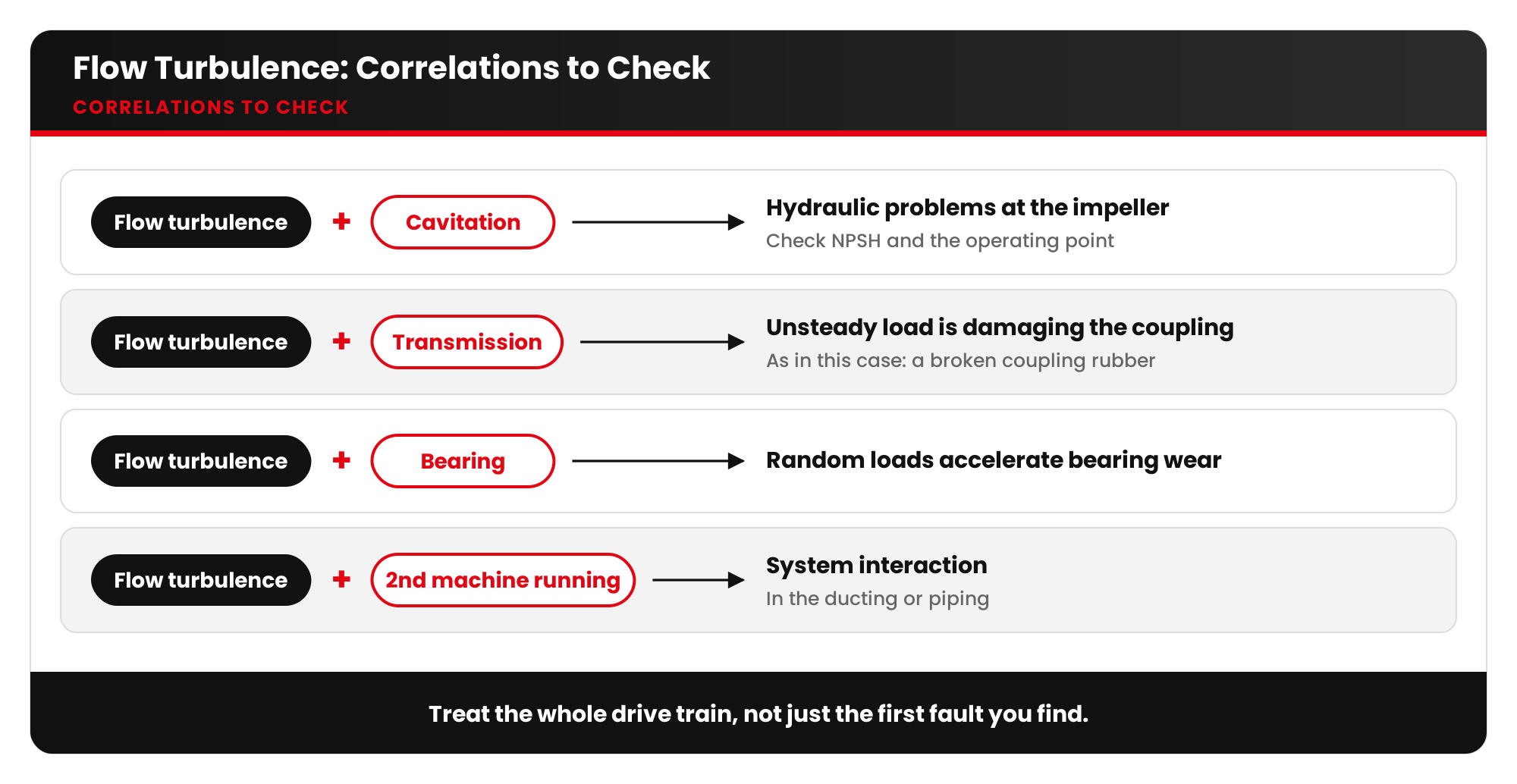
- Flow turbulence + cavitation: hydraulic problems at the impeller. Check NPSH and the operating point.
- Flow turbulence + transmission / coupling: the unsteady load is damaging the coupling, as happened here.
- Flow turbulence + bearing: random loads accelerate bearing wear.
- Turbulence only when another machine runs: system interaction in the ducting or piping.
Checklist
- Compare the operating point with the pump or fan curve.
- Review valve and damper positions and control strategy.
- Inspect impeller or blades for erosion, deformation and cavitation marks.
- Check couplings. Broken elastomers are a frequent hidden result of unsteady loads.
- After the repair, re-test. In this case, the first post-maintenance test showed the job was not yet complete and further work was needed.
Key takeaways
- A “rough-sounding” pump is telling you something. Measure it.
- Flow turbulence shows up in the motor current and is often linked to cavitation and vane damage.
- Treat the whole drive train, not just the first fault you find.
Want a full-train assessment of your critical pumps and fans? Ask Artesis about AMT Pro.






 White Papers
 Case Study
 Documents
 Webinars
 Events
 ROI Calculator
 FAQ