

When engineers select a motor, they often add a “safety margin”. A bit more power just in case, for future expansion, or to make sure it never trips. It seems sensible. But a motor chosen too large for its duty pays for that margin every hour it runs.
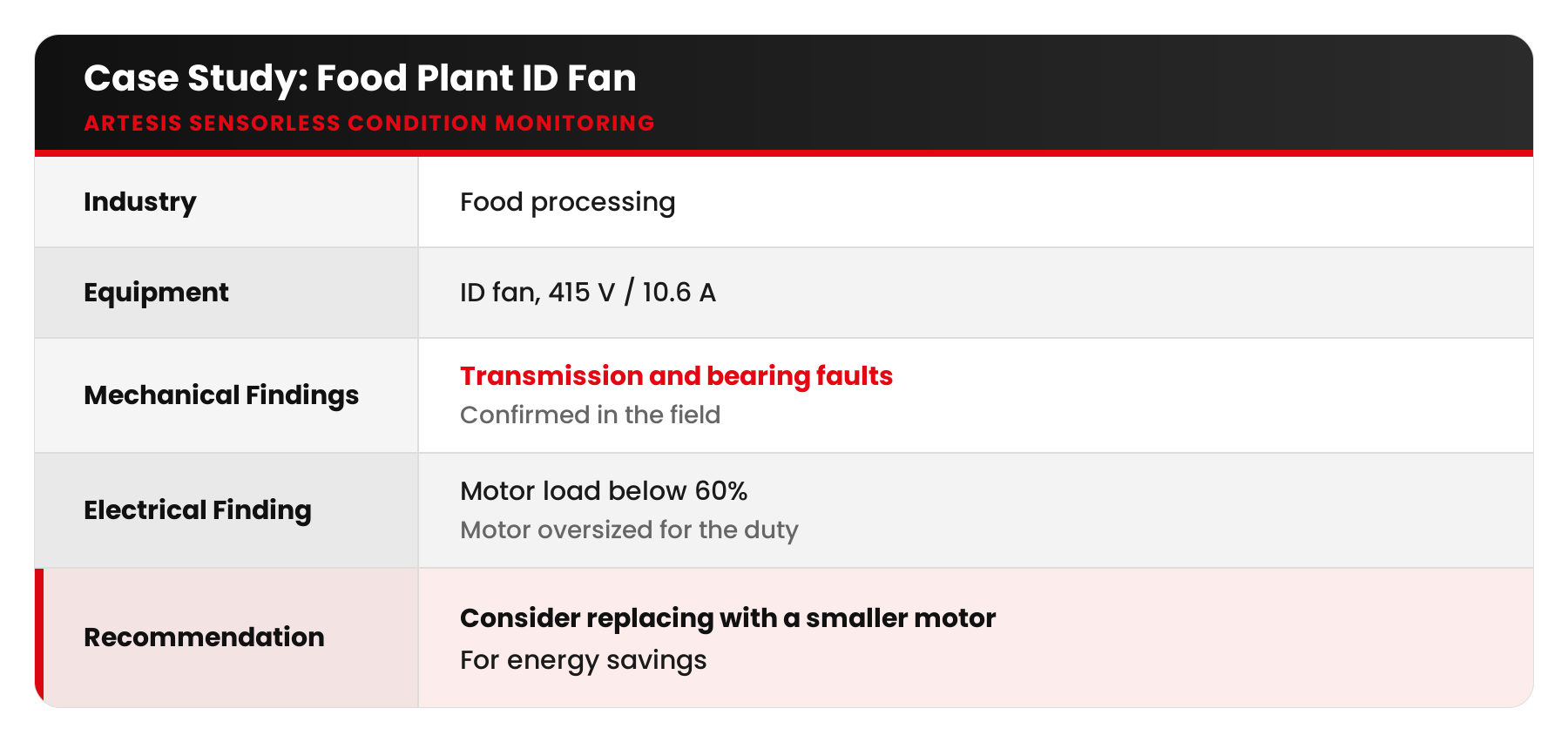
At a food processing plant, an induced draft (ID) fan driven by a 415 V, 10.6 A motor was tested with Artesis AMT Pro as part of a site survey. The mechanical findings came first: the PSD showed faults in the transmission and in the bearings, and the field inspection later confirmed them. The electrical parameters section added a second, quieter finding: the motor was running at less than 60% of its rated load.
Why “below 60%” matters
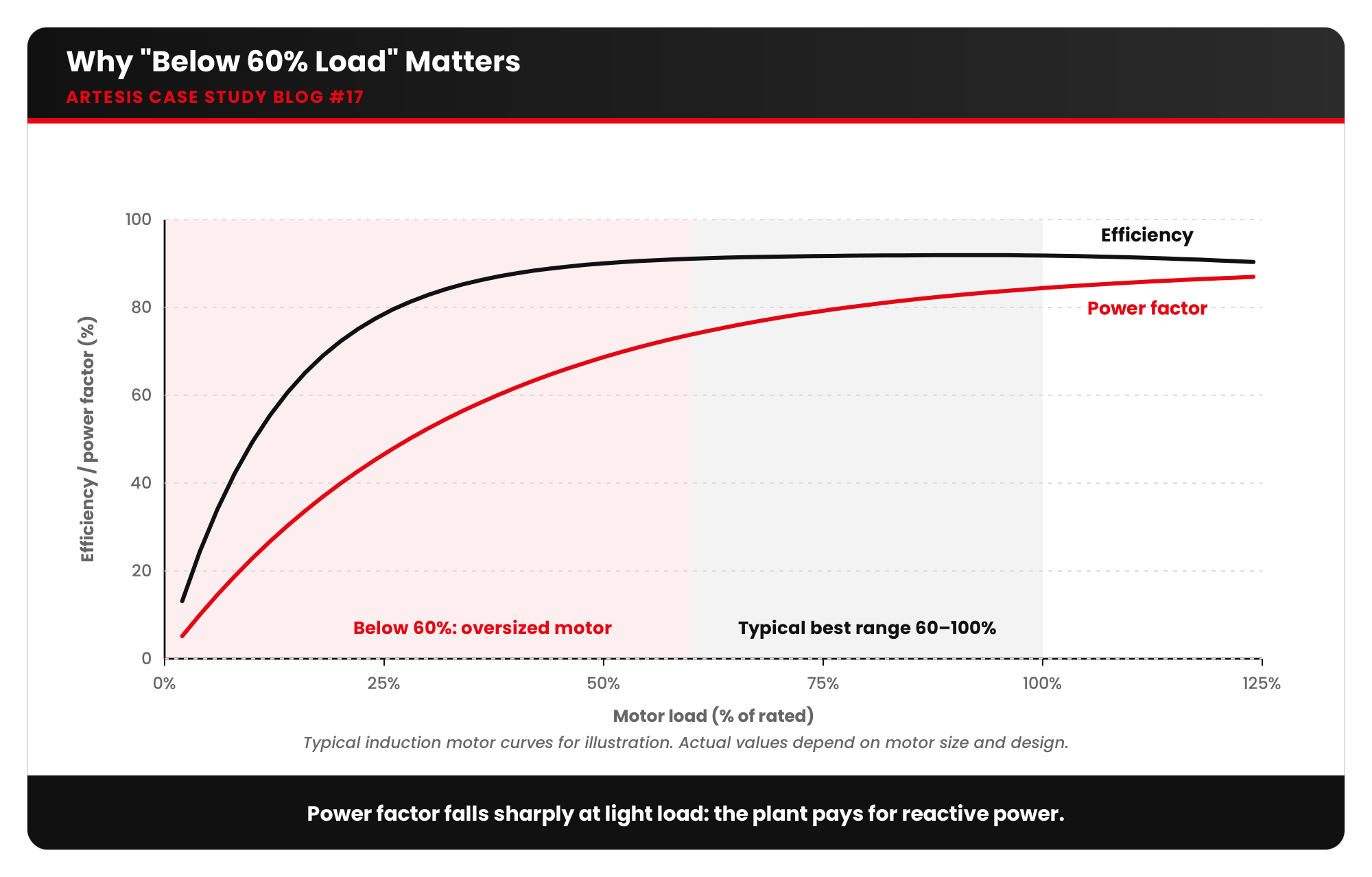
Induction motors are most efficient and have the best power factor near their rated load, typically in the 60–100% range. Below that:
- Efficiency falls, gently at first and then quickly below about 40–50% load.
- Power factor falls sharply, because the magnetising current stays almost constant while the active current drops.
- The plant pays for reactive power (directly through penalties or indirectly through larger cables, transformers and compensation).
The AMT Pro report said it simply: a motor below 60% load is oversized for the process, and replacing it with a smaller motor should be considered to save energy.
The same pattern appears across Artesis field data. An entertainment venue’s blower was found in the same condition, and an automotive plant’s fan with a loose foundation was running at 52% load, below the optimum 60–80% range.
Load changes as a diagnostic signal
Motor load is not only about sizing. Changes in load are some of the most useful signals in condition monitoring:
- Load falling on a fan: clogged filter, closed damper, slipping belt
- Load falling on a pump: blockage, worn impeller, air ingress, loss of suction
- Load rising: increased friction, mechanical binding, a process change, or a blocked discharge on a positive displacement machine
- Load fluctuating: process instability, turbulence, cavitation
In one Artesis case, a mining conveyor’s load decreased and the crew found a worn belt scraper that no longer applied enough force. In another, a US Navy pump’s motor current rose sharply because of a faulty relief valve.
What low load and low power factor lead to
- Wasted energy and higher reactive power charges
- Oversized cables, switchgear and transformers
- A risk of over-compensation if capacitor banks are sized for a different load
- In some cases, unstable operation of the driven machine far from its best efficiency point
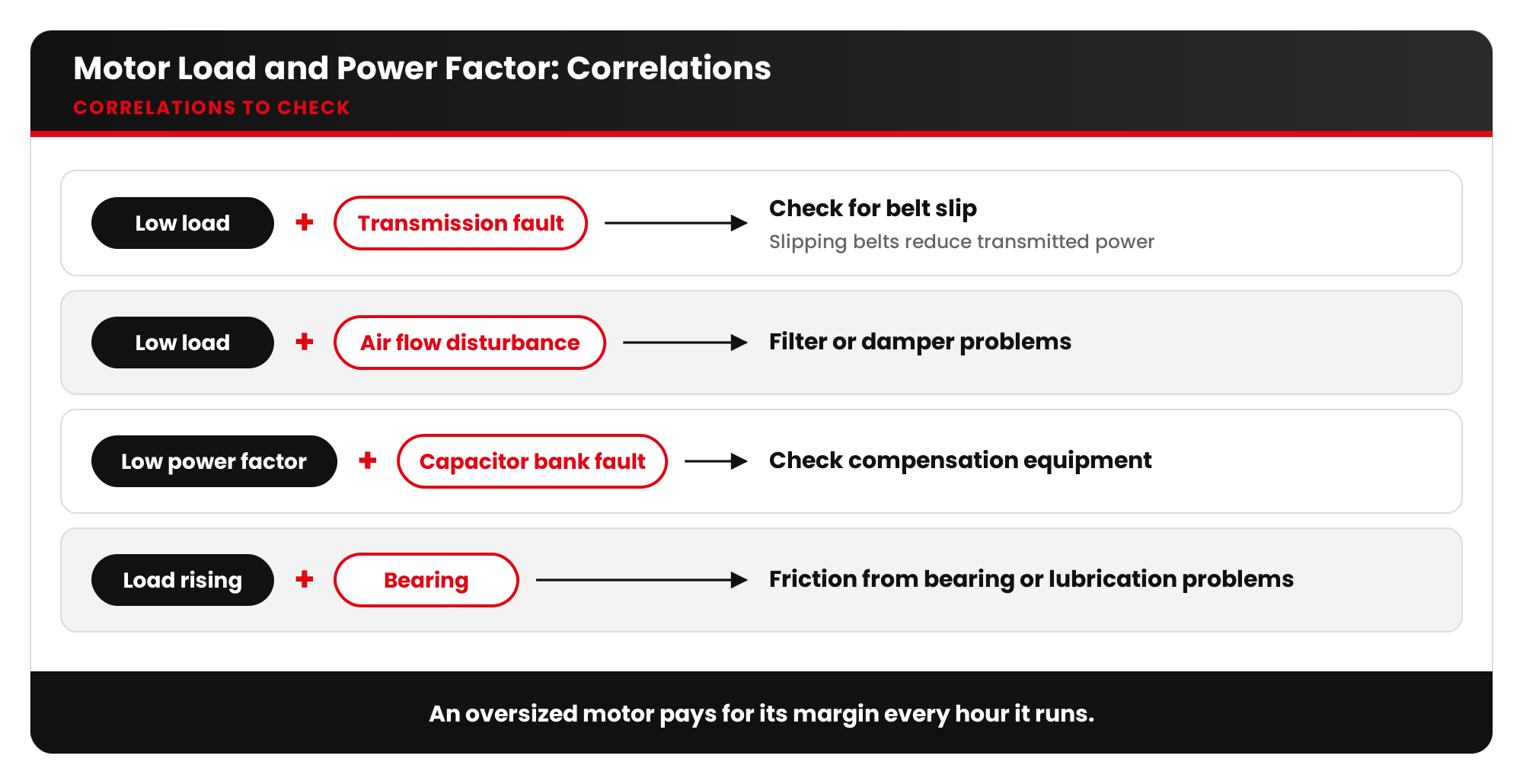
Correlations to check
- Low load + transmission faults: check for belt slip, which reduces transmitted power.
- Low load + air flow disturbance: filter or damper problems.
- Low power factor + capacitor bank faults: check compensation equipment.
- Load rising + bearing: friction from bearing damage or lubrication problems.
Checklist
- Record the load percentage and power factor for every motor surveyed.
- Flag motors consistently below 60% load for a right-sizing review at the next replacement.
- Consider VFDs where the load varies widely. They improve efficiency at part load.
- Trend load and compare changes with process events, filter changes and maintenance.
- Check power factor correction equipment against actual load profiles.
Key takeaways
- An oversized motor is an energy and power factor problem every hour it runs.
- Load trends are among the most powerful process diagnostics available, straight from the motor.
- A condition survey can deliver mechanical, electrical and energy findings in one test.
Want a picture of load, power factor and condition across your motor fleet? Ask Artesis about an AMT Pro survey.










 White Papers
 Case Study
 Documents
 Webinars
 Events
 ROI Calculator
 FAQ