

Ask a maintenance team what makes a good condition monitoring system and “accurate date and time” will rarely be at the top of the list. It sounds like housekeeping. But the best diagnoses often come from one simple question: what happened first? That question can only be answered with a reliable clock.
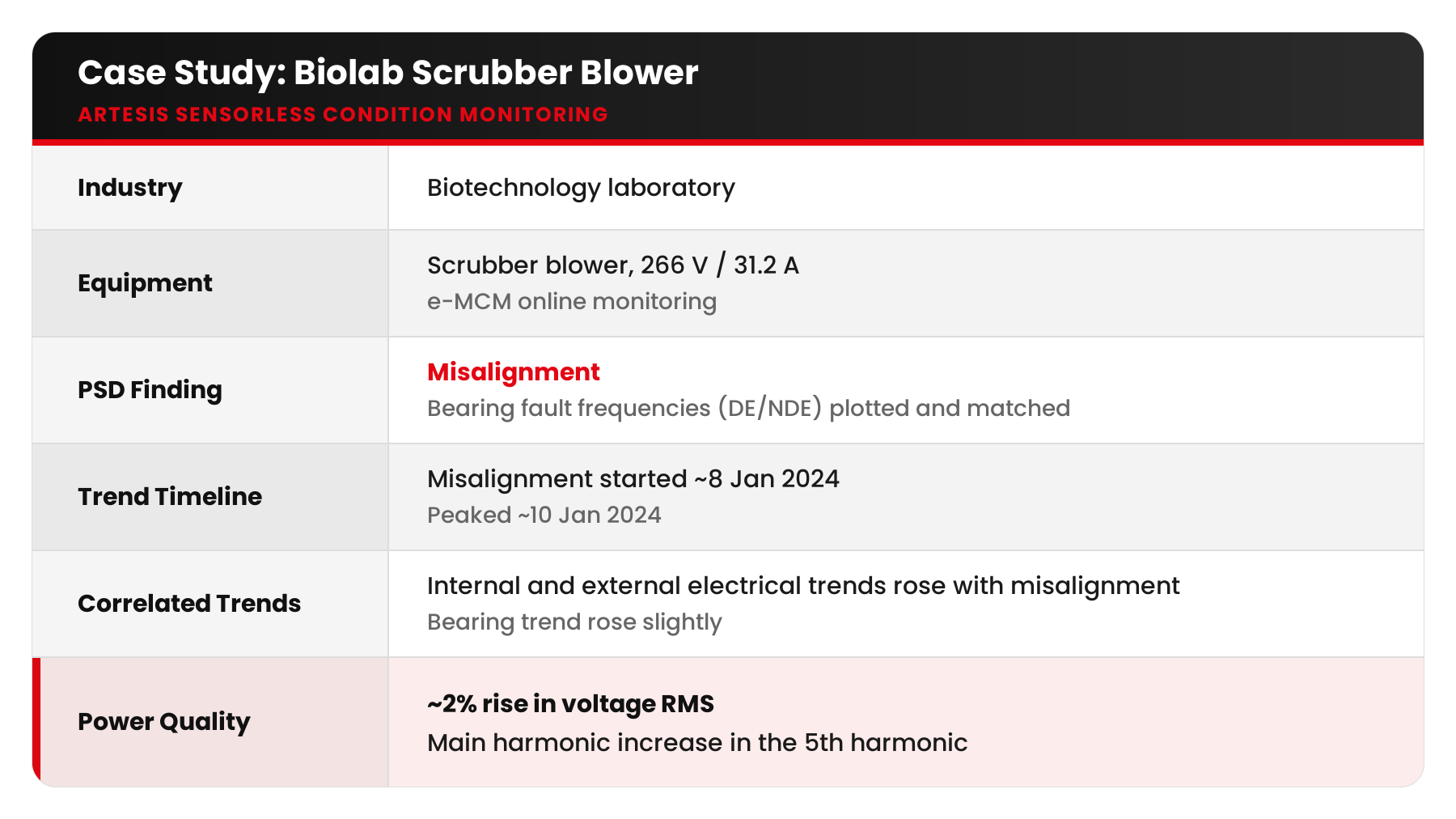
At a biotechnology laboratory, a scrubber blower (266 V, 31.2 A) was monitored with Artesis e-MCM. It removes contaminated air from lab exhaust systems, so it has to run continuously. In January 2024, several of its trends started to move.
Reading the sequence
The PSD analysis identified misalignment. Bearing fault frequencies for the drive end and non-drive end bearings were calculated in the software and plotted on the spectrum. They matched, but the pattern suggested that the root cause of the bearing faults was mostly misalignment.
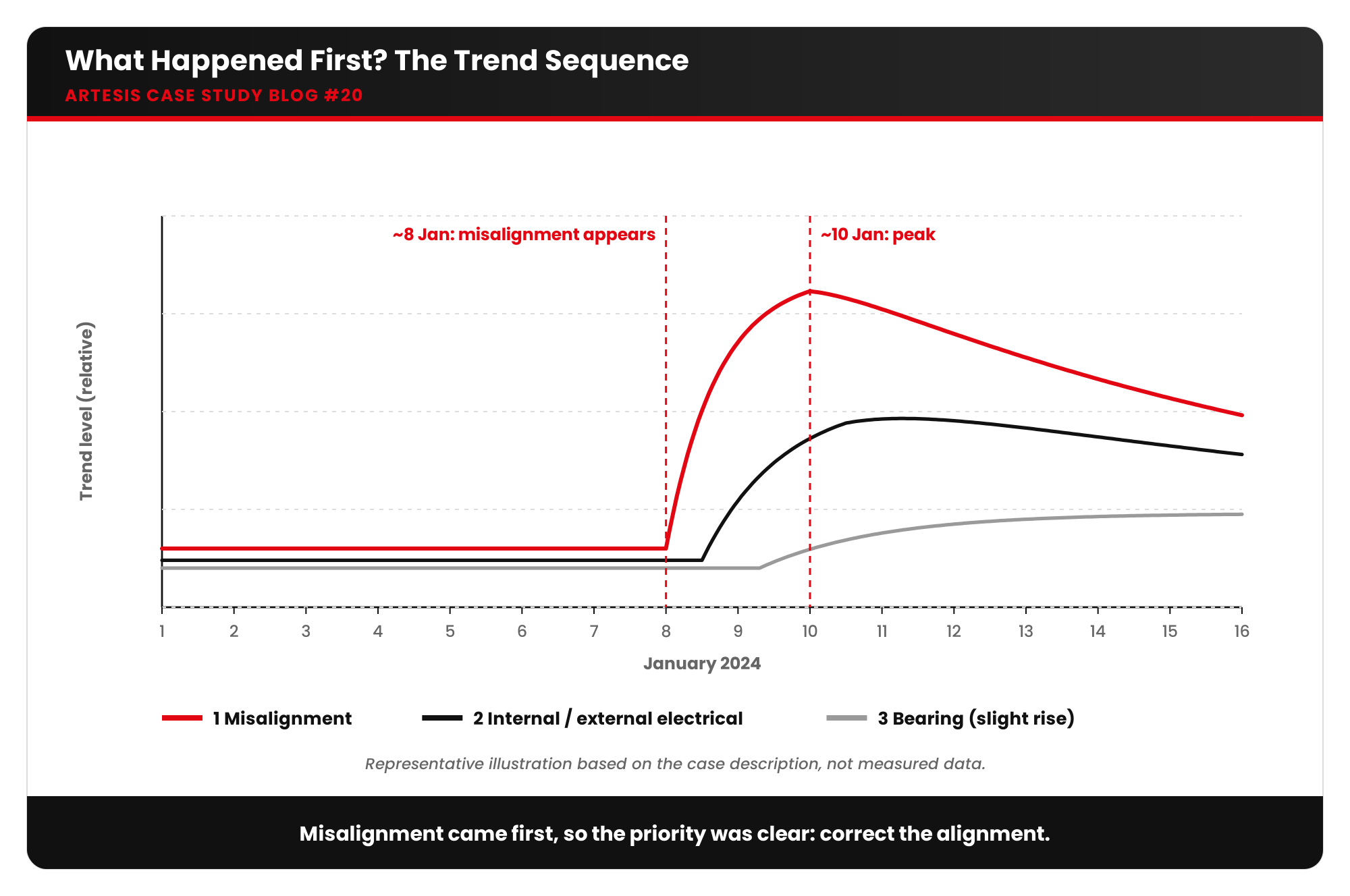
The timeline confirmed it. The trends showed:
- Around 8 January 2024, the misalignment fault first appeared.
- It peaked around 10 January 2024.
- As misalignment rose, the internal and external electrical trends rose with it.
- The bearing trend followed with a slight increase.
The order matters. If the bearing trend had risen first, the team might have replaced the bearing and moved on. Because the timestamps showed misalignment came first, the priority was clear: correct the alignment, then re-check the bearing.
The same data also showed a 2% rise in voltage RMS and an increase mainly in the 5th harmonic, which the report noted can cause unwanted vibration and long-term mechanical stress. Knowing when these changes started made it possible to check what else had changed on site at the same time.
Why date and time matter so much
- Cause and effect. Faults cascade. Misalignment damages bearings, looseness causes misalignment, and electrical problems load bearings. Only accurate timestamps show the order.
- Correlation with plant events. Alarms become meaningful when you can line them up with:
- Maintenance work orders (“the trend changed the day after the alignment job”)
- Process changes (start-ups, product changes, second fans running)
- Electrical events (switching operations, capacitor bank changes, supply dips)
- Weather and ambient conditions
- Verifying repairs. “Trends decreased on 5 January” is only useful if 5 January is correct.
- Fleet analysis. Comparing many assets, or several sites, requires a common time reference.
- Audit trail. In regulated industries (pharmaceutical, food, energy), time-stamped records of alarms, notifications and actions support compliance and investigations.
What goes wrong without reliable time
- Device clocks drift after power loss or battery failure
- Time zones and daylight saving changes are handled differently between systems
- Data from the monitoring system cannot be matched to SCADA, BMS or CMMS records
- Alarm e-mails show times that do not match the trend, which undermines trust in the system
Correlations that depend on good timestamps
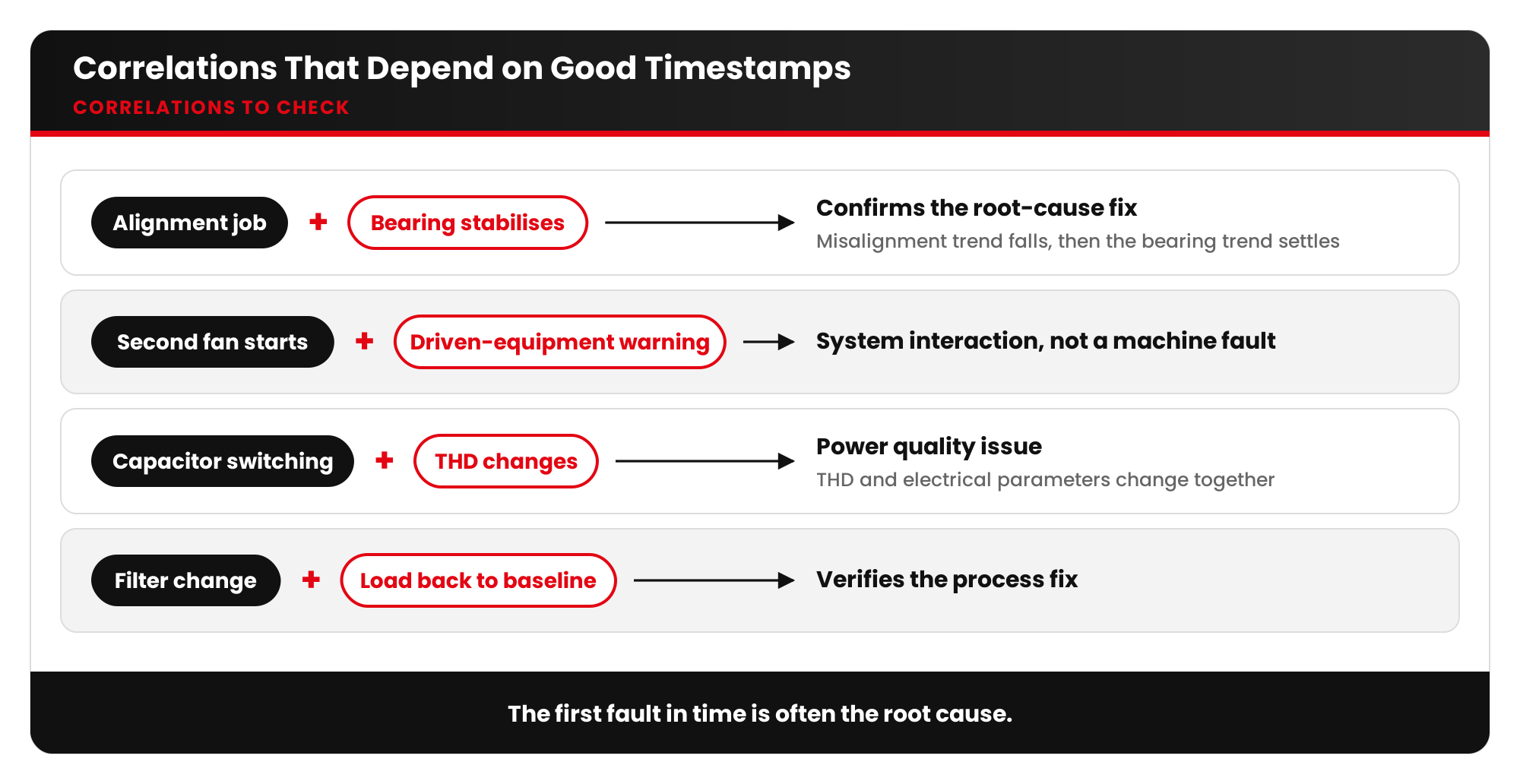
- Alignment job → misalignment trend falls → bearing trend stabilises: confirms the root cause fix.
- Second fan starts → driven-equipment warning appears: system interaction, not a machine fault.
- Capacitor bank switching → THD and electrical parameters change: power quality issue.
- Filter change → load returns to baseline: verifies the process fix.
Checklist for FAT, commissioning and daily use
- Verify device and software date/time during FAT and commissioning, including time zone.
- Synchronise monitoring devices, servers and SCADA with a common time source (for example NTP).
- Confirm timestamps on trends, alarms, e-mail notifications and reports all agree.
- After a power outage or device replacement, re-check the clock.
- Record maintenance actions with dates in the monitoring system so trends can be annotated.
Key takeaways
- Timestamps turn a set of alarms into a sequence of events.
- The first fault in time is often the root cause.
- Checking date and time at FAT is a small step with a big effect on diagnostic quality.
Want monitoring data you can line up with every event in your plant? Ask Artesis about e-MCM and OmniSight integration.










 White Papers
 Case Study
 Documents
 Webinars
 Events
 ROI Calculator
 FAQ