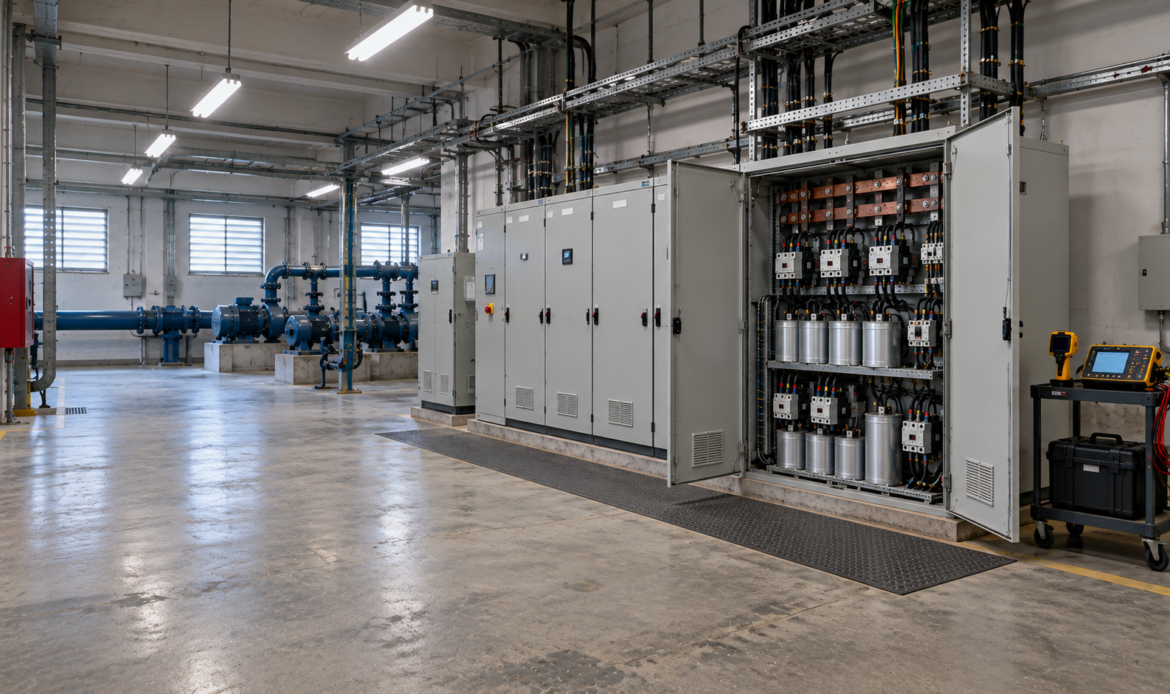
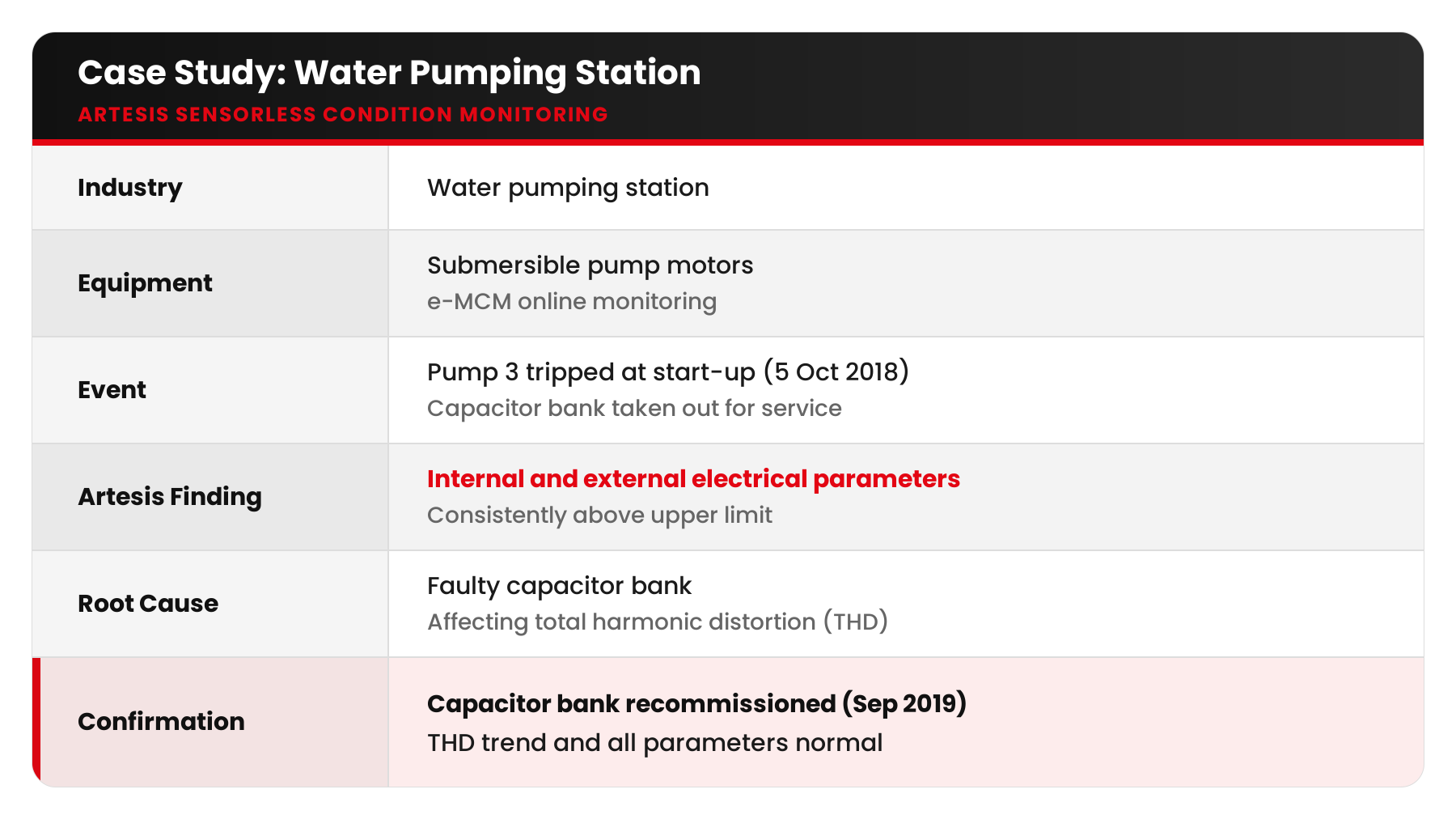
On 5 October 2018, Pump 3 at the water pumping station tripped during start-up and would not run. The station’s capacitor bank was racked out for servicing, and the team began to look at what else had been going on.
The submersible motors at the station were monitored by Artesis e-MCM. Looking back through the data, the pumps’ mechanical condition was fine. There was, however, a clear pattern: occasional spikes in the internal and external electrical parameters, and more importantly, consistent crossing of the upper limit for both.
What the data showed after the repair
The capacitor bank was repaired and recommissioned in September 2019, and e-MCM was updated. From then on, all parameters stayed in good condition, and the THD trend dropped to a normal level. The faulty capacitor bank had been affecting the total harmonic distortion seen by every motor it served.
It is a useful reminder that power quality problems are shared. One faulty component in the supply can put stress on every motor downstream.
What harmonics are
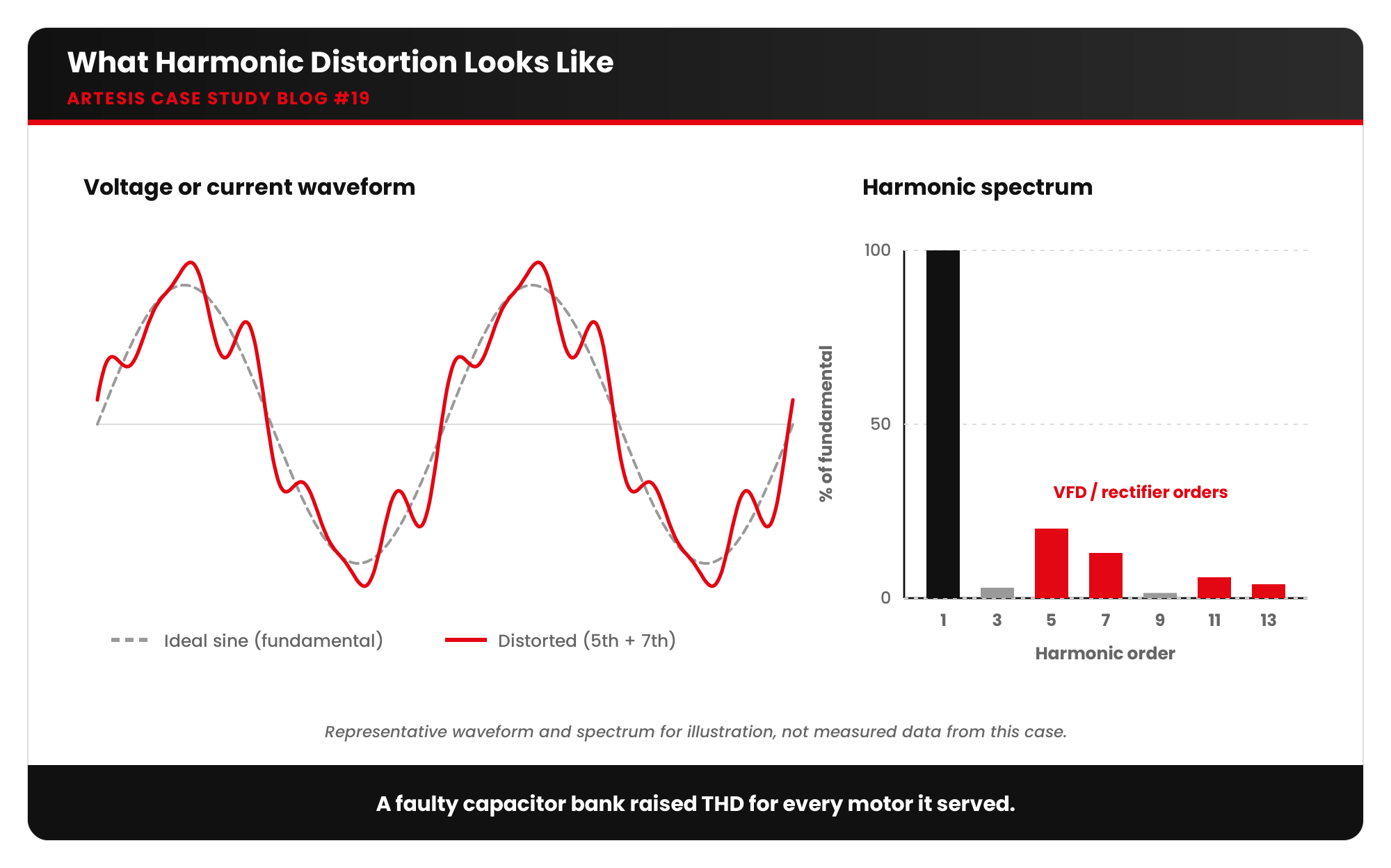
In an ideal system, voltage and current are clean sine waves at the fundamental frequency (50 or 60 Hz). Harmonics are components at integer multiples of that frequency. They are produced mainly by non-linear loads:
- VFDs and rectifiers (typically the 5th, 7th, 11th, 13th harmonics)
- UPS systems, LED drivers, IT equipment
- Arc furnaces and welding equipment
Odd harmonics (3rd, 5th, 7th…) dominate in most industrial systems. Total harmonic distortion (THD) summarises all of them as a percentage of the fundamental.
Capacitor banks and resonance
Power factor correction capacitors interact with the network inductance. At certain frequencies they can form a resonant circuit that amplifies harmonics instead of absorbing them. Faulty, unbalanced or wrongly sized capacitor stages make this worse, which is why capacitor banks in harmonic-rich systems often need detuning reactors.
What harmonics lead to
- Extra heating in motors, transformers and cables
- Torque pulsations, noise and vibration in motors. The 5th harmonic produces a counter-rotating field.
- Insulation stress from distorted voltage peaks
- Capacitor failures, blown fuses and nuisance trips
- Malfunction of sensitive equipment and protection relays
- Bearing currents on VFD-fed motors (together with high crest factor)
In another Artesis case, a rotary kiln fan in a chrome plant showed THD of 5.6%, along with serious unbalance and stator fault levels. On a biolab scrubber blower, the main harmonic increase was in the 5th harmonic, which the report noted can induce unwanted vibration and long-term mechanical stress.
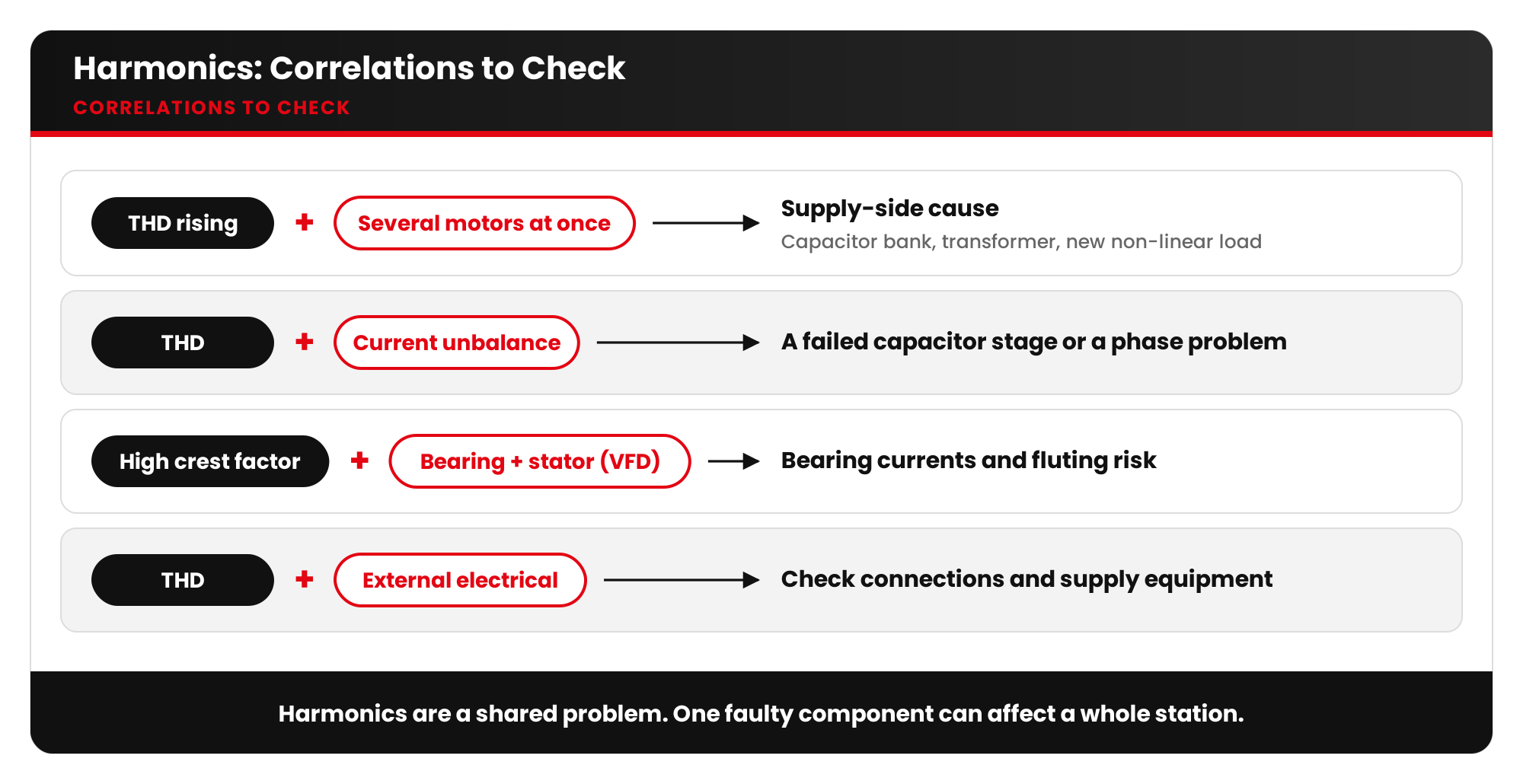
Correlations to check
- THD rising on several motors at once: a supply-side cause (capacitor bank, transformer, new non-linear load).
- THD + current unbalance: a failed capacitor stage or a phase problem.
- High crest factor + bearing and stator on VFD motors: bearing currents and fluting risk.
- THD + external electrical fault: connections and supply equipment.
Checklist
- Trend THD for voltage and current on critical motors and at the main switchboards.
- Compare against recognised limits (for example IEEE 519 at the point of common coupling).
- Inspect capacitor banks regularly: fuses, contactors, capacitance per stage, temperature.
- Use detuned capacitor banks or harmonic filters where VFD loads are significant.
- When electrical parameters rise on many assets at once, look at the supply.
Key takeaways
- Harmonics are a shared problem. One faulty component can affect a whole station.
- Capacitor banks can reduce or amplify harmonics, so keep them healthy.
- Motor-level monitoring doubles as a power quality monitor for the network that feeds it.
Want visibility of power quality and motor health together? Ask Artesis about e-MCM.




 White Papers
 Case Study
 Documents
 Webinars
 Events
 ROI Calculator
 FAQ