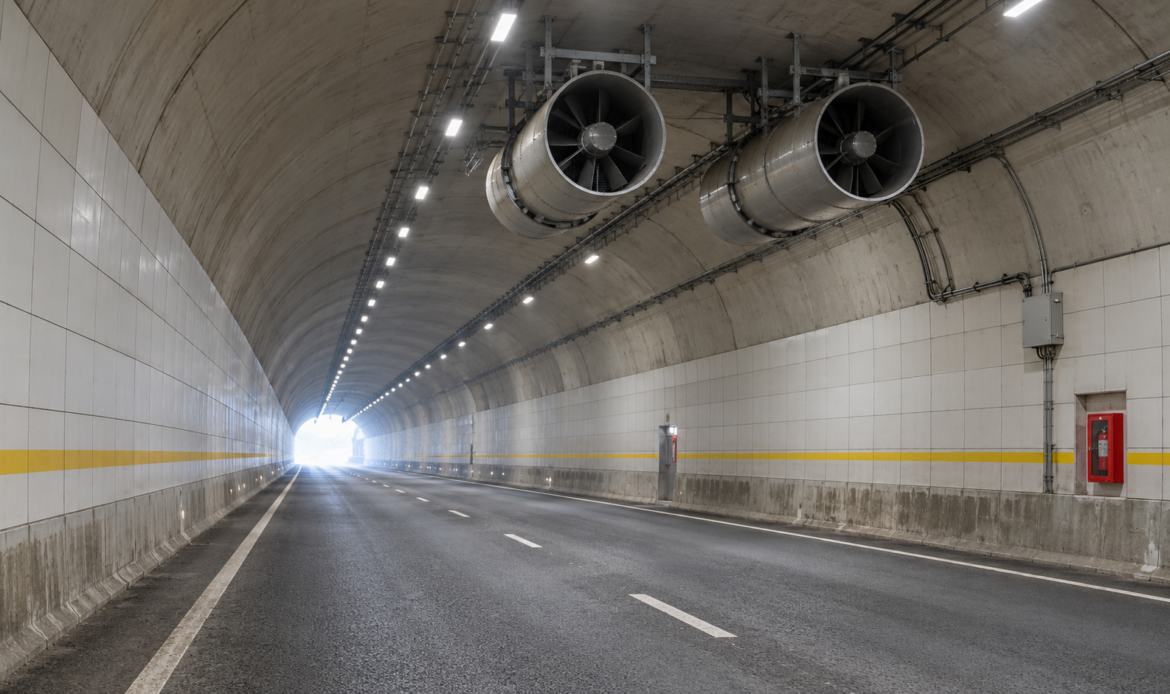
Road tunnel jet fans are safety equipment. In normal operation they keep the air moving. In a fire they control smoke. Maintaining them is expensive and disruptive, because every unplanned intervention means lane closures, traffic management and night work. So when one fan in a busy urban tunnel began to look slightly out of balance electrically, the team wanted to understand it without rushing into a closure.
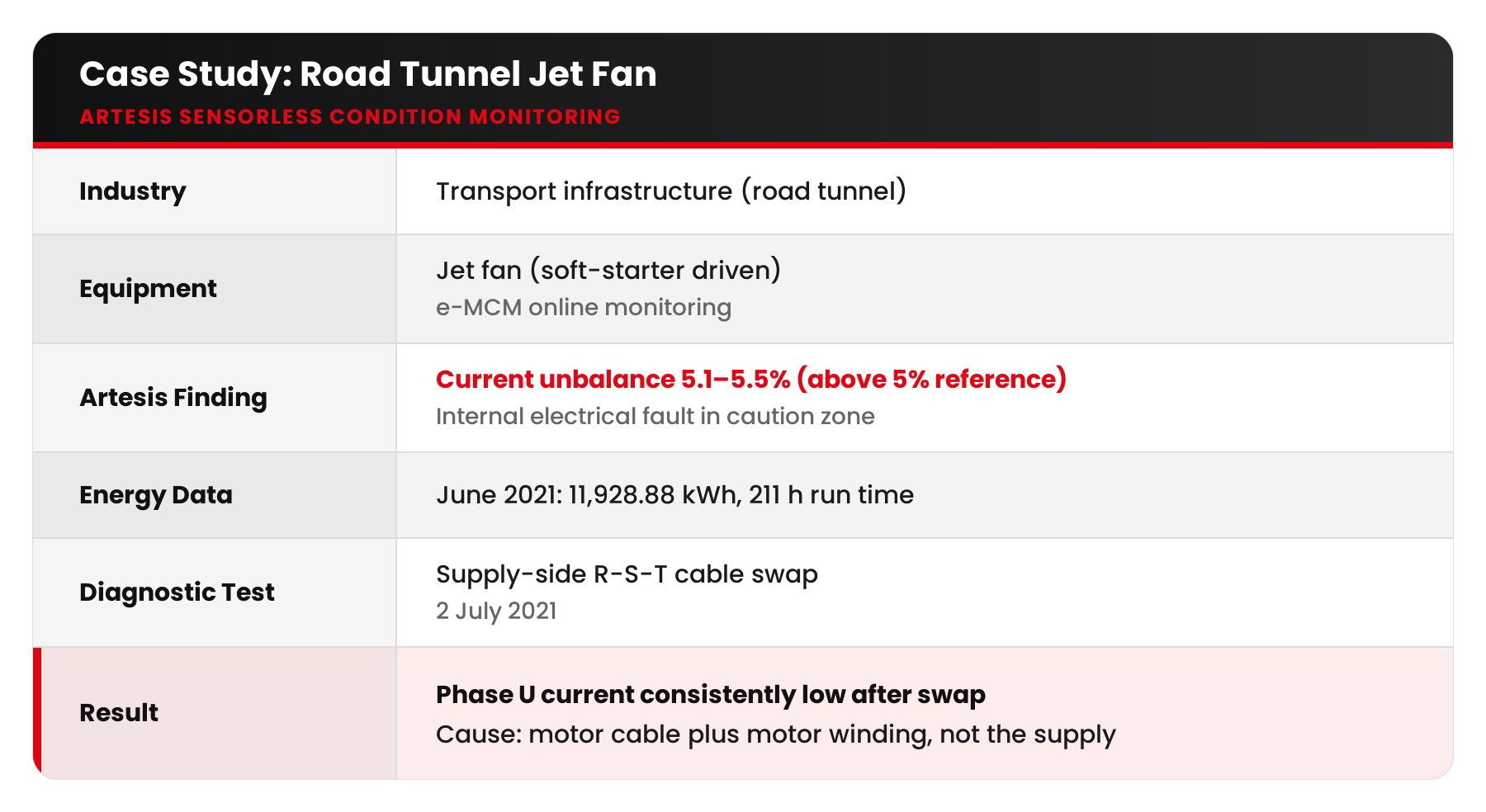
An Artesis e-MCM unit had been commissioned on the fan on 4 May 2021. The learning phase finished within a week. The first report showed a current unbalance of 5.8%.
Following the trend
Through June, e-MCM reported a current unbalance of 5.1–5.3%, above the 5% reference, and an increase in the Internal Electrical Fault parameter. The client took their own readings at the soft starter and at the incoming supply and saw the same unbalance. The incoming supply and the outgoing current to the fan had similar values, so the question remained: was the problem in the supply or in the motor circuit?
The cable-swap test
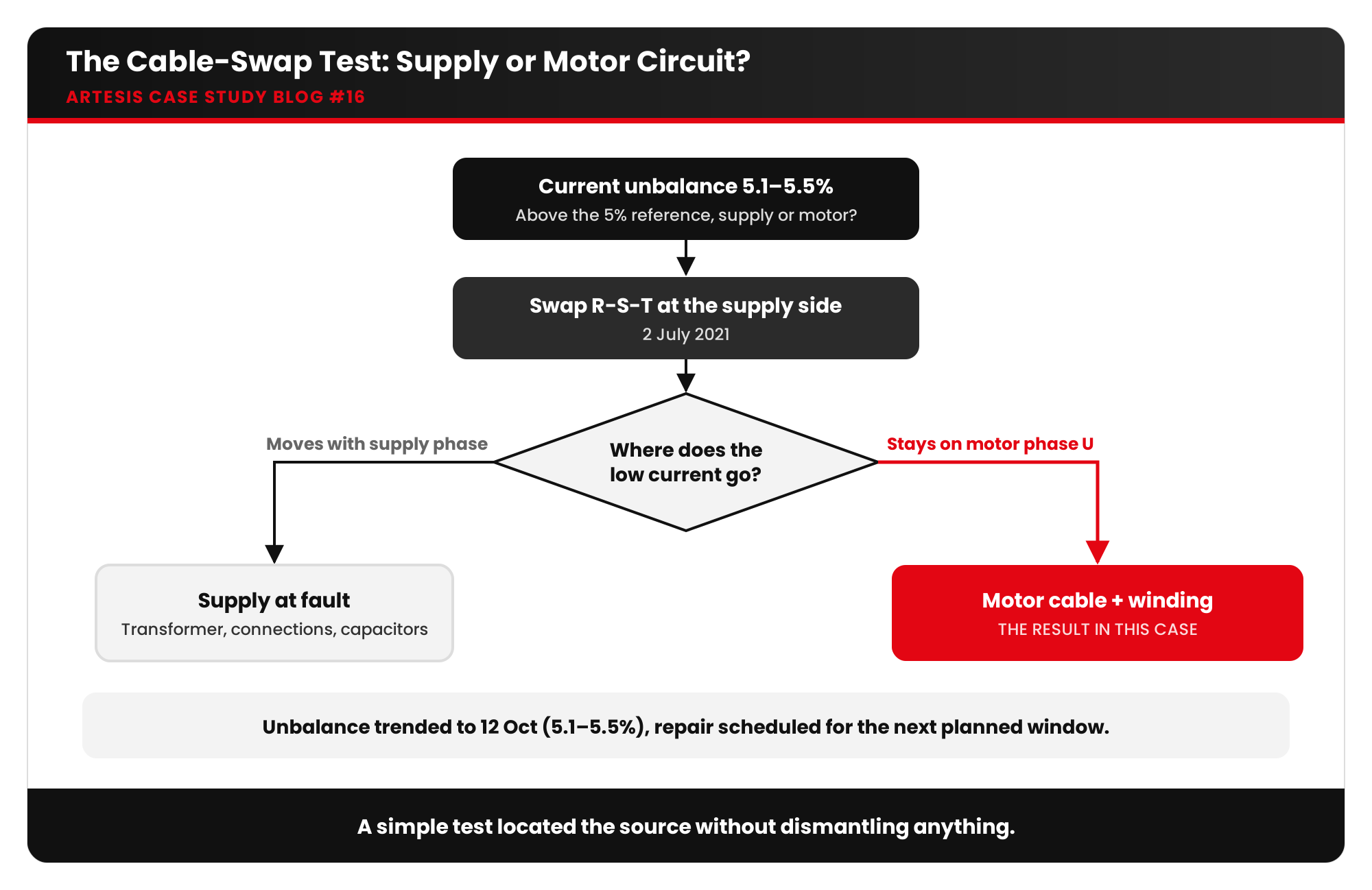
The service partner proposed a simple, effective test: swap the R, S and T cables at the supply side and watch where the low current goes.
- If the low current moves with the supply phase, the supply is at fault.
- If it stays on the same motor phase, the cable to the motor or the motor winding is at fault.
On 2 July 2021 the swap was done. The current on phase U stayed consistently low, whichever supply phase fed it. The cause was the motor cable and motor winding, not the incoming supply.
Monitoring continued to 12 October. The unbalance fluctuated between 5.1% and 5.5% and sometimes dropped below 5%. The internal electrical fault stayed in the caution zone. With continuous trending, the operator could judge the severity and schedule the repair for the next planned maintenance window instead of closing the tunnel at short notice. A second trial, measuring at the MCC instead of the local panel, gave the same result (5.2%), which confirmed the measurements.
Voltage unbalance vs. current unbalance
Voltage unbalance is a difference between the three supply phase voltages. Common causes:
- Unevenly distributed single-phase loads
- Faulty or unevenly loaded transformers
- Blown capacitor bank fuses
- Poor connections on one phase
Current unbalance is a difference between the three phase currents drawn by the motor. It can come from voltage unbalance (a small voltage unbalance produces a much larger current unbalance) or from the motor circuit itself: winding faults, cable faults or loose connections.
Why the thresholds matter
- A voltage unbalance of only 1% is often considered the start of concern. NEMA recommends derating motors above 1%.
- A current unbalance above 5% is widely used as an action threshold.
- Unbalance creates negative-sequence current, which produces a counter-rotating field, extra heating and torque pulsation.
What unbalance leads to
- Overheating of the stator and rotor, which shortens insulation life
- Reduced torque and efficiency
- Vibration at twice the line frequency
- Bearing stress from torque pulsations
- Nuisance tripping of protection
Correlations to check
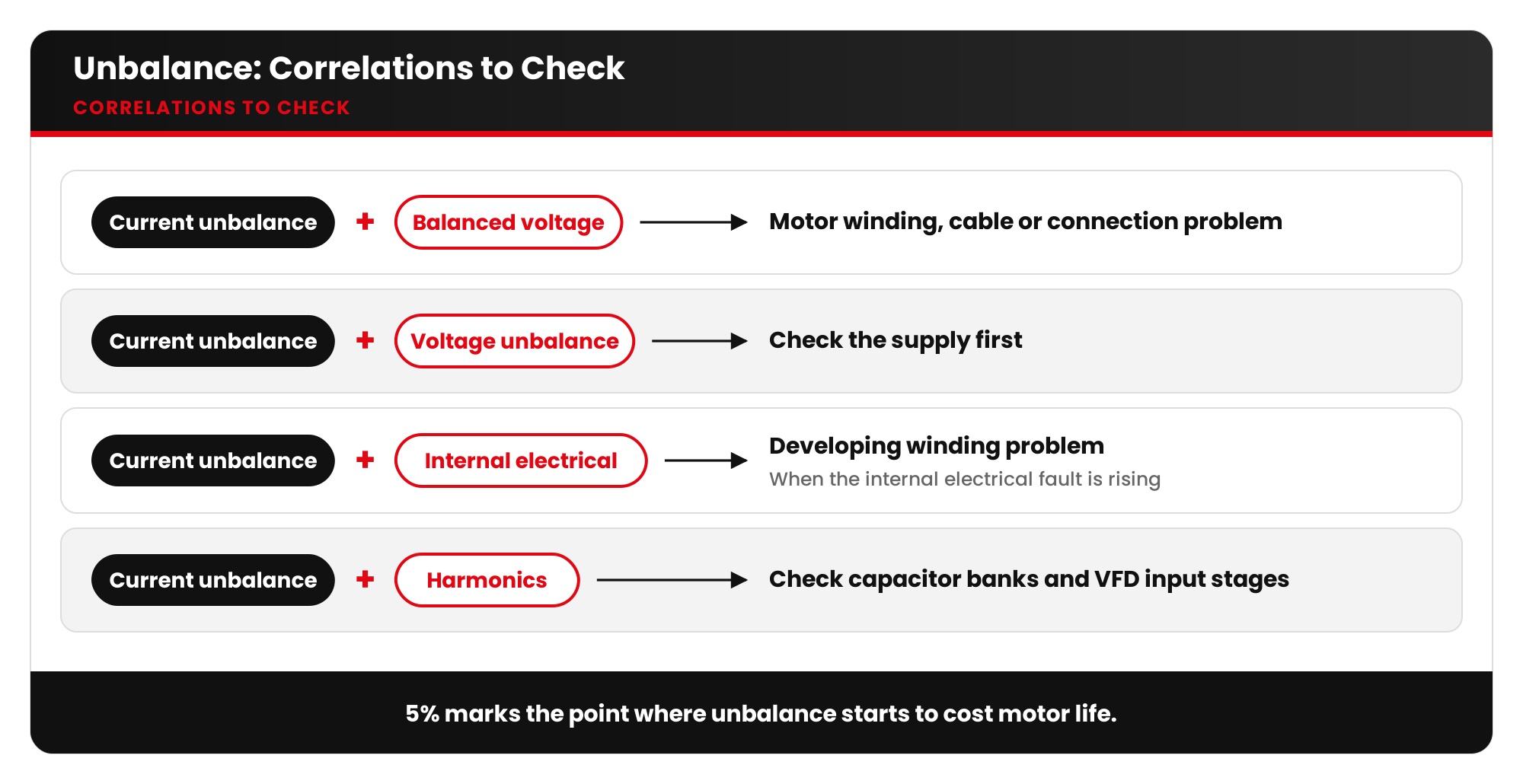
- Current unbalance + balanced voltage: motor winding, cable or connection problem.
- Current unbalance + voltage unbalance: check the supply first.
- Current unbalance + internal electrical fault rising: developing winding problem.
- Current unbalance + harmonics: check capacitor banks and VFD input stages.
Checklist
- Always evaluate current unbalance together with voltage unbalance.
- Use a cable-swap test to separate supply problems from motor-circuit problems.
- Thermally scan all connections along the circuit.
- Test the cable and winding offline (insulation, resistance balance, surge) at the next opportunity.
- Trend unbalance continuously. A single reading can mislead when values fluctuate around the threshold.
Key takeaways
- 5% is not just a number. It marks the point where unbalance starts to cost motor life.
- A simple, well-designed test can locate the source of unbalance without dismantling anything.
- Continuous trending lets you plan repairs on safety-critical assets around operations.
Monitoring safety-critical fans or pumps where unplanned access is costly? Ask Artesis about e-MCM.









 White Papers
 Case Study
 Documents
 Webinars
 Events
 ROI Calculator
 FAQ