
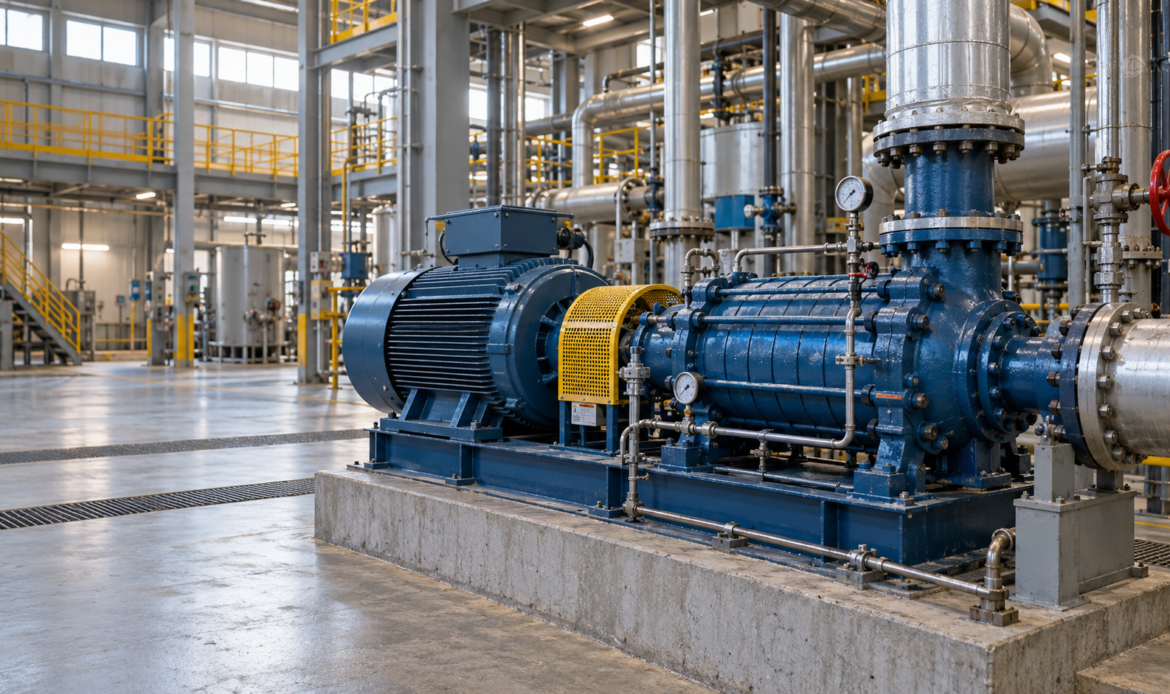
Cavitation has a reputation as a noise, “like pumping gravel”, but by the time you can hear it clearly, the damage has usually started. At a combined-cycle power plant in the Middle East, the condition monitoring team wanted to know about it earlier than that.
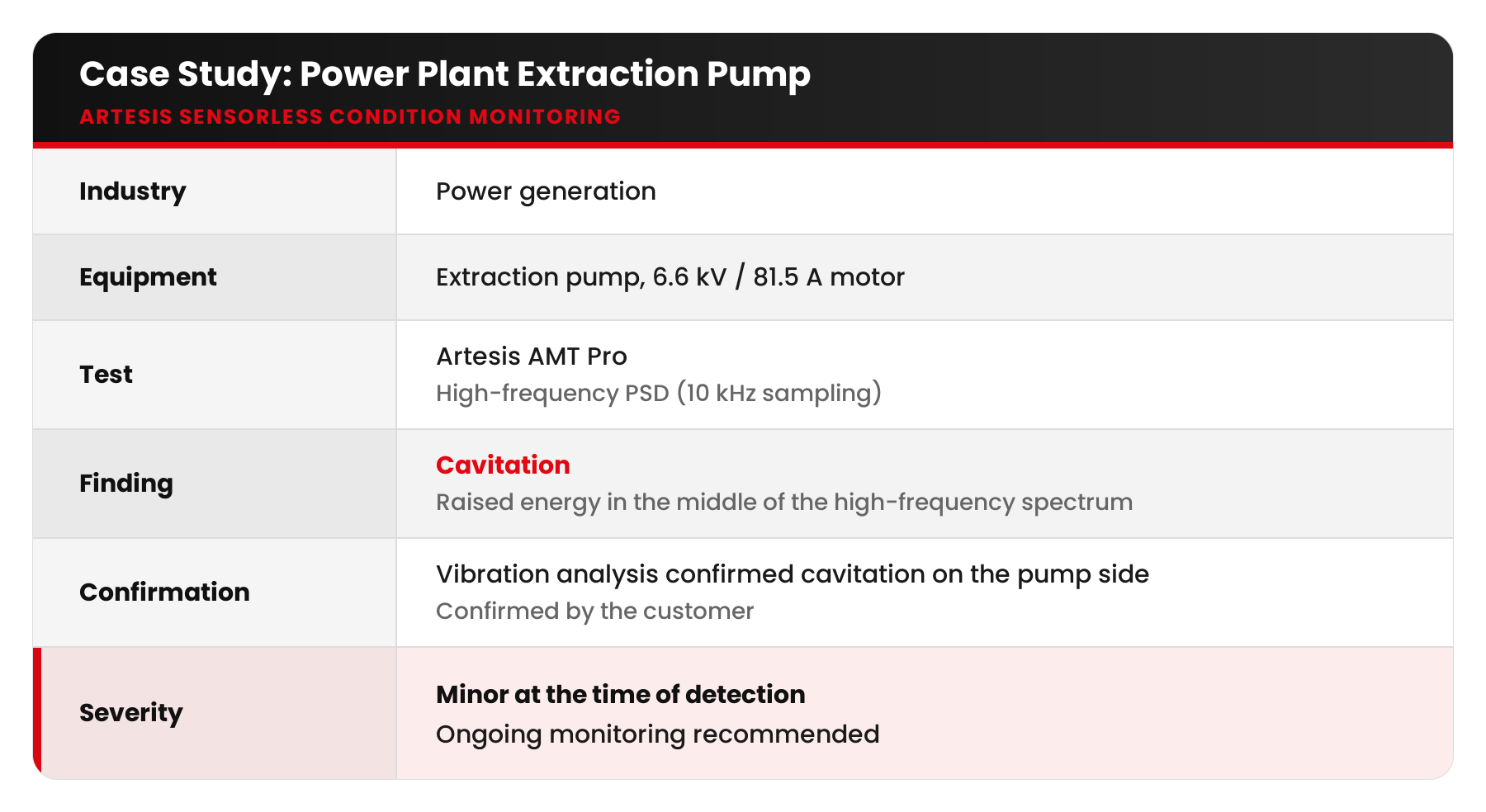
The asset was an extraction pump driven by a 6.6 kV, 81.5 A motor. The team ran an Artesis AMT Pro test, sampling the motor current and voltage at 10 kHz.
What the spectrum showed
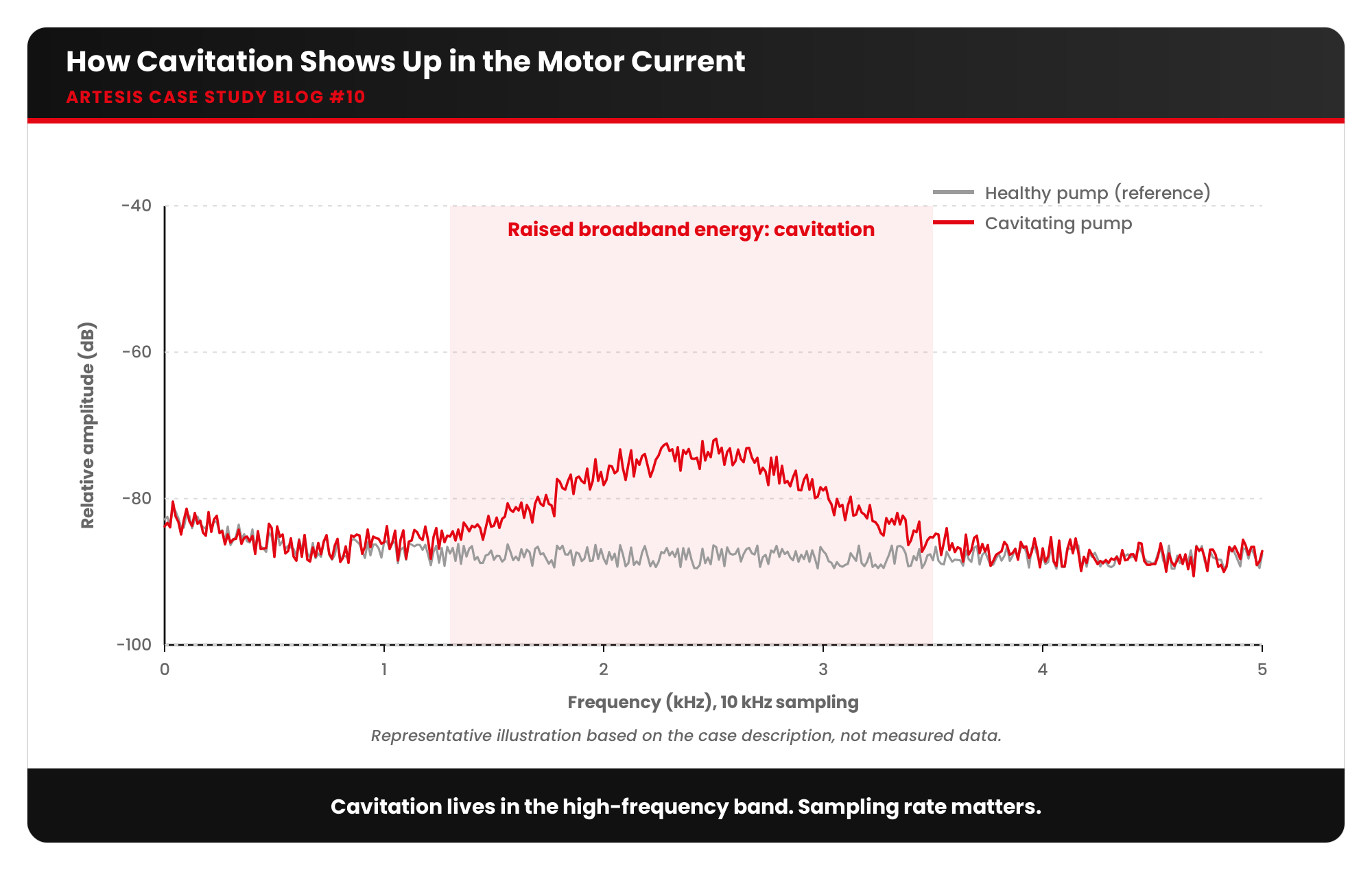
Low-frequency analysis, where most mechanical faults appear, looked unremarkable. The high-frequency PSD told another story: a clear increase in energy across the middle of the high-frequency band. Cavitation creates broadband, random energy as vapour bubbles collapse, and that disturbance reaches the motor as high-frequency torque noise.
A follow-up vibration test confirmed cavitation on the pump side. The customer’s feedback was clear: “Cavitation phenomenon observed in the pump.” It was minor at the time, which is when you want to find it.
What cavitation is
When the pressure at the impeller eye falls below the liquid’s vapour pressure, the liquid boils locally and forms vapour bubbles. When these bubbles move into higher-pressure regions, they collapse violently. The micro-jets and shock waves from millions of collapses erode metal from the impeller vanes, often leaving a pitted, sponge-like surface.
How cavitation develops: common causes
- Insufficient NPSH available: low suction level, high suction lift, blocked strainers, undersized suction piping
- High liquid temperature, which raises vapour pressure (common in condensate and extraction service)
- Operating far from the best efficiency point (BEP): too much flow (classic cavitation) or too little flow (recirculation cavitation)
- Air entrainment and vortexing at the suction
- Partially closed suction valves
What cavitation leads to
- Impeller erosion: pitting and loss of vane material, reducing head and efficiency
- Vibration and noise, which damage bearings and mechanical seals
- Flow and pressure fluctuations, and unstable process control
- Shaft fatigue from unsteady hydraulic loads
- Eventually loss of performance, and in severe cases, impeller breakage
In a separate Artesis case at a sugar refinery, MCM raised a cavitation-band alarm on a deep well pump just after its learning period. When the pump was dismantled, small pits on the blades confirmed the diagnosis.
Correlations to check
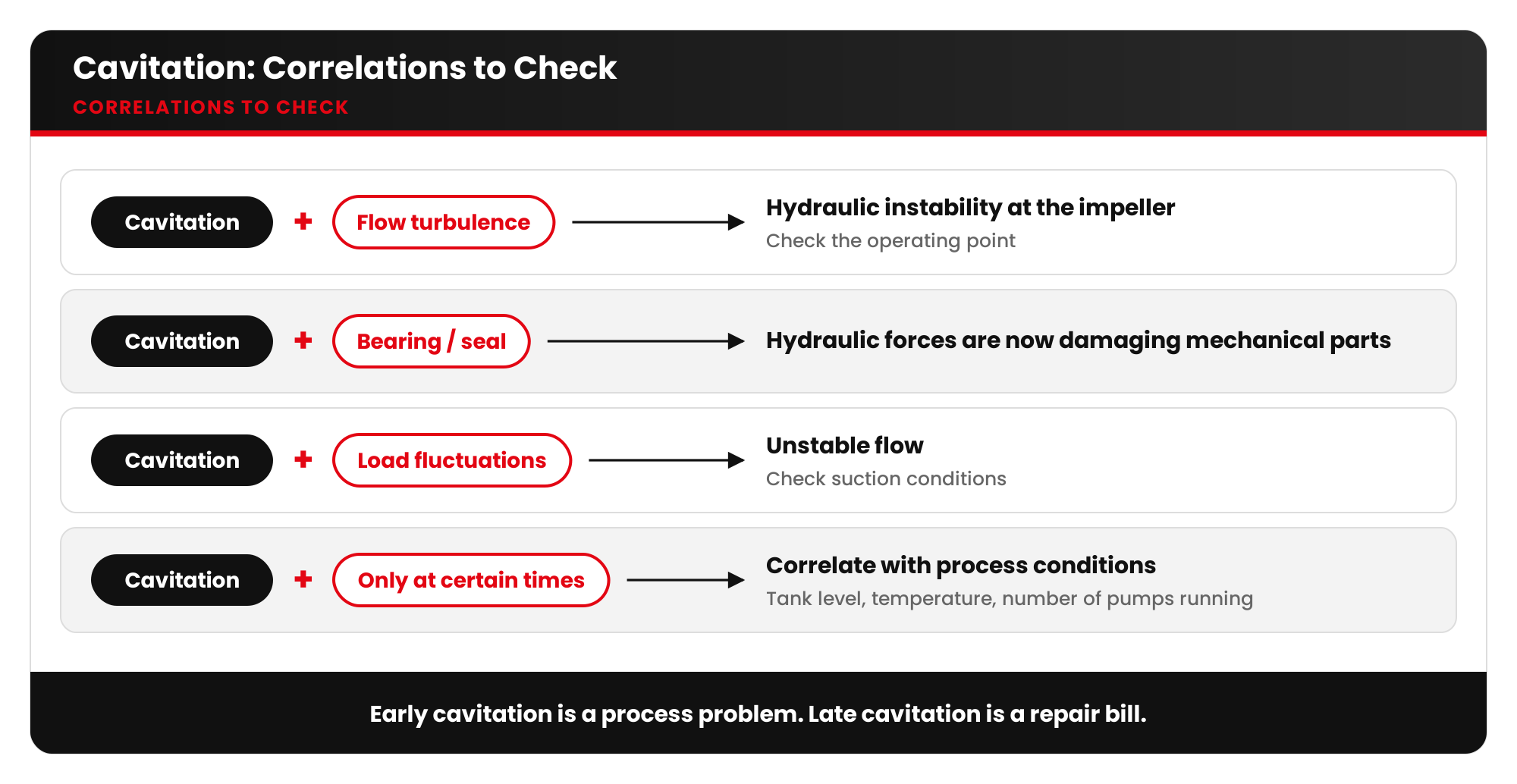
- Cavitation + flow turbulence: hydraulic instability at the impeller. Check the operating point.
- Cavitation + bearing / seal: the hydraulic forces are now damaging mechanical components.
- Cavitation + load (power) fluctuations: unstable flow. Check suction conditions.
- Cavitation only at certain times: correlate with tank level, temperature or number of pumps running.
Checklist for maintenance and operations
- Compare the actual operating point with the pump curve. Is the pump near its BEP?
- Check suction pressure and NPSH available against NPSH required, including temperature effects.
- Inspect and clean suction strainers and screens.
- Check suction valves are fully open. Never throttle on the suction side.
- When the pump is opened, inspect vanes for pitting and record the location (suction side vs. pressure side).
- Keep trending the high-frequency band to track severity over time.
Key takeaways
- Cavitation appears in the high-frequency part of the motor current spectrum, so sampling rate matters.
- Early, minor cavitation is a process problem you can fix. Late cavitation is a repair bill.
- Always look at the operating point as well as the pump.
Want to know if your pumps are cavitating right now? Ask Artesis about high-frequency AMT Pro testing and e-MCM online monitoring.









 White Papers
 Case Study
 Documents
 Webinars
 Events
 ROI Calculator
 FAQ