
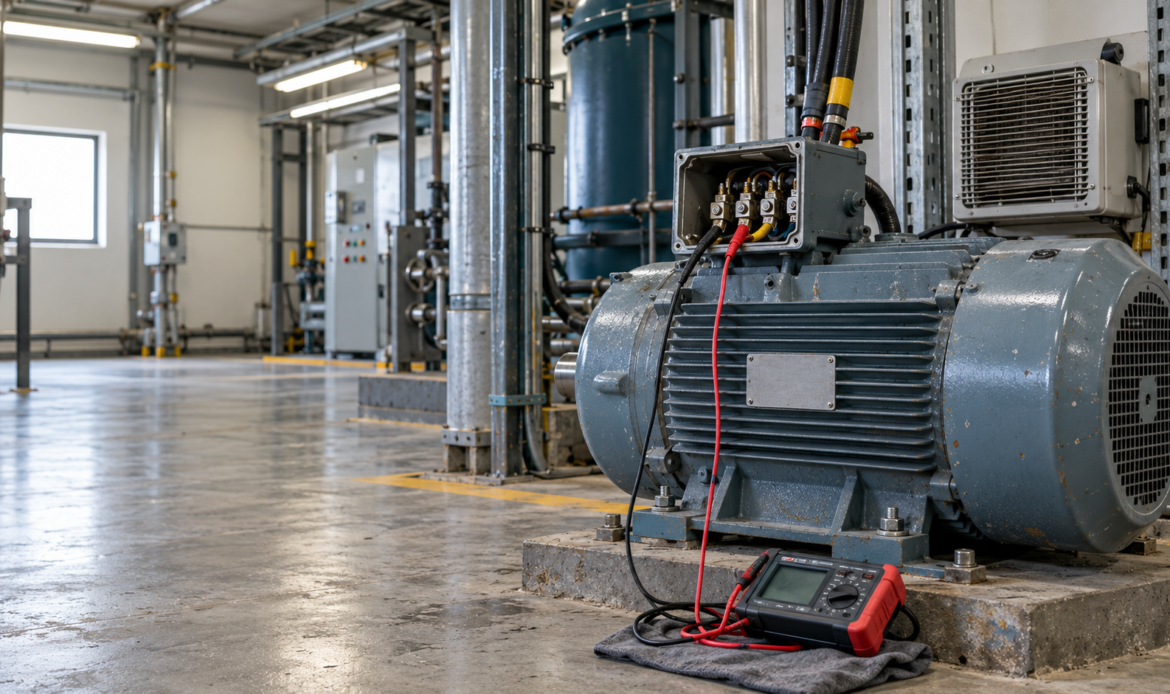
Some faults are fixed in an afternoon. This one took almost a year, and it is a good illustration of how online monitoring supports every stage of a repair, from the first warning to the final sign-off.
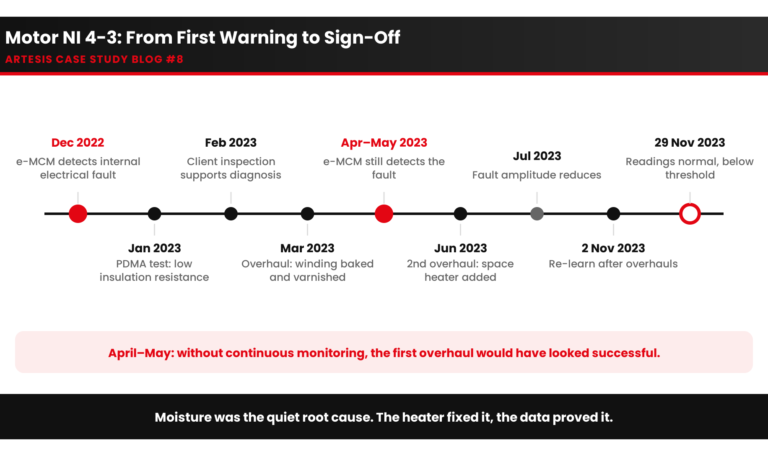
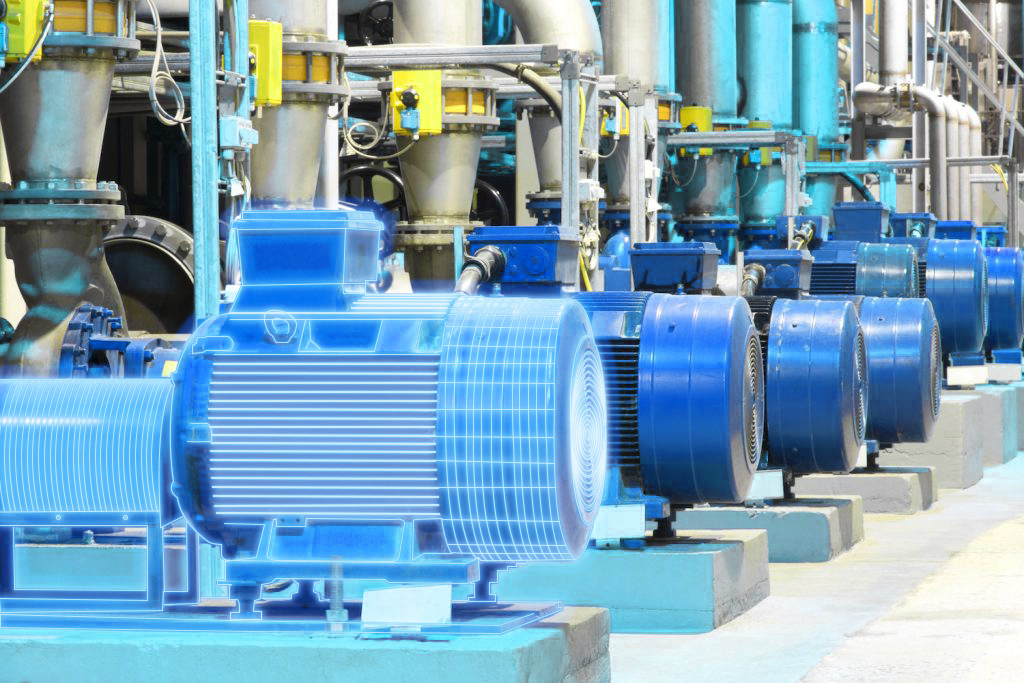
The motor, known on site as NI 4-3, was monitored by Artesis e-MCM through the service partner Vibtech. In December 2022, e-MCM began reporting an Internal Electrical Fault in the caution zone.
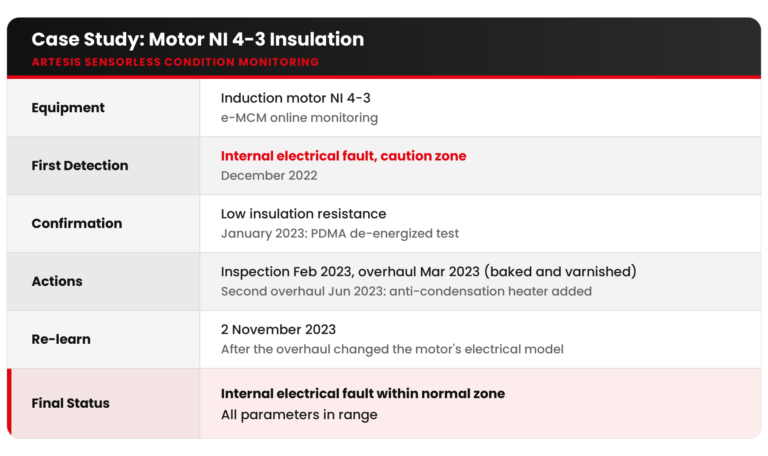
The timeline
- December 2022: e-MCM detects an internal electrical fault.
- January 2023: a PDMA de-energized test confirms low insulation resistance.
- February 2023: the client inspects the motor. The findings support the diagnosis.
- March 2023: the motor is overhauled and the winding is baked and varnished.
- April–May 2023: e-MCM still detects the internal electrical fault. The repair had not fully solved it.
- June 2023: a second overhaul. This time a space heater is added to prevent condensation while the motor stands idle.
- July 2023: the amplitude of the internal electrical fault reduces.
- 2 November 2023: Vibtech performs a re-learn on the e-MCM. The overhauls had changed the motor’s current waveforms enough that the original model no longer represented it.
- 29 November 2023: readings are normal. The trends sit below the average threshold.
The lesson from April and May is important. Without continuous monitoring, the team would probably have assumed the first overhaul had worked. The online data showed it had not, and the heater fixed the likely root cause: moisture.
Internal vs. external electrical faults
Internal electrical faults are inside the motor:
- Stator winding insulation degradation (moisture, heat, contamination)
- Turn-to-turn and phase-to-phase shorts
- Rotor bar and end ring defects
- Loose or damaged internal connections
External electrical faults are between the supply and the motor:
- Loose, corroded or overheated connections at terminals, contactors, MCCs and weatherheads
- Damaged or undersized cables, and faulty cable joints
- Defective contactors or fuses
- Supply problems: voltage unbalance, harmonics, faulty capacitor banks
In another Artesis case, AMT Pro found average RMS current values more than 10% out of line on a 480 V blower. A thermal camera then found a hot spot on one phase cable, an external fault that could have ended in a cable fire.
How electrical faults develop and what they cause
- Moisture and contamination lower insulation resistance, especially in motors that stand idle in humid areas.
- Loose connections heat up, oxidise and loosen further, which is a self-reinforcing cycle.
- Both lead to current unbalance, overheating, efficiency loss, nuisance trips and eventually insulation failure or fire.
- Electrical faults also cause mechanical damage: phase fluctuations create torque pulsations that load the bearings.
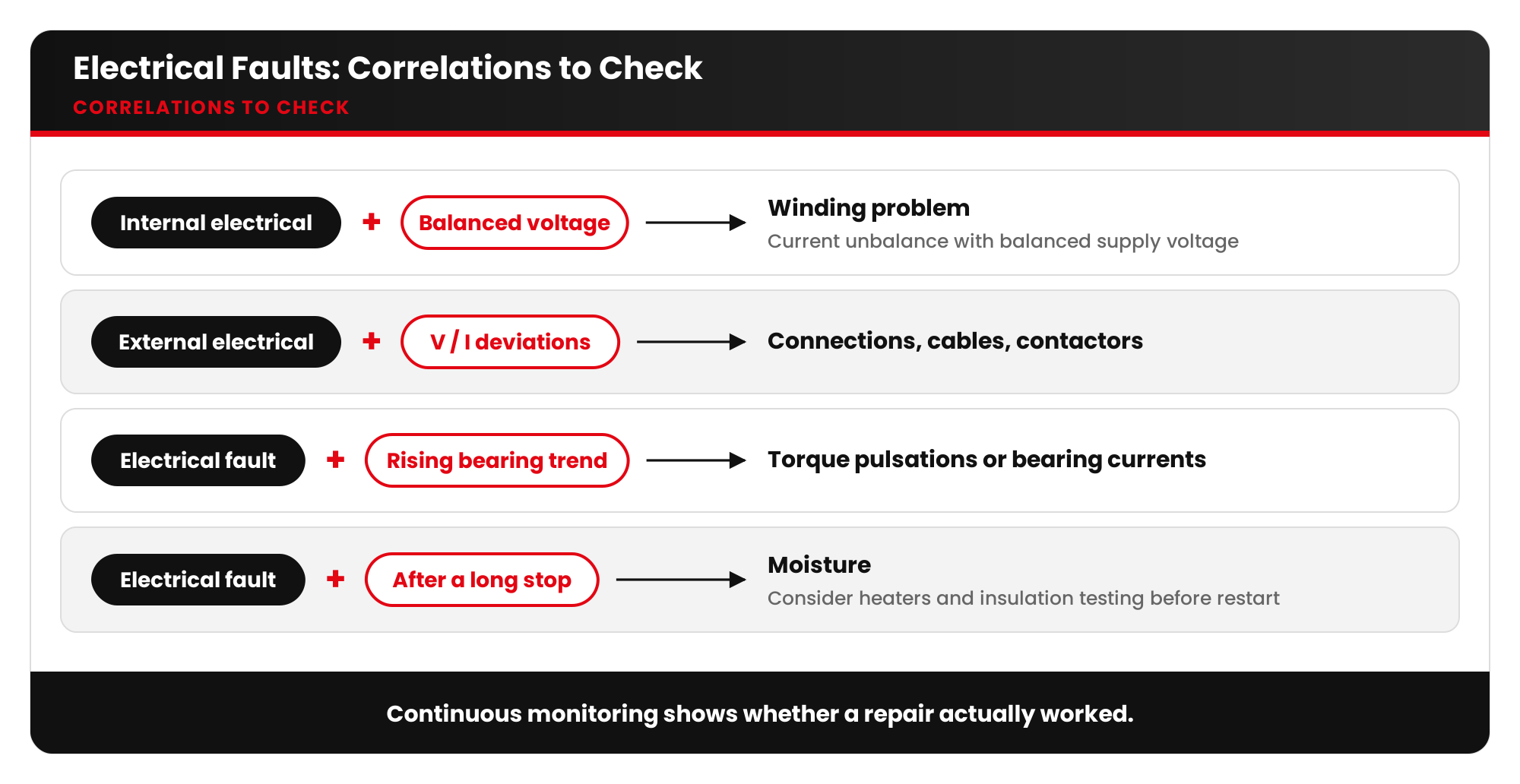
Correlations to check
- Internal electrical + current unbalance with balanced voltage: winding problem.
- External electrical + voltage or current deviations: connections, cables, contactors.
- Electrical fault + rising bearing trend: torque pulsations or bearing currents.
- Electrical fault after a long stop: Consider heaters and insulation testing before restart.
Checklist
- When an internal electrical fault is flagged, confirm with an offline test (insulation resistance, PI, surge).
- Thermally scan terminals, MCC connections and cable joints for external faults.
- For motors in humid or washdown areas, fit and use anti-condensation heaters.
- After any rewind or major overhaul, re-learn / re-baseline the monitoring system.
- Keep monitoring after the repair. Confirm the fix with data.
Key takeaways
- Continuous monitoring shows whether a repair actually worked.
- Moisture is a quiet but common root cause of insulation problems. Heaters are cheap insurance.
- A monitoring model must be updated when the machine changes, so re-learn after overhauls.
Want to know whether your last motor repair really fixed the problem? Ask Artesis about e-MCM online monitoring.








 White Papers
 Case Study
 Documents
 Webinars
 Events
 ROI Calculator
 FAQ