
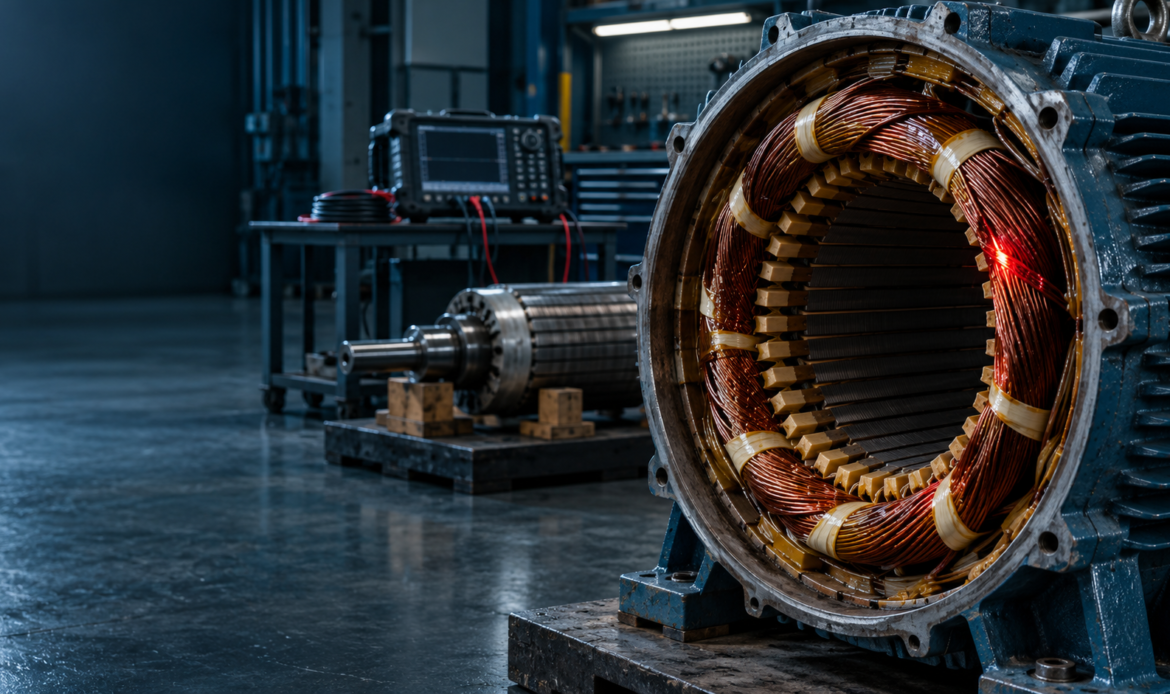
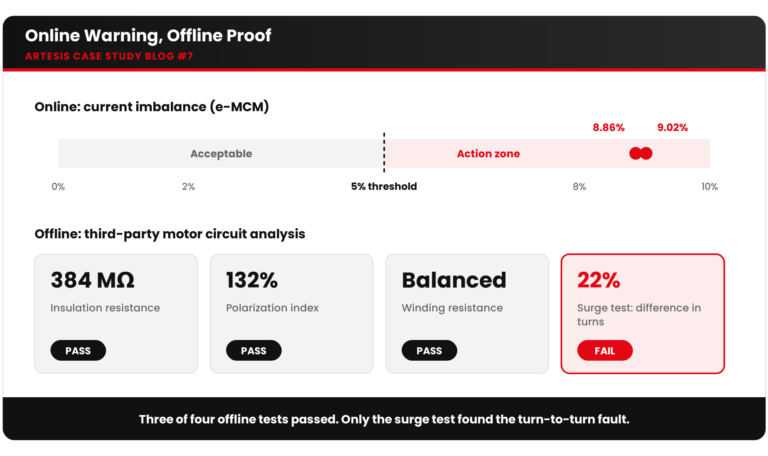
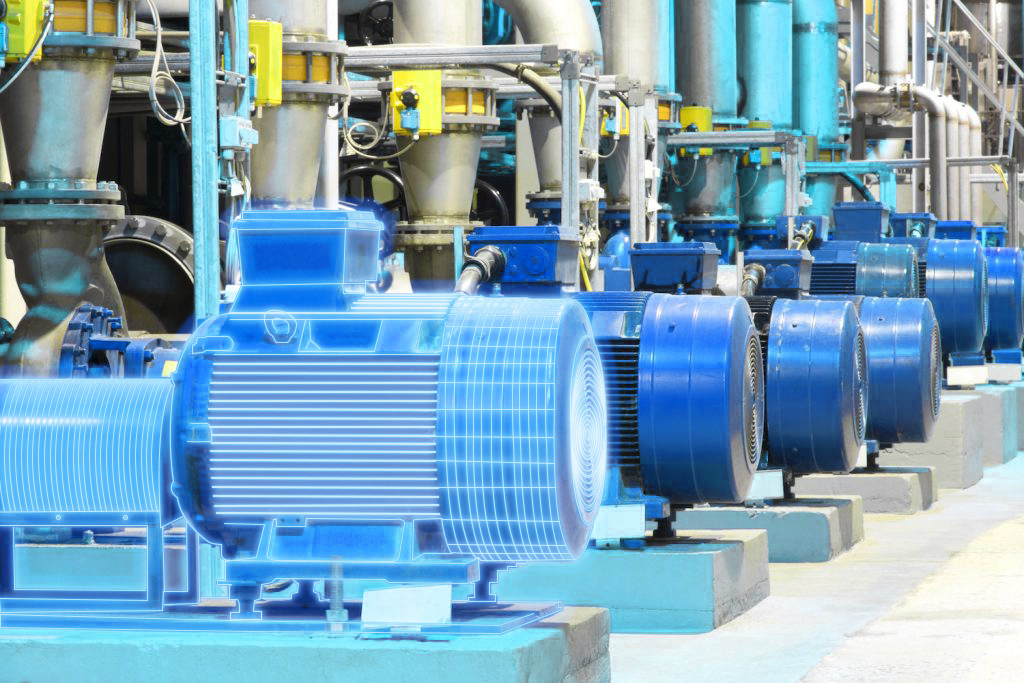
The 710 kW motor had been running for years without trouble. It was the kind of machine that appears in the maintenance plan only as an annual line item. Then, in July 2023, the Artesis online monitoring system flagged it.
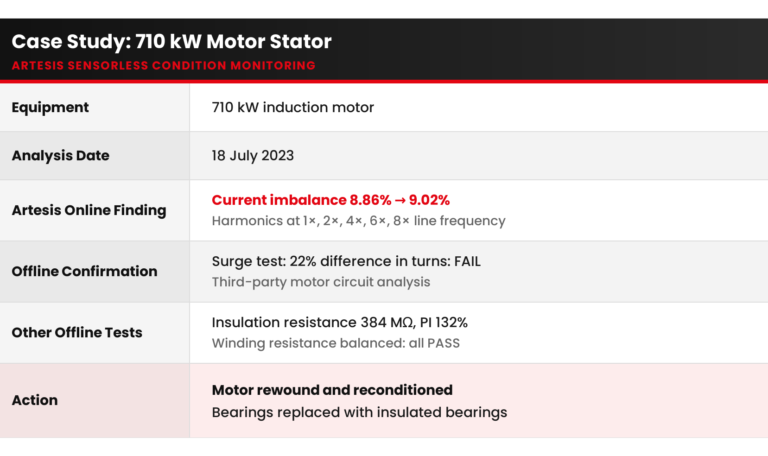
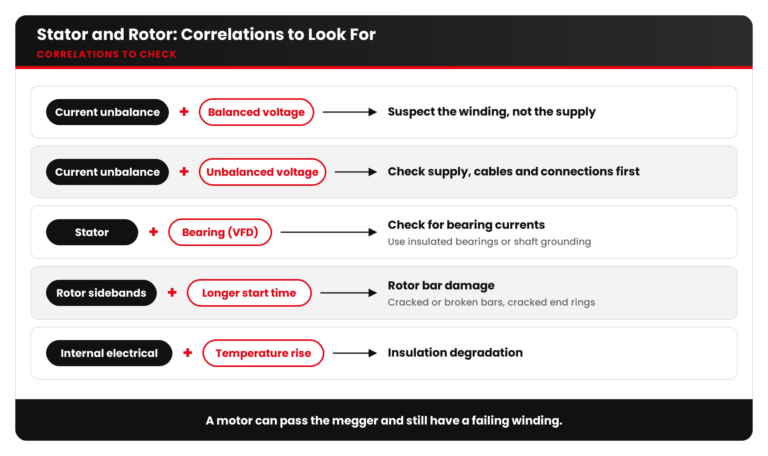
The first sign was a current imbalance of 8.86%, which later rose to 9.02%, far above the 5% threshold normally considered acceptable. The supply voltage was balanced, so the imbalance was coming from the motor.
The PSD analysis added to the picture. The spectrum showed multiple harmonics at 1×, 2×, 4×, 6× and 8× the line frequency. Together with the imbalance, this is a classic signature of a developing turn-to-turn fault in the stator winding.
Why the offline test matters
The online data gave enough evidence to justify a planned outage and a specialist test. A third-party motor circuit analysis (MCA) was carried out. The results were instructive:
- Insulation resistance: 384 MΩ, PASS
- Polarization index: 132%, PASS
- Winding resistance: balanced, PASS
- Surge test (turns comparison): 22% difference, FAILURE
Three of the four standard tests passed. Only the surge test, which stresses the turn-to-turn insulation, revealed the fault. A maintenance team relying only on a megger would have returned this motor to service.
The motor was sent for a full rewind and reconditioning, and its bearings were replaced with insulated bearings as best practice.
Stator faults: what they are and how they develop
The stator winding is a coil of insulated copper. Its insulation degrades from:
- Thermal ageing: every 10 °C above rated temperature roughly halves insulation life
- Voltage stress: VFD switching spikes, surges, poor supply quality
- Contamination and moisture: dust, oil, humidity, condensation in idle motors
- Mechanical stress: vibration, loose windings, start-up forces
- Voltage unbalance: a small voltage unbalance causes a much larger current unbalance and heating
Failure usually progresses from turn-to-turn to coil-to-coil, then phase-to-phase or phase-to-ground. The earliest stage is the hardest to find offline and the cheapest to repair.
Rotor faults
Rotor faults usually mean cracked or broken rotor bars, or cracked end rings. Causes include frequent or heavy starts, thermal stress and manufacturing defects. They show up as pole pass frequency sidebands around the line frequency.
In another Artesis case, two identical 11 kV condensate pumps were compared. Pump 13 showed rotor sidebands next to the 50 Hz line and Pump 12 did not. A start-up test showed a longer start time (3.02 s vs. 1.47 s) and an oscillating current. Offline rotor testing confirmed cracked or defective rotor bars.
What stator and rotor faults lead to
- Overheating and loss of efficiency
- Increased vibration (electromagnetic forces)
- Winding burnout, phase-to-ground faults and trips
- Rotor bar breakage, rotor-to-stator rub and destruction of the motor
Checklist
- Trend current unbalance continuously. A slow rise matters more than a single reading.
- Always compare voltage unbalance with current unbalance.
- When a stator fault is suspected, include a surge test. Insulation resistance alone is not enough.
- Compare identical motors: the healthy one is the best baseline.
- After a rewind, re-baseline the online monitoring.
Key takeaways
- Online electrical signature analysis finds stator faults in service and guides targeted offline testing.
- A motor can pass insulation resistance and PI and still have a failing winding.
- A planned rewind costs far less than an unplanned burnout of a 710 kW machine.
Want early warning on your critical HV and LV motors? Ask Artesis about e-MCM online monitoring.








 White Papers
 Case Study
 Documents
 Webinars
 Events
 ROI Calculator
 FAQ