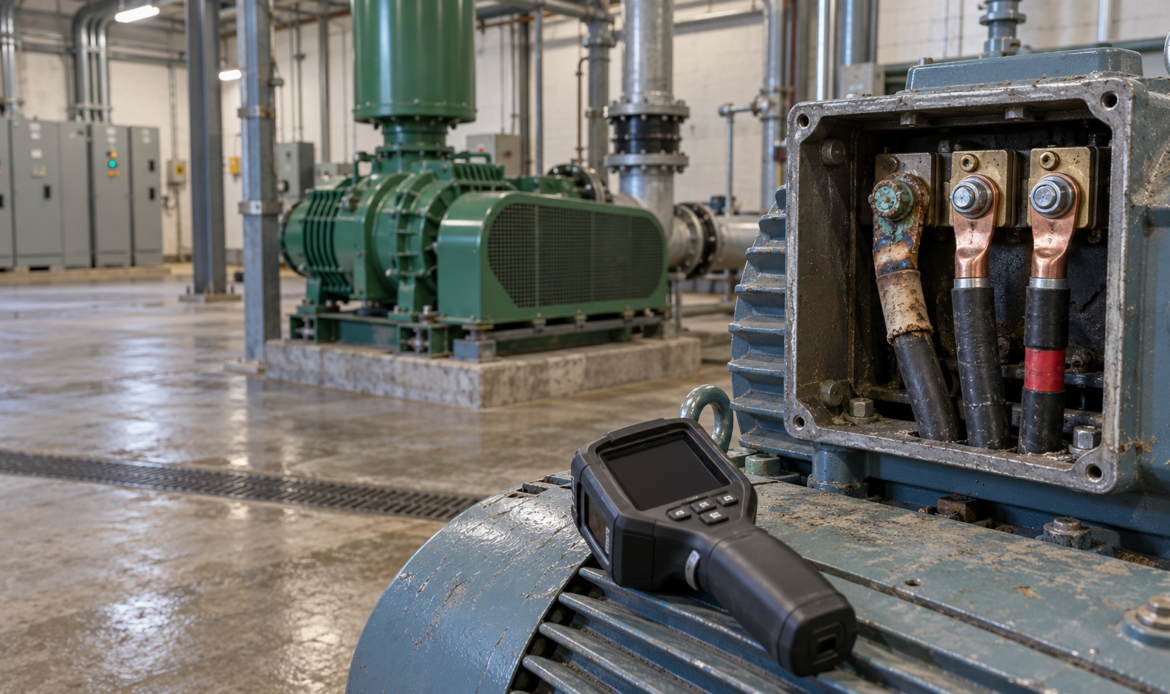
Positive displacement (PD) blowers are the lungs of many wastewater treatment plants. They supply air to the aeration basins and run around the clock. That also makes them some of the biggest energy consumers on site. So when the engineering team monitoring one of these blowers with Artesis e-MCM saw its trends start to climb in early February, they took it seriously.
“We would have never found the fault without the Artesis MCSA system,” the project director said afterwards.
What the electrician found
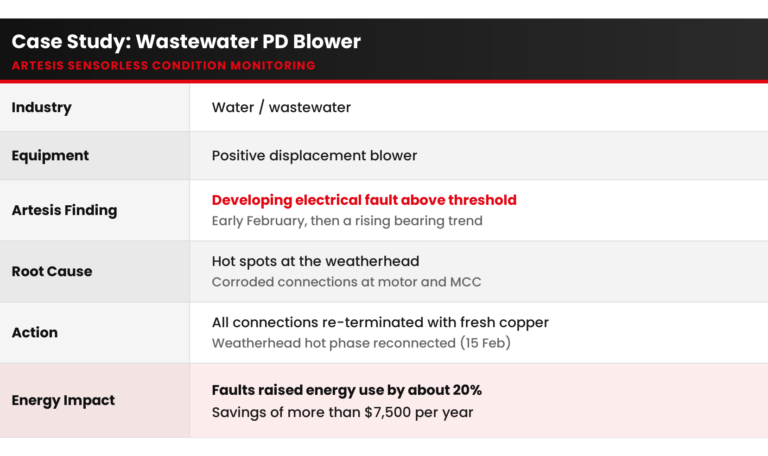
The e-MCM trend showed a developing fault at the beginning of February. Within days the signals were above threshold. The responsible electrician examined the system with an infrared camera and found:
- Hot spots at the weatherhead, where the supply enters the building
- Corroded connections at the motor and at the motor control centre
He re-terminated all connections with fresh copper and reconnected the hot phase at the weatherhead. The improvement in electrical performance was immediate and lasting.
The part nobody expected: bearings and energy
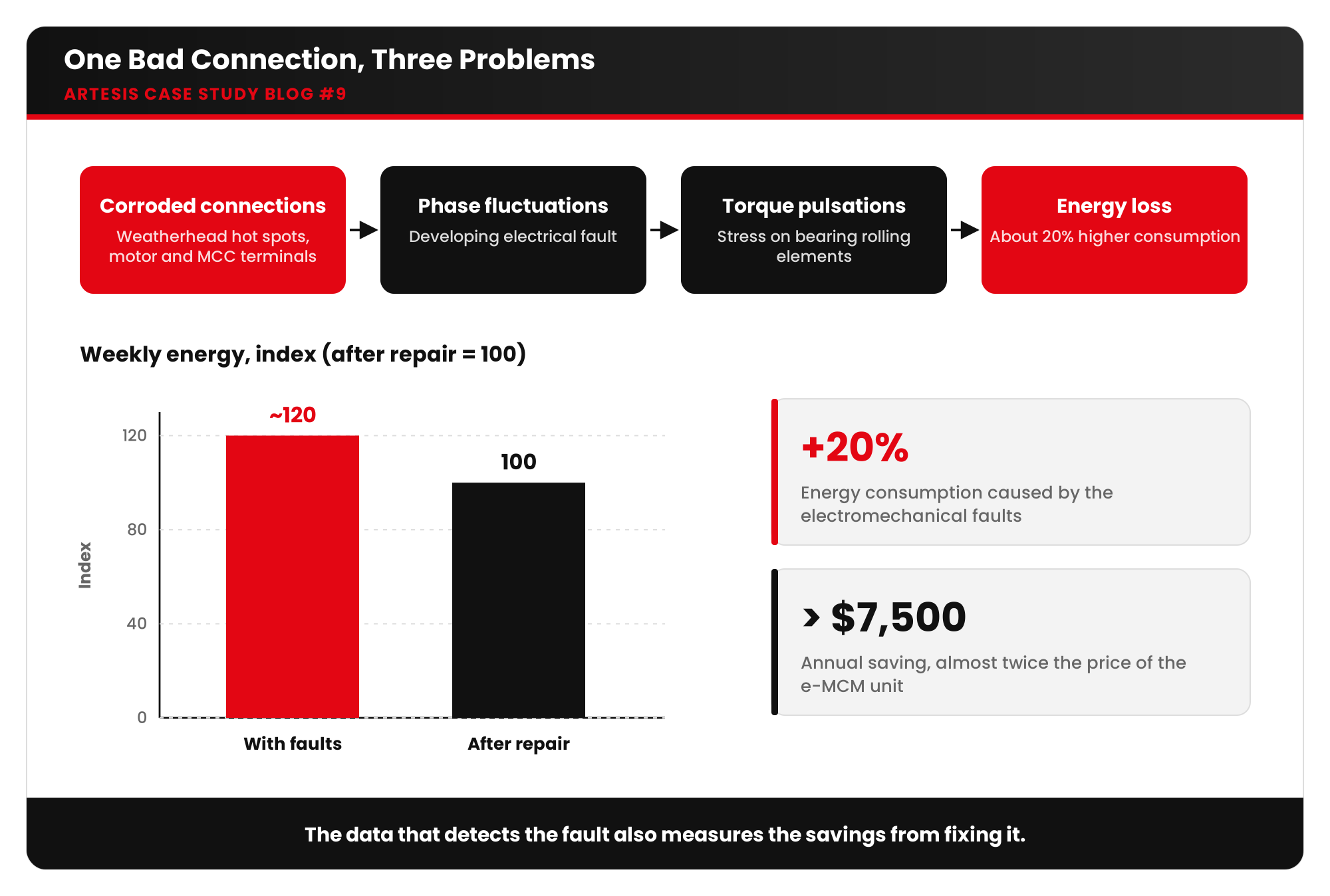
The electrical fault had not stayed electrical. The phase fluctuations caused by the bad connections created torque pulsations, which led to a dramatic increase in stress on the bearing rolling elements. The bearing trend rose alongside the electrical trend and dropped sharply after the repair.
The cost showed up on the electricity bill. Using the electrical parameters recorded by e-MCM, the team calculated the average weekly kWh consumption. The electromechanical faults had increased energy consumption by about 20%. After the repairs, power use returned to normal. The annual saving was more than $7,500, almost twice the price of the e-MCM unit.
Where energy is lost in motor-driven systems
A motor system wastes energy when the input power is higher than the useful work at the process. Common causes:
- Electrical: poor connections, voltage unbalance, harmonics, low power factor, undersized cables
- Mechanical: misalignment, loose or slipping belts, worn gearboxes, bearing friction
- Process: clogged filters, fouled heat exchangers, throttled valves, worn impellers and wear rings
- Sizing: oversized motors running at low load, where efficiency and power factor both drop
What it leads to
- Higher operating cost, often much larger than the repair cost
- Extra heat, which shortens insulation and lubricant life
- Hidden capacity loss: machines work harder for the same output
- A higher carbon footprint, increasingly an audit item
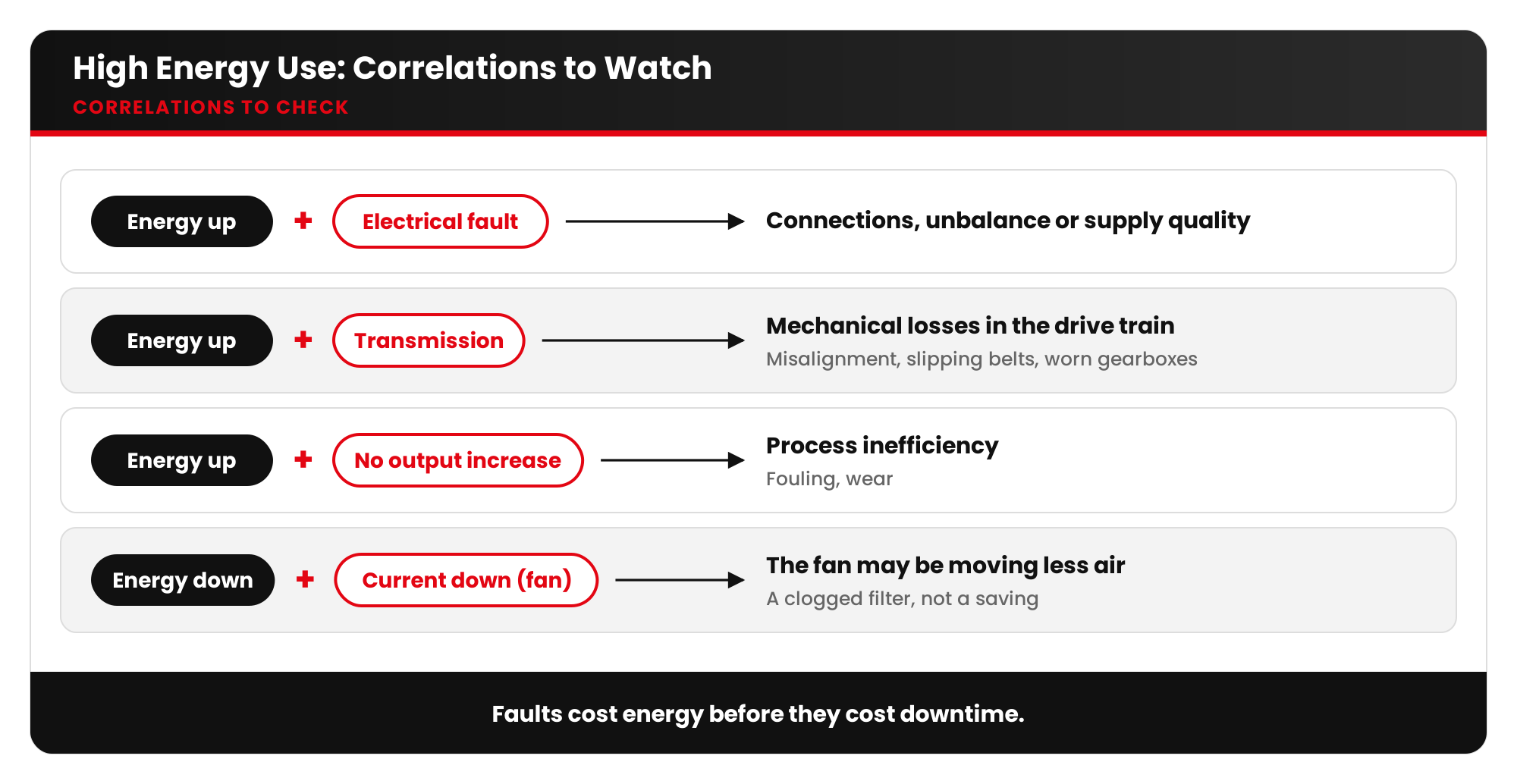
Correlations to watch
- Energy up + electrical fault: connections, unbalance or supply quality.
- Energy up + transmission / misalignment: mechanical losses in the drive train.
- Energy up with no output increase: process inefficiency (fouling, wear).
- Energy down + current down on a fan: the fan may be moving less air (clogged filter) rather than saving energy.
Checklist
- Trend active power (kW) and energy (kWh) per asset, alongside the fault parameters.
- Normalise energy by output (per m³, per tonne, per hour of operation) where possible.
- Thermally scan connections on any motor with an electrical fault indication.
- Put a cost on each finding. Energy savings are often the strongest argument for repair.
- Verify savings after the repair using the same data.
Key takeaways
- Faults cost energy before they cost downtime.
- One bad connection can create electrical, mechanical and energy problems at the same time.
- The data that detects the fault can also measure the savings from fixing it.
Want to find out which of your motors are wasting energy? Ask Artesis about e-MCM energy and condition monitoring.








 White Papers
 Case Study
 Documents
 Webinars
 Events
 ROI Calculator
 FAQ