
If You Manage Pump Stations, You Already Know the Hardest Truth
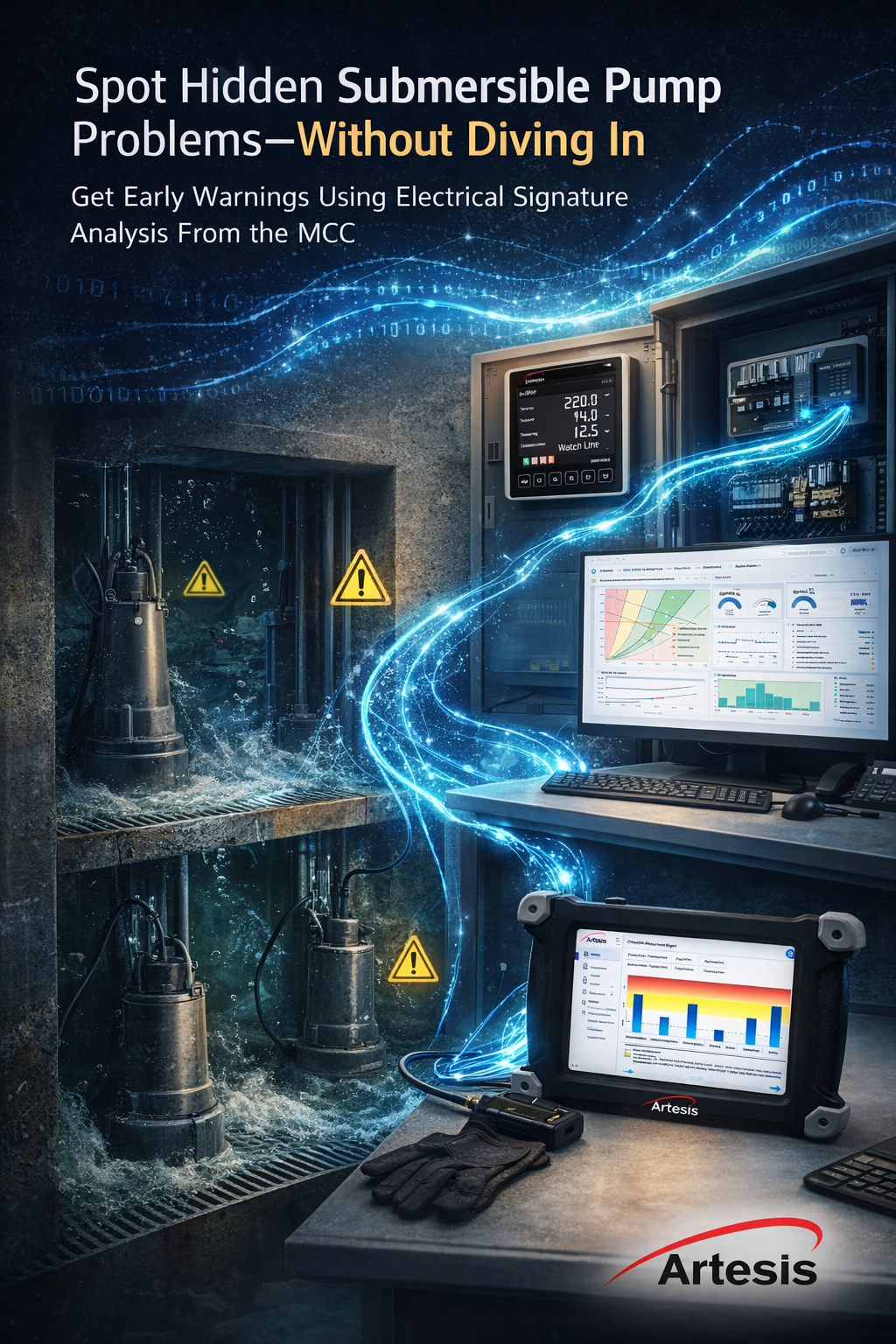
A submersible pump can look ‘fine’ right up until it isn’t. There’s no warning rattle you can hear from the control room. No easy access for sensor mounting. When the pump trips, consequences include lift station overflow risk, compliance exposure, emergency call-outs, disrupted operations, and accelerated wear on the standby pump. Submersible pumps are underground, wet, and difficult to access—making traditional monitoring methods challenging.
What Is Predictive Maintenance? Types, Uses Cases, and How It Work
The Submersible Monitoring Problem
In theory, every pump would have full instrumentation. In reality, many facilities operate with limited sensors, inconsistent operator rounds, mixed equipment ages, and environmental constraints. The core challenge: detecting developing pump and motor issues early—without adding complexity at the wet end.
The Motor Leaves a Fingerprint in the Electrical Cabinet
Every pump station already has a control cabinet or MCC.
Motor voltage and current signals reflect not only electrical faults but also mechanical and hydraulic changes affecting load, torque ripple, slip, and efficiency.
Electrical Signature Analysis (ESA) measures current and voltage at the MCC, analyzes time and frequency patterns, trends indicators, and converts patterns into actionable maintenance insight.
Detectable Submersible Pump Issues
Hydraulic Issues: ragging, clogging, impeller wear, air entrainment.
Mechanical Issues: bearing degradation, misalignment, mounting looseness.
Electrical Issues: phase imbalance, harmonics, rotor/stator degradation.
These conditions often manifest as increased power draw, load drift, and rising energy consumption trends.
Why ESA Fits Water & Wastewater Operations
Installed at the electrical side, e-MCM enables continuous monitoring without pump-mounted sensors.
AMTPro supports portable route-based diagnostics.
OmniSight delivers centralized fleet-level visibility across stations.
Artesis Insight™ translates diagnostics into structured decision support.
A Familiar Scenario
A lift station appears normal, yet average current increases slightly, power factor drifts, and energy per operating hour rises.
ESA trending enables planned intervention before emergency cleaning or trip events occur.
How to Get Started
1-Select representative stations.
2-Establish baseline monitoring.
3-Validate insights with operations.
4-Expand monitoring in tiers (critical → important → seasonal).
Closing
Submersible pumps rarely provide clear warning signs—but the motor does.
Electrical Signature Analysis provides earlier visibility into pump and motor health, helping reduce unplanned events, improve availability, and support energy-aware maintenance.






 White Papers
 Case Study
 Documents
 Webinars
 Events
 ROI Calculator
 FAQ
FAQ